Issues
Christmas recipes from Parisian bistros Le Square Trousseau, Chez Georges and La Poule au Pot
In an act of seasonal goodwill, a few of our favourite establishments in Paris have shared some usually-under-wraps recipes that will provide your celebratory feasts with a touch of Gallic gourmet gusto.
Le Square Trousseau
Escalopes de veau à la crème
Serves 4
For the cream sauce
Ingredients
- 400g veal trimmings
- 50ml white wine
- 20g carrots, sliced
- 20g onions, sliced
- 20g celery, sliced
- 20g leeks, sliced
- 1 garlic clove
- 2 pinches sea salt
- 1 pinch black pepper
- 4 sprigs of thyme
- 2 bay leaves
- 1.8 litres heavy cream (35 per cent fat)
Method
- Sauté the veal trimmings in a saucepan until lightly browned.
- Deglaze the pan with the white wine, scraping the bottom to dissolve the cooking juices.
- In a separate pan, sauté the vegetables until they begin to soften.
- Combine everything, season with salt and pepper, and add the thyme and bay leaves.
- Pour in heavy cream and simmer gently for an hour, until the sauce thickens and develops a rich flavour.
- Strain if desired; keep warm to serve.
Cocotte de poularde crème et morilles
Serves 2
Ingredients
- 50g dried morel mushrooms
- 50g shallots
- 20g butter
- 50ml port wine
- 50ml madeira wine
- 1 litre heavy cream (35 per cent fat)
- 25g veal stock powder
- 2 pinches of sea salt
- 1 pinch black pepper
- 2 poularde breasts, 400g each
- Puréed mashed potato (for two)
For the morel sauce
Method
- The day before you’re intending to cook, rehydrate the morels in a large bowl of cold water.
- The next day, remove the morels from the soaking water and rinse them several times if necessary to remove any grit.
- Drain and gently press to remove excess water.
- In a saucepan, sauté the shallots in butter until translucent. Add the morels, then deglaze with the port and madeira and let the liquid reduce.
- Add the heavy cream and veal stock powder, season with salt and pepper, and let simmer gently for about 30 minutes, until the sauce thickens to a creamy consistency.
For the poularde
Method
- Preheat oven to 200C. Roast the poularde in a baking tray for 30 minutes with butter, salt and pepper.
- Remove bones while keeping the breast intact. Slice the supreme (breast).
- Plate up the poularde and add the warmed sauce.
- Serve with the mashed-potato purée.
Crêpes Suzette
Makes 10 to 12 crêpes
Ingredients
- 190g plain white flour
- 60g caster sugar, for the batter
- 10g salt
- 1 vanilla bean
- Zest of orange and lemon, to taste
- 4 eggs
- 30g butter, for the batter
- 430ml whole milk
- 180g caster sugar, for the sauce
- 100ml orange juice
- 25g butter, for the sauce
- 20ml Grand Marnier
Method
- In a mixing bowl, combine the flour, sugar, salt, vanilla and the zest of the orange and lemon.
- Gradually add the eggs while stirring, mixing until you obtain a smooth batter.
- Warm up a third of the milk with the butter until it melts completely.
- Once melted, add the rest of the milk and mix well. Pour this mixture into the main batter and stir until fully combined.
- For the best results, blend the batter with a hand mixer to make it perfectly smooth.
- It’s best to prepare the batter the day before and let it rest overnight — it will develop more flavour and yield lighter, more aromatic crêpes.
For the Suzette sauce
Method
- Make a dry caramel: heat the caster sugar in a pan without water to 160C or until it turns a very light brown. Don’t let it darken or burn.
- Deglaze with the orange juice, then add the butter and let it melt gently.
- Zest the orange very finely. Blanch the zest by placing it in a small saucepan with cold water, bringing it to a boil, then draining. Add the zest to the caramel mixture.
- Stir vigorously with the Grand Marnier and cook until the sauce becomes slightly syrupy.
- Warm the crêpes, brush each one with the suzette sauce, and arrange them in a large serving dish.
- Pour the remaining sauce over the crêpes and flambé – carefully – with Grand Marnier before serving.
Chez Georges
Frisée aux lardons
Serves 1
Ingredients
- 1 small frisée lettuce
- 100g artisanal semi-cured farmhouse
- pork belly
- 1 free-range egg
- Aged wine vinegar, to deglaze
- 50g white bread, for the croutons
- Parsley, finely chopped, to garnish
Method
- Cut and wash the frisée in cold water with a few drops of vinegar.
- Slice the pork belly into thick lardons.
- Prepare a vinaigrette with sunflower oil, some aged wine vinegar, Dijon mustard, sea salt and freshly ground black pepper.
- Poach the egg in simmering water with a splash of vinegar for 3 minutes, then stop the cooking in cold water.
- Sauté the lardons in a little oil until golden, then deglaze with a dash of aged wine vinegar.
- Toss the frisée with the vinaigrette, add the warm lardons and top with homemade croutons lightly toasted in the oven.
- Finish with a poached egg on top and a sprinkle of finely chopped parsley.
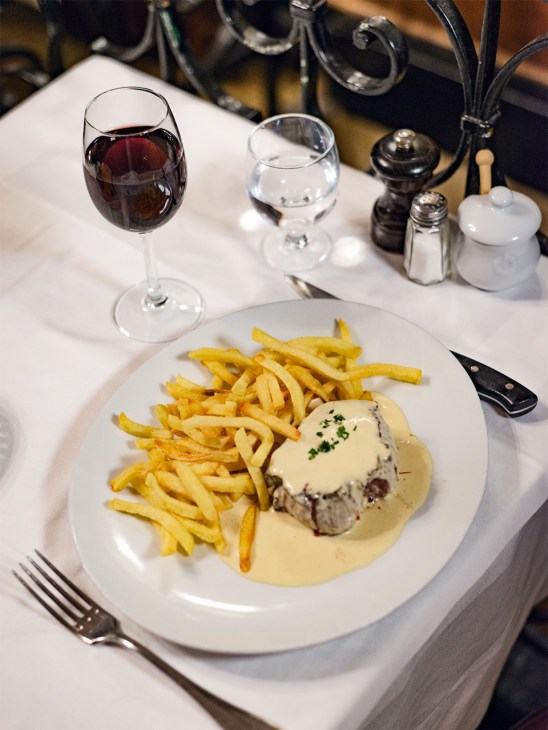
Pavé du mail
Serves 1
Ingredients
- 220g centre-cut beef fillet
- Freshly ground black pepper, to season
- 30ml cognac
- 100g single cream
- 1tbsp Dijon mustard
- Fresh French fries for serving
- Parsley, finely chopped, to garnish
Method
- Preheat your oven to 100C, then season the beef fillet with salt and freshly ground black pepper. Sear it in a very hot pan for about 2 to 3 minutes on each side (depending on the desired doneness). Keep warm in the oven.
- Deglaze the cooking juices with the cognac over a medium heat.
- Add the cream, stir and let the sauce reduce gently over a low heat.
- Whisk in the Dijon mustard to thicken and bind the sauce.
- Spoon the hot, velvety sauce over the plated beef.
- Serve with freshly made French fries (use yellow-fleshed potatoes such as agria: first fry at 140C to blanch, then again at 180C to crisp and brown).
- Finish with a sprinkle of finely chopped parsley over the pavé.
Crème caramel
Serves 6
Ingredients
- 340g caster sugar
- 250ml water
- 750ml semi-skimmed milk
- 300ml liquid cream
- 5 free-range eggs
- 1 vanilla pod
Method
- Make a light golden caramel by heating 140g of the sugar (to 160C) and water in a copper saucepan.
- Pour the caramel into an ovenproof ceramic terrine dish, swirling to coat the bottom evenly.
- Heat the milk and cream together with the vanilla pod.
- In a separate bowl, whisk the eggs and the rest of the sugar until the mixture turns pale and slightly frothy.
- Gradually pour the hot (but not boiling) milk mixture over the eggs and sugar, stirring continuously.
- Strain, then pour into the terrine dish over the set caramel.
- Bake in a bain-marie in a preheated oven at 140C for an hour.
- Allow to cool completely, then unmould and serve thick slices in shallow bowls, letting the caramel sauce coat each piece.
La Poule au Pot
Gratinée à l’oignon
Serves 4
Ingredients
- 5 brown onions
- 1 knob butter
- Salt, to taste
- 1 sprig thyme
- 1 bay leaf
- 2 garlic cloves
- 250ml dry white wine
- 1.5 litre beef consommé
- 30ml madeira wine
- 20 slices sourdough bread
- 100g comté cheese, grated
- 30g parmesan, grated
Method
- Preheat the oven to 220C. Peel, wash and thinly slice the onions.
- In a saucepan, melt a knob of butter and add the onions. Season with salt, then add the thyme, bay leaf and one crushed garlic clove. Cover and cook gently over a low heat for an hour, stirring occasionally.
- Deglaze with the white wine, then pour in the beef consommé. Add the madeira and raise to a simmer for 10 minutes.
- Toast the slices of sourdough bread and rub them with the remaining garlic clove.
- Fill lion-head soup bowls threequarters full of onion soup. Sprinkle generously with the grated cheeses, then oven grill for about 10 minutes, until bubbling and golden.
- Serve piping hot, with the cheese perfectly gratinéed on top.
Quenelle de bar baignee d’une sauce nantua
Serves 4
Ingredients
- 500g sea bass fillet
- Salt and black pepper
- 200g panade (paste of bread and milk)
- 80g egg whites
- 400g single cream
- 1g cayenne pepper
- 20ml reduced shellfish stock
- 500ml nantua sauce (an enriched béchamel)
- Dash of lemon juice
- Cooked crayfish tails for garnish
Method
- Place the bowl of a food processor in the freezer for 30 minutes. Mince the sea bass using a grinder, then place in the chilled processor bowl with a pinch of salt. Blend at medium speed, then add the panade. Add the egg whites and blend at high speed.
- Gradually pour in the cream while mixing slowly to emulsify the mixture. Season with cayenne pepper and add the reduced shellfish stock. Taste and adjust the seasoning. Transfer the mixture to a bowl set over ice and cover.
- Refrigerate for 12 hours before using.
- Preheat the oven to 210C.
- Using two spoons (or a piping bag), shape the mixture into quenelles and poach them in simmering water for about 5 minutes on each side. Remove and set aside on a baking tray.
- Warm the nantua sauce over a low heat. Add the lemon juice and a grind of black pepper. Taste and adjust the seasoning as needed.
- Just before serving, place the quenelles in a gratin dish and bake for 7 to 8 minutes until puffed and lightly golden. Spoon over the nantua sauce, garnish with crayfish tails and serve immediately.
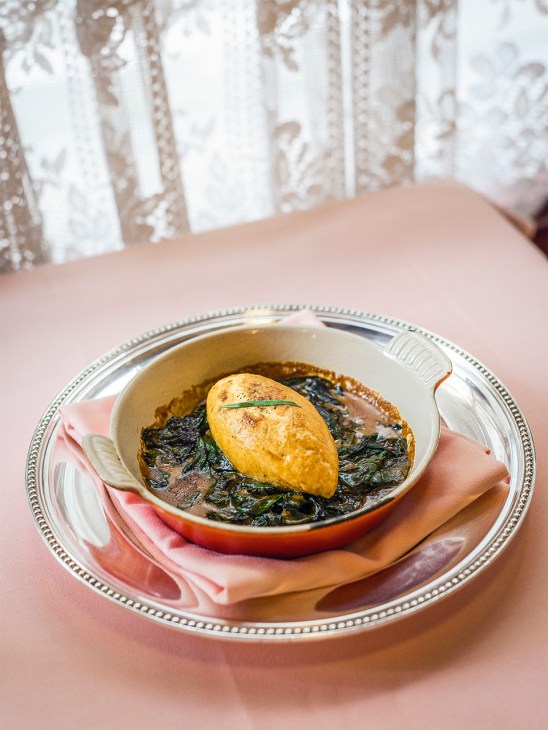
Île flottante aux pralines
Serves 6 to 8
Ingredients
- Butter, to line baking tin
- 100g caster sugar
- 330g egg whites
- 50g crushed pink pralines
- 500ml custard (crème anglaise)
Method
- Preheat the oven to 140C. Butter and sugar a 20cm baking tin.
- Pour the egg whites into a stand mixer bowl with 10g of sugar.
- Start whisking slowly, then gradually increase the speed and add half of the remaining sugar.
- Whisk at full speed, then add the rest of the sugar. Continue whisking for 1 minute and fold in the crushed pink pralines.
- Pour the mixture into the prepared tin and bake for 15 minutes.
- Once baked, let it cool, then unmould and pour the warm custard around the floating island before serving.
Raise a glass to the year ahead with our 12 best wines of the season
Monocle’s wine expert Chandra Kurt has a useful skill: she can pick a wine for almost any occasion. With the festive season approaching, she shares a selection fit for any special gathering.

1.
The Trouble with Dreams 2021
Sugrue South Downs
British fizz from West Sussex. A blend of chardonnay and pinot noir with a chalky acidity and a fruity expression of Granny Smith apples, gooseberries and lime.

2.
Rosé Réserve Brut 2015
Sekthaus Raumland
This is Germany’s sparkling star. A blend of pinot noir and pinot blanc grapes seduces with freshness, juiciness and delicate fruitiness. A truly great alternative to champagne.

3.
Rosamati 2024
Fattoria Le Pupille
Pure syrah vinified as a rosé from a small plot in Maremma, Tuscany. Delicate, fresh and ideal with lobster or shellfish.

4.
Jaspis Unterirdisch
Weingut Ziereisen
A clay bottle containing one of Germany’s best orange wines – a pure gutedel (called chasselas in France) with enough skin contact to leave a blood-orange hue. Deep, structured and great with roast turkey.

5.
Grattamacco 2022
Grattamacco
The 40th vintage of this Maremma red is ideal for beef wellington or a complex stew. A blend of cabernet sauvignon, merlot and sangiovese with notes of black fruit.
6.
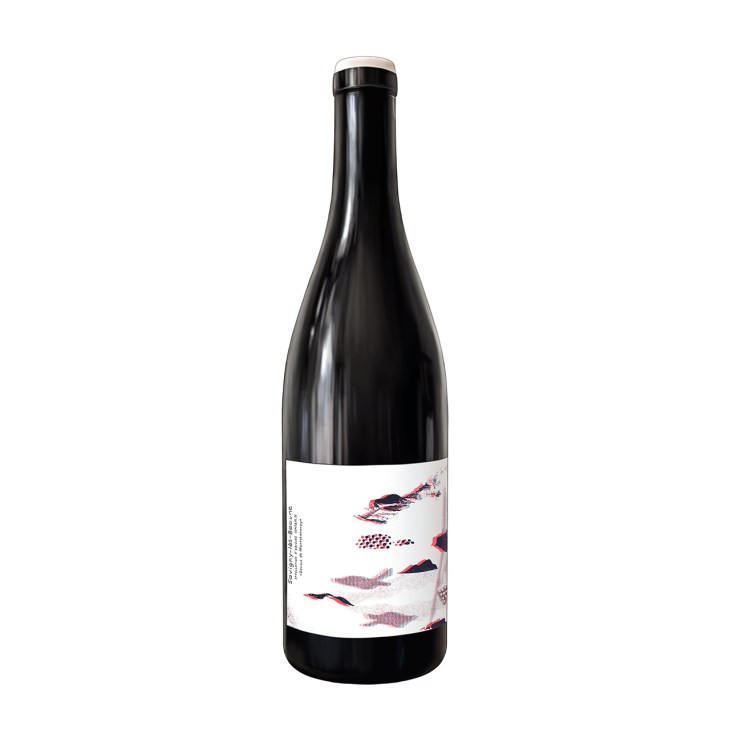
Savigny-lès-Beaune 2023
Domaine Chanterêves
A new-style burgundy by Frenchman Guillaume Bott and Japan-born Tomoko Kuriyama. Hard to get but well worth it.

7.
Arrocal Village 2023
Bodegas Arrocal
The best vintage of this pure tempranillo is marked by delicate tannins and an elegant structure that’s great with red meat.

8.
Cadran Blanc 2012
Château Monestier La Tour
This white bergerac shows a beautiful balance between fruit and structure with a hint of salt. A juicy, refreshing blend of sauvignon blanc, sémillon and muscadelle.

9.
Grüner Veltliner Smaragd 2023
Domäne Wachau
Organic and sustainable, this Grüner veltliner is full of tension and energy, with aromas of ginger and lime. Serve chilled with fish or vegetable dishes.

10.
Château de Vinzel 2024, Grand Cru
Château de Vinzel
Pure chasselas. Notes of honey, white flowers and apple seduce the nose and palate. Great with raclette or fondue.

11.
Cockburn’s 2019 LBV
Cockburn’s
Dense and full-bodied port with fruity notes of black cherries, raisin compôte and blackberries. Perfect with chocolate.

12.
Château Lafaurie-Peyraguey 2022
Château Lafaurie-Peyraguey
This blend of sauvignon blanc and sémillon is a pure nectar that improves sip on sip. A fine partner to foie gras or dessert.
Seafuture is the trade show racing to shape the blue economy with underwater power
Stimulating the so-called “blue economy” might not be a new idea but the geopolitical climate makes understanding, protecting and, yes, monetising ocean resources more important than ever. Indeed, attacks on underwater infrastructure, notably the Nord Stream explosion in September 2022, have upped the ante.
Seafuture, a biennial trade show in La Spezia, a coastal city in Italy’s Liguria region, brings together civilian and military outfits to focus on the great blue yonder. The show’s growth is a testament to the uptick in interest in this field: when the event debuted in 2009, it hosted about 40 companies; at the 2025 edition, it welcomed 370. An estimated 80 per cent of the world’s oceans remains unexplored and there are clearly business opportunities for those navigating and defending the aquatic realm.

“Often the sea is seen as a barrier,” says Cristiana Pagni, the president of Italian Blue Growth. “But we want it to be a bridge that unites.” Pagni’s company organises the conference based on the idea that the sea is not only a means to connect people but a “motor of economic development” that could and should be capitalised on. Given that visiting international naval delegations span countries from Tanzania to Mexico – and the show has attracted brands from India, the US and beyond – she might be on to something.
Defence heavy hitters such as MBDA, Leonardo, Fincantieri and Rheinmetall were all in attendance at the naval base this year. Pagni says that 80 per cent of the companies at the show service both civilian and military markets, with only 10 per cent dedicated solely to defence. Nonetheless, it’s the armed forces that are at the forefront of the blue economy, with their discoveries subsequently bobbing over to the private sector.
“Defence leads the industry in terms of adoption of technology,” says Martijn Wilbrink, business development manager for Europe at Kraken Robotics. Pagni agrees. “Military research results in innovations that are immediately transmitted to civilians,” she says. What’s not in doubt is the rising importance of the blue economy to both businesses and states. And, as host, Italy wants a piece of the action.
The 2025 Seafuture featured a prominent booth for Italy’s newly minted National Pole for the Underwater Dimension, which is based in La Spezia. By bringing together the event but also an ecosystem of SMEs, larger companies and research centres, Italy is seeking to develop underwater technologies and research, and give itself a competitive advantage for the sea change to come.
Three companies floating new ideas at Seafuture
1.
Italy’s Saipem showed off its Innovator 2.0, a remote-controlled submersible craft for oil and gas exploration.
2.
US-based Edgetech exhibited eBoss, which uses sonar for 3D imaging of the seabed. Nick Lawrence, its international business development director, jokes that it’s “an overnight sensation 20 years in the making”.
3.
Canada’s Kraken Robotics demonstrated its Katfish-180, a towbody (an object towed behind a vessel) that can be used for everything from mine detection to critical infrastructure monitoring.
Monocle comment:
As geopolitical tensions and the effects of climate change put the spotlight on the sea, protecting (and policing) it should be on more people’s minds. The year ahead could be, well, sink or swim.
How Europe’s airports must prepare for an increasingly drone-prone 2026
The past year was supposed to be one of soaring growth for Europe’s civil-aviation sector, with a post-pandemic bounce-back and plenty of innovation in sustainable travel, from cleaner fuel to electric flight. Sadly, things have stalled. Among the problems is the debilitating effect of drone activity near airports: as long ago as December 2018, Gatwick, the UK’s second busiest airport, had to close for two days for this reason, affecting more than 140,000 passengers. But the scale of this year’s disruptions in Oslo, Copenhagen and other cities has been on another level, with a spate of incidents lasting several months. It’s a worrying departure from business as usual.
Germany registered a more than 30 per cent increase in air-traffic disruptions caused by drones in 2025, while airports as far south as Spain’s Fuerteventura and Palma de Mallorca have also been targeted. In Poland, news of the national flag carrier Lot’s bid to muscle into the continent’s civil-aviation market was dampened after Russia’s September drone incursion shut down part of the country’s airspace for hours.

Airports and security chiefs are scrambling for solutions and many are pointing to bad actors, including Russia. One short-term suggestion is to empower the police to shoot down drones, something that Germany opted for after its cabinet approved new security legislation in October. Meanwhile, Munich Airport had a laser installed to measure the distance between drones and the airport to better assess the threat. The Danes and Poles have called in Ukrainian soldiers; well-practised in shooting down drones targeting civilian areas, they are now training Danish and Polish soldiers. But there are risks to this approach, from falling drone debris to stray bullets.
Ultimately, the long-term goal must be co-ordinated national air defence and better, less disruptive safety protocols. Beyond the economic impact, a broader problem is that these drones cause fear and uncertainty. Will hopping on a flight feel dangerous if Russia increases its use of hybrid-war tactics? Europe’s connectivity, economy and, yes, even its sense of freedom, relies heavily on civil aviation. Safeguarding it needs to be on the radar for everyone, from airline leaders to politicians and airport bosses.
Three ways to protect airports in 2026
1.
Radars
Used for detection rather than elimination, military radars can help security forces to distinguish between a threat and a wayward toy. Danish armed forces now use such radars at Copenhagen Airport.
2.
Anti-aircraft guns
Germany has snapped up a number of Rheinmetall’s Skyranger anti-aircraft guns, with a repeat order in play. The system can shoot down short-range missiles and cannon shells, as well as drones; for better mobility, it can be mounted on tanks, armoured vehicles or large trucks. But this is a military system for complex threats, rather than a day-to-day solution for the police force.
3.
Interceptor missiles
While most of the drones that we see are relatively flimsy, countries such as the US, Russia and China possess those with a wingspan of more than two metres. Ukrainian engineers have developed interceptor drones to counter the threat. The UK and Ukraine have committed to scaling up production.
Monocle comment:
The West looks naive in the face of hybrid warfare, which seeks – and often succeeds in – destabilisation. Civil aviation needs better protection.
Read next: EOS and DroneShield step up as European drone threats drive global demand for air defence tech
Can the rise of Contech mitigate the US housing crisis?
The US housing crisis has become structural: by some estimates, the country is short of more than five million dwellings, while the price of new homes has climbed by nearly a third in five years. Meanwhile, about 40 per cent of the workforce is expected to retire within the decade, leaving an industry trying to build more with fewer hands and under the growing stress of wildfires, floods and rising temperatures.
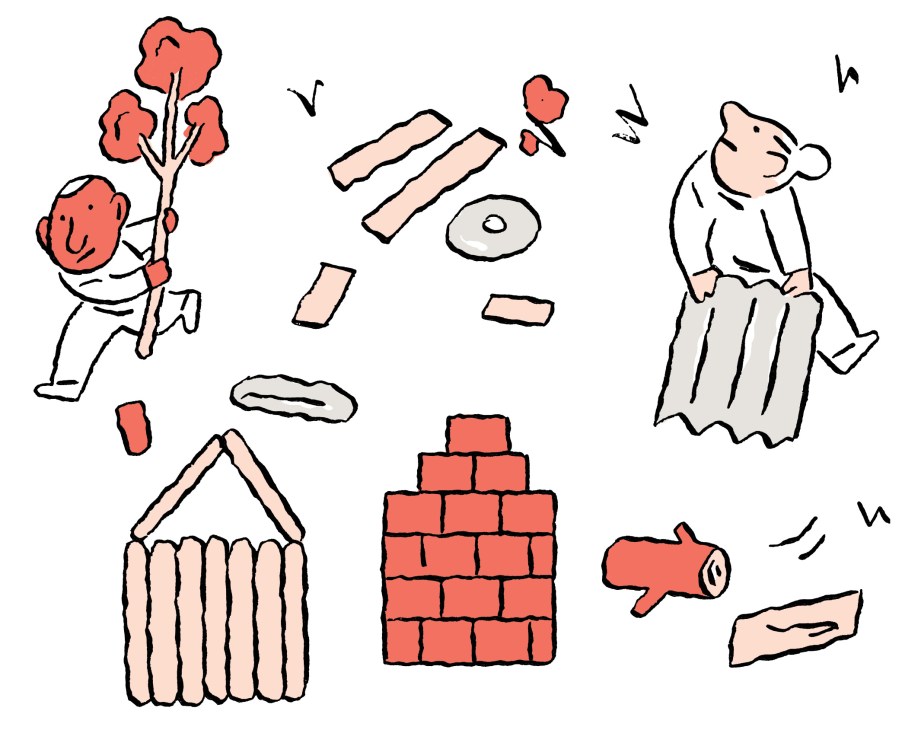
Enter “contech” (construction technology). A new generation of firms is using robotics, data and design automation to rethink how we make buildings. Some firms in this sector have already flown too close to the sun: remember Katerra, the Silicon Valley darling that tried to reinvent everything, everywhere, all at once? It raised $2bn (€1.7bn) but collapsed in 2021. Today, others are learning to play smaller and smarter, treating the housing shortage not as a mass-production problem but as one of mass customisation.
In Los Angeles, there’s Model Z, which provides prefab infill homes; in Chicago is the US office of Tel Aviv-based Buildots, which digitally manages construction progress using AI. Another Californian firm, Versatile, uses data about building sites to improve processes. In Massachusetts, you’ll find Reframe Systems, a venture founded by former Amazon roboticists. Its answer to the housing crunch is a network of AI-optimised micro-factories: compact, robotic workshops that can be deployed in under 100 days to produce energy-efficient, healthy and affordable homes suited to a changing climate. Reframe focuses on small homes, duplexes and multi-family residences. Its first micro-factory is in Massachusetts, with the second set to open in Los Angeles in the new year to support post-wildfire rebuilding. “We want to act as co-developers,” says its CEO, Vikas Enti. “We’re working with communities to make resilience accessible, not aspirational.”
Automation, he says, isn’t about displacing labour but augmenting it. The company uses AI-powered work instructions to enable apprentices to perform complex tasks with precision and create accurate floor and roof systems. Just as Enti’s team once helped Amazon to unlock the economics of same-day shipping, Reframe now aims to use robotics to rethink the factory and bend the rules of construction along the way.
Comment:
Advanced construction technology is already helping to build housing both at scale and at speed – but it’s not just a matter of passively waiting for robots to solve all of our problems. Human innovators need to keep finding clever ways to use the tech.
What Osaka’s 2025 Expo taught the world about temporary and sustainable greenery
Temporary greenery is everywhere, draped across shops, trade fair floors or pop-up restaurants. Yet most plants hauled in for the week share the same bleak fate. In Osaka, family-run landscaping company Ryokukou Garden showcased its green-fingered skills to an international audience when Expo 2025 rolled into town.
Responsible for overseeing greenery at the pavilions occupied by the UAE, the EU, Germany, Austria and Panasonic, Ryokukou Garden showed off a simple but effective philosophy that the wasteful trade-show and pop-up circuits should seek to cultivate. Namely it sees plants as living collaborators, not disposable decor, and lets them take root and survive when the trade shows shut.

“We’re not just landscape designers – we grow trees at our own nursery too,” Toshiki Tanisaki, who heads the company’s design work, tells Monocle. “That gives us a real understanding of what plants need to stay healthy.” Now joined by the fifth generation of the Tanisaki family, Ryokukou Garden assures its longevity through continuity. At 89, Toshiki’s grandfather remains involved in everyday maintenance at the nursery while his father manages construction. The three generations handle every stage of any given project, so each decision reflects a shared respect for the plants that they are working with.
At the Expo, the Tanisakis’ brief was simple: to create displays that would thrive throughout the event’s six-month run and be suitable for planting out afterwards. For larger plants, this meant making sure that they didn’t fully take root and could easily be craned out of the event space and replanted while avoiding undue stress. Their roots were wrapped in water-permeable landscaping fabric, preventing them from settling entirely in their temporary home. When choosing smaller plants, Toshiki prioritised perennials for longevity and ensured that they were extracted by hand once the Expo had run its course. “It’s very labour-intensive work,” he says. “You have to dig around very slowly and carefully so as not to disturb the roots.”
While Toshiki acknowledges that it’s common for healthy plants to be thrown out at the end of such events, Ryokukou Garden turned the process into a closed-loop system, one in which nature was not a prop but a partner. Crucially, he says that when a plant is designated for a temporary event, it doesn’t mean that we should treat it with less care. Instead, it’s an opportunity to plan for renewal – something that designers and architects the world over should consider when picking out greenery for their next event.
Monocle’s tips for a greener 2026
1.
Make a start.
Ryokukou Garden’s closed-loop system is admirable but there needs to be more than just one canny company pushing for temporary displays to be treated like an ongoing concern. Take a leaf from its book (or bush).
2.
Ditch the tree quotas.
Cities are blinded by big numbers and developers rush to plant saplings that offer no shade or cover. Context is everything.
3.
Get shaggy.
Keeping every lawn trimmed and weed-free might make sense at a royal residence but cities should leave spaces to go wild: grassy verges and unused railway lines can be left to develop into green corridors for flora and fauna.
4.
Avoid ‘green walls’.
These features can look appealing in renderings but they demand constant attention, care and cultivation to even stay presentable – which is why they often end up being left to wither.
5.
Go native.
Too many cities fall into the trap of planting what looks nice rather than what will thrive. Cities in the Gulf, for instance, should be looking at salt-loving halophytic plants or ghaf trees, rather than beautiful but thirsty and heat-sensitive species that wouldn’t last a day without the sprinklers.
Comment:
Trade shows are excellent places to get a snapshot of an industry, from arms fairs to design showcases, but they’re often wildly wasteful. Better practice means being thoughtful about a fair’s footprint.
Why an obsession with Big Tech is not progress
I have never owned a smartphone but my life doesn’t feel demonstrably worse as a result. I am not on Whatsapp; my friends tell me that it’s a time-sapping curse. From social-media-addicted teens to smouldering mountains of electronic waste, smartphones appear to be hastening our descent into dystopia in myriad ways. And it’s not just phones: the advent of AI heralds a future in which creative work is abolished, vast data centres consume ever more energy and water, and humanity might well be turned into paperclips (or so a thought experiment by Oxford professor Nick Bostrom on the single-mindedness of machine learning once suggested).
Yet, despite the ubiquitous anxieties about an impending technological apocalypse, being a Luddite still feels like a naive minority position. When people see me brandishing my “brick” of a mobile phone, they might assume that I’m being insufferably condescending to those with less willpower – but my refusal to update it is, in part, motivated by my own susceptibility to distraction.
One reason why it’s difficult to alter the course of technology’s onward march is a stubborn belief in automatic progress. We might have a degree of healthy scepticism towards the tech bros, suspecting that their ambitions to live for ever in pod cities on Mars are hubristic and far-fetched. Yet it’s hard not to retain an implicit faith – inherited from the Enlightenment – that not only is technology unstoppable but that it’s also always improving.

This assumption of linear progress can cause us to forget about what was actually much better in the past. From the mid-19th century onwards, UK travel retailer WHSmith ran a subscription library on train platforms; you could borrow a book from one station and return it at another. Residents of Victorian London enjoyed 12 mail deliveries a day. Take a stroll around the Made in Ancient Egypt exhibition at the University of Cambridge’s Fitzwilliam Museum and you’ll see a striking illustration of the sophistication of pre-modern artisanal cultures: a statuette of a woman’s head with individual strands of hair carved in glass; tiny turquoise faience frogs inlaid with gold; an elaborate collar made from turquoise and carnelian beads – all crafted more than 3,000 years ago. The screens that surround us serve to conceal historical ingenuity, so that we can comfort ourselves with the illusion that things are getting better all the time.
In The Shock of the Old: Technology and Global History Since 1900, historian David Edgerton demonstrates that technological change often runs in reverse. Ship-breaking is an example of this “low-tech future” – the process has regressed from specialised docks in Taiwan to beaches in Bangladesh where barefoot workers use axes and hammers. Sound quality has decreased on our single wireless speakers. Software updates provide only a simulacrum of advancement. As Cory Doctorow argues in his recent book Enshittification: Why Everything Suddenly Got Worse and What to Do About It, the “development” of products and services is driven by market forces, not human desire.

It is a testament to our persistent faith in technological progress that this year’s Nobel Memorial Prize in Economic Sciences was awarded to three scholars for explaining “innovation-driven economic growth”. In fact, as economist Carl Benedikt Frey has argued, not only is the pace of innovation slowing around the world but the most advanced and technologically innovative countries are suffering from economic stagnation too.
The buzz around AI suggests that we are finally about to witness a genuine game-changer. As Edgerton observes, however, this kind of futurism is itself unoriginal. People have been hailing the coming of a fourth industrial revolution since the 1950s, when it was thought that automation would do away with both blue-and white-collar jobs; despite the excitement around 3D printing in the 1990s and 2000s, its main use now is in art schools. An MIT report has shown that 95 per cent of AI pilots in companies are failing and there are increasingly widespread warnings of a major market correction in 2026 or beyond.
If the public and media commentary around new technology tends to forget past instances of technological optimism, we are often reminded, conversely, that techno-pessimism is not new: Socrates denounced writing for implanting “forgetfulness” in our souls and medieval scholars fretted that the invention of the index would dispense with the need to read entire books. But the fact that those concerns recur does not mean that they aren’t valid: James Marriott of UK newspaper The Times recently reminded us that after the introduction of smartphones in the mid-2010s, PISA scores – an international measure of the academic performance of 15-year-old students in reading, maths and science – began to decline.
There is a cognitive dissonance between the AI “revolution” that is perpetually around the corner and our everyday experience of technology, which remains obstinately dysfunctional – from my hours spent this week trying to connect a laptop to an external monitor to the unidentified items still languishing in the literal and metaphorical bagging area. Not only is new technology trashing the planet and ushering in a post-literate society, it is failing on its own terms too.

Resisting new technology feels futile. Whereas the advent of the internet in the 1990s was legitimised by utopian chatter about democratisation, the approaching AI revolution is announced with a grim realism; we are simply told to learn to live with it. Yet there is an ambiguity at the heart of this sense of inevitability: it’s not clear whether it refers to the implicit assumption that technology always moves forward or to the unstoppable power of those promoting it. It’s an important distinction.
This is related to the residual mystique of tech bros, even though the media now often pillories them – a niggling sense that their wealth and power are the consequences of their being geniuses ahead of the curve. Yet they appear to suffer the most catastrophic nightmares of us all, if their scramble to buy bunkers in New Zealand is anything to go by. And this pessimism serves to inoculate them against public critique, even as their greed brings about the end that they seem to fear.
State investment funds much of the innovation in the first place. Yet governments appear blinded by the hype, unable to exert what little powers they have to regulate Big Tech. As my ability to function without a phone illustrates, human requirements haven’t changed much over time. It’s important to interrogate our apparent need for the latest devices and to ask whether it’s necessity, compulsion or mere addiction. It is time to ask what progress means and who gets to define it. Can we dare to regard technology only as a means to an end? Let’s see what happens in 2026 – just don’t try and Whatsapp me with an update.
About the writer:
Eliane Glaser is a writer, radio producer and regular contributor to Monocle. Her books include Get Real: How to See Through the Hype, Spin and Lies of Modern Life and Elitism: A Progressive Defence.
Read next: Used with consideration, smartphones can deepen our connection to the present
Three Mexican companies bridging the country’s offline workforce with global clients
Mexico has long been well known for its can-do attitude. Today there’s also investment to match the ambition and a talented workforce – not to mention the effects of US tariffs on countries such as China, which are creating fresh opportunities here. But here’s the rub: even people wanting to make things closer to home in the Americas have struggled to engage with Mexico’s informal, mostly offline system of factories and makers. We meet three companies trying to join the dots.

Prima
Connecting ideas with makers
Headquartered in Mexico City’s Lomas de Chapultepec neighbourhood, Prima identifies products with potential – from welded metal structures to other industrial components – then finds the factories to make them. Once selected, it sets up a joint venture with the plant and manages the production process. “Getting to work with Prima isn’t easy,” says co-founder Daniel Autrique. “We’ll audit you and look at working standards, safety and insurance.” Clients and factories communicate via a digital platform, with AI helping with everything from quality control to engineering.
Prima employs 70 people and raised $42.5m (€36.6m) by the end of 2024. It has been canny in realising that, though Mexico can’t compete in everything – electronics, for example, is out – it can forge ahead in metals, plastic assembly and welding, while ensuring high standards of production, traceability and sustainability. It is also tapping into the shift to near-shoring, making the US a key market. Autrique, who hails from a family of industrialists in San Luis Potosí, says that there’s “a forgotten system” in Mexico, with factories doing business via text messages with little banking credit. Prima is bringing that resourcefulness and work ethic into the 21st century.
Yumari
Harnessing the skills of Mexico’s workers
Andrés Díaz Bedolla is the CEO and co-founder of Yumari, an AI platform that links Mexican factories with companies – many of them in the US – that need any number of products, from clothing to home decor and furniture. According to Bedolla, interest in Yumari surged in April when Donald Trump unleashed his trade war.
As with Prima, a big part of the job is the standardisation and professionalisation of the vast, skilled but unregulated factories that already exist. In Yumari’s case, an app features a “buyer dashboard” where clients can view everything from ideas and sampling to manufacturing and logistics. “If anyone comes to our platform and says, ‘We used to manufacture in Asia but need a cheaper option,’ we say don’t come to Latin America,” says Bedolla, explaining that Yumari isn’t about offering low-cost substitutes for Chinese factories but rather about taking pride in where and how things are done.
Allie
The future-proof factory-builders
Allie uses technology to enhance efficiency and combine complex processes. It works with clients in F&B and packaged goods to make their machinery “smart”, rather than having a series of operations working independently of one another.
Through Allie’s FactoryGPT, clients can talk to their factory, which has become a “thinking, speaking entity”, says Allie’s co-founder Alex Sandoval, who is originally from Venezuela. AI and machine learning predict “deviations” to nip any issues in the bud, while the system suggests ways to optimise the production line. “We have a computer that connects to all the machines,” says Sandoval. “That’s every data point in the factory.”
Comment:
There are wrinkles to work out in Mexico’s manufacturing but there’s specialism, skill and agility aplenty to rise to the challenge. The country won’t thank Donald Trump for his tarifs but that competition may just help this sector to make more of itself.
Read next: Entrepreneurs to watch: the forward-thinkers making new paths in Mexican industries
Private mediation services matter. Here’s why.
Crisis creates opportunity – and 2026 is set to be a boom year for the private mediation sector. Disputes and emergencies are multiplying and resolving them calls for the skills, talents and attentions of seasoned negotiators. This once fell to traditional mediating powers such as the UN and countries including Norway and Switzerland.

Today, those erstwhile arbiters of fairness have lost some of their clout and moral authority. So private mediation firms, often founded by former diplomats and humanitarian workers, are filling the void. Maryna Domushkina, an independent mediator who began her career at the UN before joining the Geneva-based Center for Humanitarian Dialogue, explains.
Why is private mediation on the rise?
Conflicts have become more fragmented. It probably began about 10 years ago. We’re now in a landscape of multipolarity without multilateralism. We have moved from a rules-based order to a transactional one. Private mediators fill the gap between formal and informal actors in negotiations. They can help to build confidence where official channels are blocked, can operate more discreetly and, because they’re not constrained by institutions or public opinion like states are, can move faster.
What do you think will be the global flashpoints in 2026?
We’re in a period of sustained geopolitical instability. The Middle East will continue to be a flashpoint; some states are looking for fast solutions without addressing the root causes but they won’t work. The Ukraine conflict will continue; the challenge lies beyond the battlefield in how to build a lasting and just peace. There’ll be new flashpoints in the Indo-Pacific too: climate- and resource-driven instability are amplifying existing conflicts.
How might things change?
Mediators need to be able to integrate competing alignments and non-state actors. The global consensus mechanisms will weaken further and there will be more transactional diplomacy. That requires layers of engagement, with various interests and incentives. There will also be a new demand for state-to-state negotiation, with a third state as a mediator. There still needs to be someone guaranteeing agreements.
Comment:
In an increasingly disordered world, trust is at a premium. An outside perspective can be crucial: at their best, private mediators can offer genuine neutrality and help to bring down the temperature of heated, high-stakes negotiations.
B-Quik: The automotive player keeping Thailand on the move
As Chinese electric vehicles challenge Toyota and other Japanese legacy brands for market share across Southeast Asia, a Thai company is racing through a gap in the middle by providing services that all automobiles need. B‑Quik fits tyres, fixes brakes and handles suspension – types of routine maintenance that are required regardless of whether there’s an engine or a battery under the bonnet. This agnosticism is one of the reasons why B‑Quik’s centres are becoming increasingly difficult to miss on Thai roads – something that’s aided by their striking yellow façades. But the brand’s success ultimately comes down to what it offers.
B‑Quik has more than 235 branches in its home market, a handful in neighbouring Cambodia and 40 in the Indonesian capital, Jakarta. Southeast Asia’s biggest economy, Indonesia, is home to some 284 million people and most still rely on two‑wheeled transport to get around. About one in 10 Indonesian households owns a four‑wheeled vehicle, compared to one in two in Malaysia. As the country’s growing middle class becomes more affluent and investment in public transport struggles to keep up, car ownership is expected to rise, which means a lot more wheels on the road.

Driving B‑Quik’s success is its 63‑year‑old Dutch CEO, Henk Kiks. A self‑proclaimed “farm boy”, he started as a tyre‑fitter in the Netherlands and now drives a hybrid Porsche to the company’s headquarters on the outskirts of Bangkok. His office is above an immaculate service centre in Nonthaburi. Customers drink coffee in the lounge, while B‑Quik staff examine the underside of cars elevated on four‑poster hydraulic jacks.
Kiks leads Monocle through the vast tyre warehouse and its rows of floor‑to‑ceiling rubber, sharing his expert knowledge of tyre brands, as well as his excitement about the prospect of an F1 road race in Bangkok in 2028. By that time, B‑Quik’s next milestone – 300 branches across the region – will be in the rear‑view mirror, with the number of branches accelerating towards 400. The bigger it gets, the more B2B opportunities arise to partner with car manufacturers, especially new entrants that want to offer countrywide after‑sales to their customers without building their own expensive network of service centres as well as showrooms.
“We are like the dentist,” says Kiks. No one wants to pay money to change their tyres so B‑Quik staff are trained to be truthful and never oversell – a sort of Hippocratic oath for mechanics. This strategy helps B‑Quik to sell more than 1.2 million tyres a year. In 2023 the company launched a membership programme in Thailand. Today you’re more likely to see a car in Bangkok with one of its yellow stickers on its rear window than a Liverpool badge (many Thais’ football team of choice). That’s a huge achievement: far more loyalty than the best dentist could ever dream of.
Asian start-ups to watch
1.
Highlands Coffee, Vietnam
With almost 800 coffee shops in its home market, Highlands is set to go global with a new brand identity and the distinction of using only Vietnam‑grown robusta and arabica beans.
2.
Plan B, Thailand
The outdoor advertising giant is taking over screens and digital billboards in key economic hubs across Southeast Asia. Keep your eyes peeled for Plan B on your next trip.
3.
Zeekr, China
Geely Auto Group, the owner of Lotus and Volvo, is gearing up to challenge Europe’s luxury marques with premium EV brand Zeekr. Hiring Bentley’s chief designer was a statement of intent. Models are now arriving in showrooms.
Comment:
While some companies’ services are caught between electric vehicles and traditional cars, B‑Quik illustrates what you can achieve when your service remains agnostic as an industry changes lanes.
Read next: The Monocle City Guide to Bangkok, featuring the very best hotels, restaurants and retail spots in the Thai capital