Issues
The Pentax 17 film camera is bringing a digital generation back to analogue
When camera designer Takeo Suzuki first suggested to his bosses at Ricoh Imaging that they make a new Pentax film camera, he was met with an awkward silence. Ricoh had acquired the iconic Japanese camera brand from the optical-glass company Hoya Corporation in 2011 but film-camera production had been abandoned in Japan; there hadn’t been a new Pentax model since 2003 and Ricoh’s focus was now fully on digital. “I just remember everyone seemed to freeze,” says Suzuki from the Pentax Clubhouse in Tokyo. Despite his colleagues being unsure, Suzuki managed to win them over. He persuaded them that they would be doing something completely fresh: making a film camera for the modern era, aimed primarily at a young smartphone-literate generation who don’t have a clue how to load film, let alone have the patience to wait for photographs to be developed. “I was one of those people who froze,” says Makoto Iikawa, an engineer. He started out as a sceptic but ended up leading the development team of the Pentax Film Camera Project, which created the Pentax 17, the company’s first film camera in 21 years.
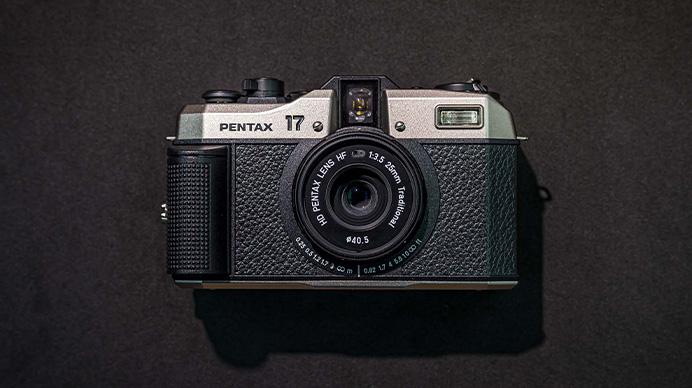
Suzuki and Iikawa were joined by Yoichi Nomura, a lens whizz, and Shinichiro Sanada, whose job was initially to turn dog-eared technical drawings for film cameras into a more usable 3D format. Suzuki had some older cameras in mind for inspiration – the Ricoh Auto Half from the 1960s and the Pentax Espio – but there was no existing mould for this new camera. “We had to start from zero,” says Suzuki.
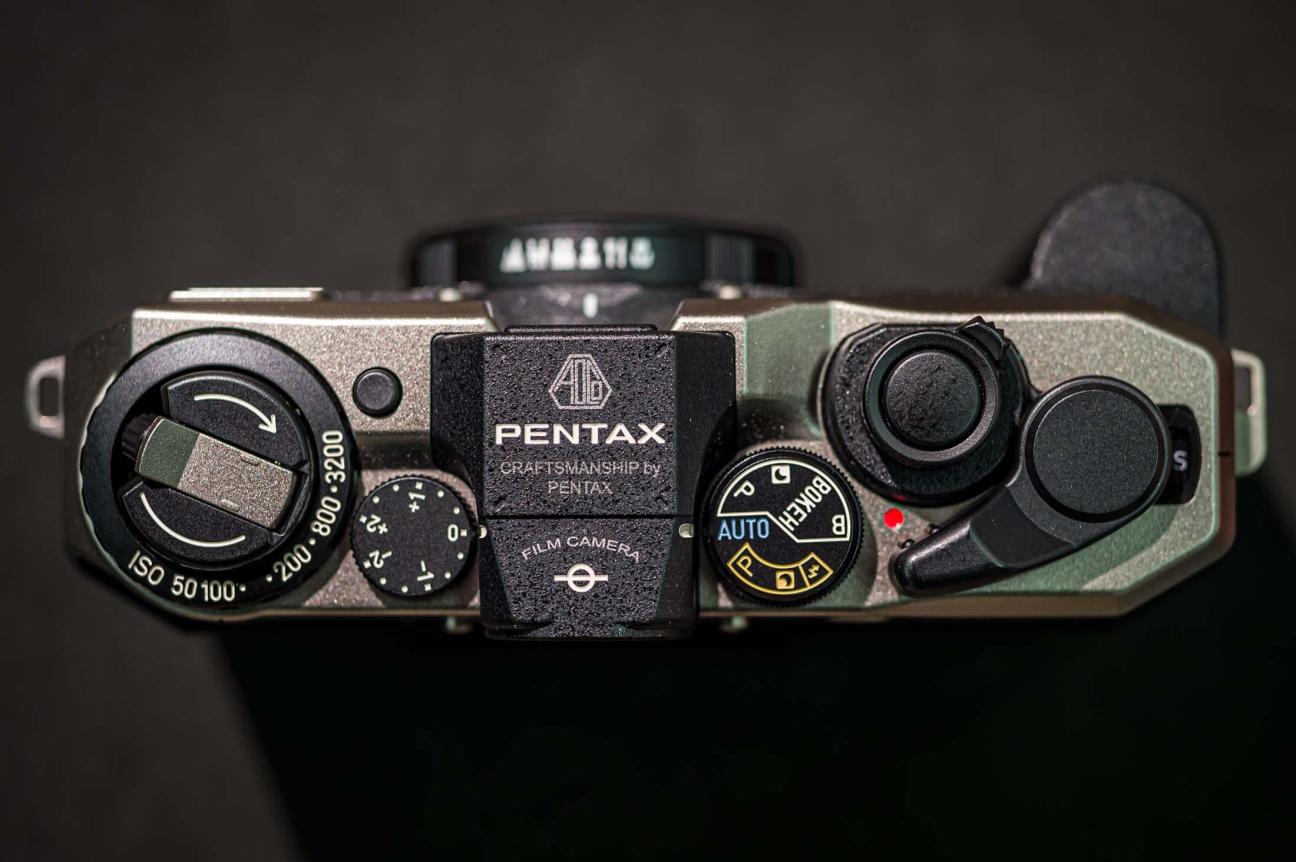
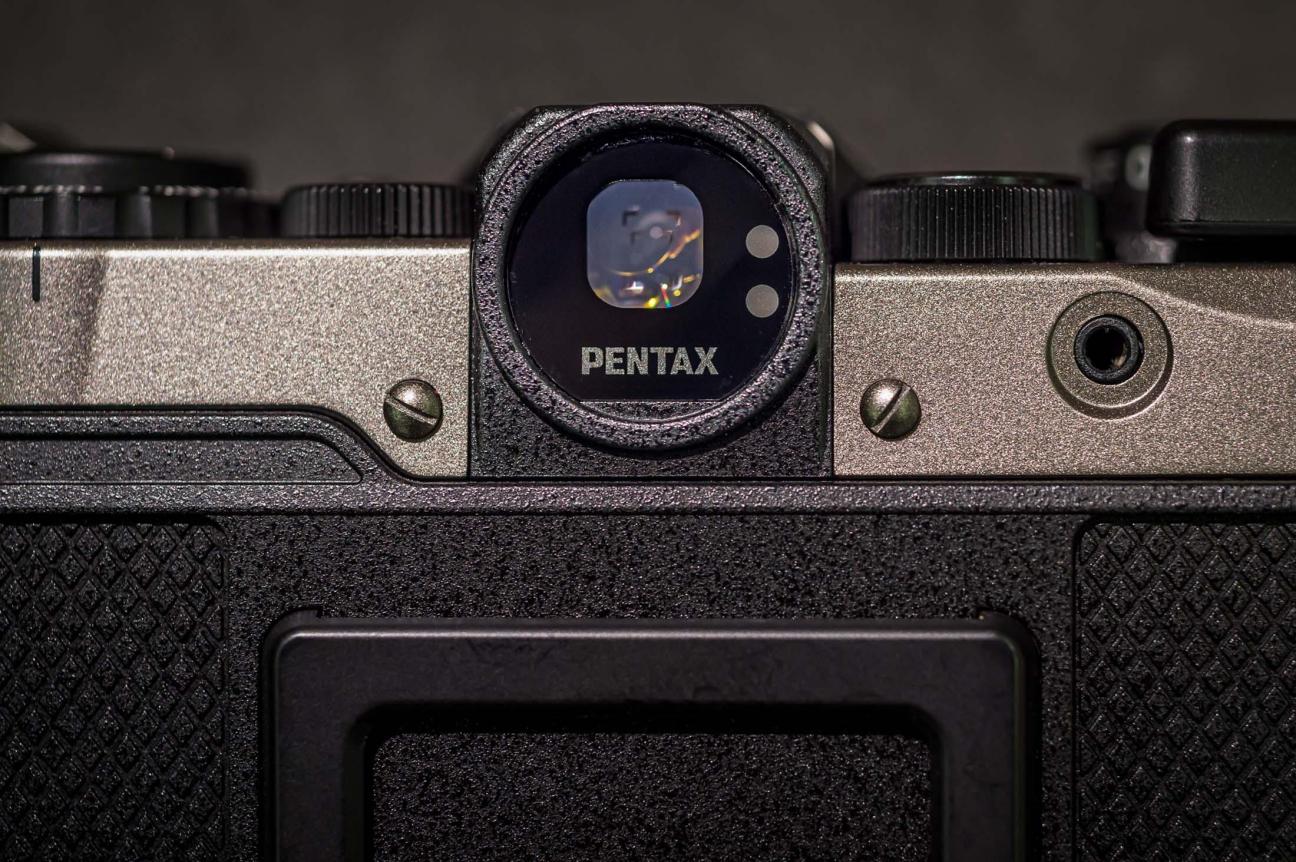
Suzuki made some key design decisions that set the Pentax 17 apart from other film cameras on the market. Unless turned on its side, it takes pictures vertically, which is good for viewing and sharing on smartphones (Suzuki knew that this would be a must for younger users); it has a simple fixed lens with manual focusing, which offers autonomy without demanding too much technical know-how, and it uses a half-frame film format (it takes two shots per frame, which doubles the number of pictures that can be taken on each roll of 35mm film). “Half-format cameras were big in the 1960s and 1970s when every family only had one camera – they were just more economical,” says Suzuki.
Suzuki was certain about one thing: having a manual advance mechanism. Sanada took advice from the one person at Ricoh who had worked in film cameras and then dedicated himself to perfecting the length of the lever and the satisfying sound as it winds the film forward. “It took a few attempts to get it just right,” he says. The Pentax 17 has blown open the possibilities for film cameras and shown that film photography can co-exist with, and even take inspiration from, smartphone cameras. “You can get the perfect shot with a smartphone but a film camera allows you to explore and mess up,” says Suzuki. “There’s a good synergy in having both.” — ricoh-imaging.co.jp
Instant gratification
Ricoh isn’t alone in combining smartphone-inspired features with film. Here are three other models taking instant snaps to the next level.
1.
I-2 Camera
Polaroid
Polaroid has recently introduced the I-2, which has an ultra-sharp lens, manual controls and Bluetooth to link up with printers and photo apps.
polaroid.com
2.
Instax Wide 400
Fujifilm
The Instax Wide 400 is twice the size of the popular Instax Mini. It offers instant high-quality prints and features a manual timer for easy group shots.
instax.com
3.
Lomo’Instant Wide Boston
Lomography
Instant cameras were once limited by a single lens. The Wide Boston comes with three lens attachments, offering flexibility on instant film.
lomography.com
How screens have rewired our brains – and why putting pen to paper matters
Experienced typists write more quickly and efficiently on digital devices than by hand. The technology also helps them to edit, structure, organise and distribute their work. That’s why tapping away on keyboards is usurping the act of putting pen to paper. Handwriting, some say, is withering as though it were a neglected plant or dying out like an endangered species. Its survival can only be ensured through care. But is it something that we must protect – and, if so, why? Even analogue nostalgists surely accept that cultural practices can lose their importance and value over time. We would all rather be operated on with a laser beam than a hand axe.
Handwriting’s decline can be dated back to the mid-1870s, when US gun manufacturer Remington launched the first commercially successful mechanical typewriter. Its benefits were clear – it allowed people to write letters more quickly and legibly – but warnings about the decline of culture and morality followed almost immediately. One sceptic even criticised the technology for threatening masculinity by replacing the pen as a “symbol of male intellectual creation” with a machine. But progress marched on unhindered. “Today we write more for private and professional reasons than ever before,” says Zürich-based linguist Andi Gredig. “We just do it less often with pen and paper.” People still rely on pens, mainly for notes, to-do lists and greeting cards, “as well as for signatures, which are still necessary in many official and legal contexts”, says Gredig. However, they’re less often used for long, coherent texts.
That is unlikely to change. In Switzerland, where I live, primary schools are paying less attention to handwriting than ever before. Calligraphy lessons have long been abandoned and handwriting is no longer assessed. Decoration has ceased to be a priority: the Swiss basic script, which can be written quickly and is designed for clarity, has replaced ornate cursive script in all German-speaking Swiss cantons. Their curriculum, meanwhile, simply requires that pupils “learn to write legibly and fluently in their own handwriting”.
Beat Schwendimann, the head of education at an umbrella organisation of teachers in Switzerland, thinks that this is enough. “Teaching time is limited,” he says. “The range of subjects taught is broader than it used to be, when it consisted of reading, writing and mathematics.” When pupils write at school, it’s no longer exclusively in German or on paper. “They still write by hand but they mostly use a computer or a tablet, as will be the case in their professional lives.”
Finland has received top marks from the Organisation for Economic Co-operation and Development’s Programme for International Student Assessment, which evaluates educational systems by measuring 15-year-olds’ scholastic performance. In 2016, the country caused a stir when it relegated handwriting in schools in favour of computer skills in order to prepare pupils for the digital world.
“Writing is one of the most complex skills of the human hand,” says Heinz von Niederhäusern, a retired psychomotor therapist from Zürich. “Handwriting is as individual as a fingerprint and deeply personal.” Though its appearance can be greatly affected by the situation of the writer, Von Niederhäusern doubts that one can accurately assess a person’s character from it. In the 1970s, however, graphologists attempted to do just that, as part of the recruitment process for companies – even though graphological reports don’t meet scientific standards.
“Writing is not only a product of cultural evolution but also its driving force,” says Von Niederhäusern. The Sumerians began using cuneiform script and the Egyptians came up with hieroglyphs more than 5,000 years ago. With the advent of the first writing systems, complex societies emerged that recorded their laws and rules. The Phoenicians developed an alphabet with 22 consonants in about 1200 bce. The Greeks adopted it, added vowels, improved its legibility and made writing more precise. This development expanded their communication options and promoted abstract thinking. The Romans then adapted the Greek alphabet and created the Latin one, and spread it throughout their vast empire. It still forms the basis of our writing today.
Medieval monks copied religious and scientific texts, preserving knowledge and promoting intellectual development. Influenced by the ideas of the Enlightenment, public schools that systematically taught reading and writing emerged in Europe in the 18th and 19th centuries. “The extent to which writing and thinking are interrelated is shown by the fact that in some of these schools only reading was taught, not writing,” says Von Niederhäusern. “The authorities considered the latter to be too subversive.”
With the invention of Gutenberg’s printing press in the mid-15th century, writing shifted to mechanical processes, which made it easier for people to access written material. Such developments didn’t diminish the magic of writing by hand – that is, until typewriters revolutionised everyday office life and, more recently, smartphones reimagined most other forms of communication.
Von Niederhäusern’s thumb and index finger grasp a pen and hold it like tweezers. The middle finger acts as a support, while the ring and little fingers are slightly curled up to help hold the pen. Joints bend and stretch; a dance begins. With gentle pressure, the wrist performs a pendulum movement inwards, then outwards. The hand and forearm move to the right. Eighteen small and 15 long muscles, 16 joints from the wrist to the shoulder and 24 bones are involved in this seemingly simple task.
“No other organ of movement is as finely tuned and versatile as the hand,” says Von Niederhäusern. With the slightest uncertainty in movement, a line can become wobbly, the letter might tilt or the image become unclear. By contrast, when someone types the letter A or Z on a computer, all it takes is a finger to press on the corresponding key. Even if you hit the key while you’re tipsy, a perfectly formed letter will appear. The typist’s state of mind leaves no trace on the display but this process won’t inspire an idea that might encourage a typing frenzy. That’s the crux of typing quickly on a keyboard. Your brain’s motor and cognitive processes remain inactive until you begin to type.
Children who write letters by hand remember their appearance more easily. They associate the sound of letters or phonemes with the movement and feeling of the pen scratching on the paper. But even subtle things such as the smell of the cleaning product in their classroom become part of their memory. “This creates a fine-meshed neuronal network in the brain,” says Lutz Jäncke, a neuropsychologist at the University of Zürich. When we write with our right hand, it activates the left half of the brain, where motor skills and language are located. All of the information that is needed for writing converges here. “The communication channels are efficient and the brain processes it so quickly that it can link a lot of other information to it,” says Jäncke. When typing, however, the information has to switch between the two halves of the brain because both hands are involved. This is a process that is prone to disruption, in which a lot of information is lost and “fewer connections are made”.
Jäncke compares the neural network in our brain to a fishing net. The tighter it is, the more it catches. This strengthens memory and enables more unexpected associations. Thus a scent of a cleaning product (or the taste of madeleines dipped in tea) can suddenly be linked to a thought. These fine details become anchored in the memory and encourage imaginative ideas. The slowness of writing by hand promotes this process and enhances our thinking, memory and creativity compared to the speed of typing. “Those who write by hand get more out of their lines and circles,” says Jäncke.
All of this is supported by several studies. One of the best known is by two US psychologists, Pam Müller and Daniel Oppenheimer. In 2014 they investigated how students’ handwritten and digital notes affected their learning. When asked about pure factual knowledge, there was no difference between those who wrote by hand and those who typed. But there was a gap when it came to conceptual knowledge, such as the question of how Japan and Sweden differed in terms of social justice. Those who wrote by hand came out on top. This was because they summarised what they had heard in their own words instead of writing things down word for word. “Our lazy brains, which are reluctant to put in much effort, tempt us to do this when we type on the keyboard,” says Jäncke. Even when laptop users were instructed not to take word-for-word notes, they still did worse in terms of conceptual knowledge than those who wrote by hand. What they typed tended to resemble half-digested ideas – not so conducive to learning or independent thinking.
Finns are no longer focusing solely on typing in schools. They have recognised the benefits of handwriting in class. Many schools now combine handwriting and digital writing to support balanced development. Swiss writer Martin Suter experienced something similar in the 1950s, when his school attempted to “correct” his left-handedness. His teacher gave up after the third lesson. Suter was left feeling unhappy about his handwriting. That’s why he almost exclusively used a keyboard from an early age. He wrote journalistic pieces on ball-head typewriters, advertising slogans on a machine with a correction key, a screenplay on an ibm computer and novels on Apple devices. He produced 13 books, all written in the Courier typeface, which resembles typewriter text. Then his wife was diagnosed with cancer. Accompanying her to her examinations, Suter decided that he wanted to carry less paper with him. So he began to revise the novel that he was working on, Melody, in waiting rooms on a hybrid device – a tablet that combines handwriting with the advantages of the digital world. It converts text written with a pen into type and creates, as Suter says, “a distanced typescript”. After reading Melody, his wife said that it was different from what he usually writes. “It was more relaxed, more like a handwritten letter,” he says. He also wrote crime novel Allmen and Mr Weynfeldt in this way.
What’s special about his tablet is the writing surface, which imitates the feel of paper and can only be used to jot down and manage readable information. There’s no internet browser, freeing him from online distractions so he can concentrate fully on his text. He is currently using the device to finish his next novel, Anger and Love, which will be published in April.
He calls his hybrid writing “unplugged”. Is this the future? If it is, it won’t entirely be about handwriting, typing on a keyboard or a hybrid device. Mixed forms will emerge. Artificial intelligence has already made it possible to dictate words straight into text form. This is even faster than typing but requires “an enormous amount of work from the brain”, says neuropsychologist Jäncke. “Everything that you want to say has to be thought out in advance and structured in its basic outline,” he adds. However, AI can also automatically polish or even complete sentences. And yet, though it’s much slower and more time-consuming to formulate your ideas by hand, anyone who forgoes that old-fashioned process altogether will miss out on the chance to capture those thoughts that flower only when you’re writing them down. —
A version of this article originally appeared in ‘Neue Zürcher Zeitung’. It was translated by Monocle.
“I despise the idea of comfort for an artist” – Audrey Diwan on eroticism in film
Early in the morning, as Paris begins to wake, Audrey Diwan likes to draw the curtains in her living room and watch a film. “It’s the best time of day for it,” she says, welcoming Monocle into her 9th-arrondissement apartment. She projects films directly onto a niche in the wall. On the floor next to the fireplace are piles of DVDs. “There are only two shops in Paris where you can still rent them. I go to Le Vidéo Club de la Butte in Montmartre, which is a magical place. It has films that you can’t find anywhere else.”

Diwan shot to fame in 2021 when she won the Golden Lion at the Venice Film Festival for L’Événement (released internationally as Happening), based on French writer Annie Ernaux’s 2000 memoir of the same name. It chronicles the author’s experience of struggling to get an abortion in the 1960s. L’Événement captured the zeitgeist, sparking conversations about a topic that remains taboo for many. The decision to adapt the book at that moment now feels prescient. In 2022, less than four months after the US Supreme Court overturned Roe vs Wade – the landmark ruling that had made abortion a constitutional right in America – Ernaux became the first French woman to win the Nobel Prize in Literature. Then, in March 2024, France revised its 1958 constitution to enshrine the right to terminate a pregnancy as a guaranteed freedom.
Diwan’s deft ability to address societal issues originates, in part, from her work before film. She studied journalism and political science, and began her career as an editor at Éditions Denoël. She then worked at magazines such as Glamour and Stylist. She has also published several novels, including La Fabrication d’un mensonge (“The Making of a Lie”) and De l’autre côté de l’été (“On the Other Side of Summer”). Today she continues to write as well as direct. She recently worked on the screenplay for The Stronghold, a Cédric Jiménez-directed film about Marseille’s criminal underworld, as well as Valérie Donzelli’s romantic comedy Just the Two of Us.
In 2024, Diwan became one of 11 people selected to join France’s newly revamped Oscar selection committee. The overhaul came as the country sought to win an Academy Award in the best international feature category for the first time in more than 30 years. “Deciding on a film was a heavy weight on our shoulders,” says Diwan. “How do you know what the right choice is?” The committee eventually selected Emília Perez, a musical by Jacques Audiard, for this year’s awards. “Watching films and talking about them is my life,” she says. “Audiard is a giant of French cinema. To win best picture would be great but we would love to receive best international picture because it’s symbolic. Many filmmakers here deserve more attention.”
Audrey Diwan’s pick of new films to watch:
1.
‘L’Histoire de Souleymane’
Boris Lojkine
This immigration story will “change your whole perception of the world”, says Diwan. “You can’t look at people on the street in the same way after seeing it.”
2.
‘September Says’
Ariane Labed
Labed’s directorial debut explores the bond between two teenage sisters.
3.
‘Misericordia’
Alain Guiraudie
“It’s an unexpected piece that sets itself up as a thriller in the French countryside,” says Diwan. “It is unlike anything you’ve seen before.”
Diwan’s third directorial feature, Emmanuelle, is a remake of Just Jaeckin’s 1974 softcore hit, which was based on a book by Thai-French novelist Emmanuelle Arsan. Unlike Jaeckin’s version, Diwan presents her film from the titular character’s point of view, restoring Arsan’s focus on female agency. It’s a brave choice but Diwan doesn’t shy away from a challenge. “I despise the idea of comfort for an artist,” she says. “When I find the right project, I have to feel as much fear as desire. Those are my two essential ingredients.” She couldn’t finish watching Jaeckin’s film adaptation. “I obviously wasn’t the intended audience,” she says. In her reinterpretation, Noémie Merlant, known for Portrait of a Lady on Fire and Paris, 13th District, steps into the role of an older Emmanuelle who roams the halls of a luxury Hong Kong hotel in search of a way to reconnect with her lost sense of pleasure.
“When I read the book, I thought, ‘What is eroticism nowadays – does it still exist?’” says Diwan. She began to see the project as an opportunity to explore how young people relate to one another in the digital age. In many ways, Emmanuelle is a natural continuation of her work on L’Événement. Both films challenge cultural taboos about women’s rights, sexuality and the struggle to reclaim control over their bodies. “There is a strong feeling of shame in the films,” says Diwan. “I talk about bodies that are broken.” The making of Emmanuelle also shows how things are changing on French film sets in the wake of the MeToo movement. Diwan and Merlant worked with an intimacy co-ordinator, a role that is now common in Hollywood but is still new in France.
On-screen intimacy is frequently treated with a frustrating lack of nuance and Diwan is determined to change this. “I’ve read so many screenplays that simply state, ‘And then they have sex,’” she says. “That’s where the problem is. You would never say, ‘And then they have dinner.’ You would explain what’s going on during that dinner, what kind of interactions you expect.” Too often, she says, filmmakers avoid discussing these scenes with the cast and crew, which leads to improvisation. It’s a risky approach that can create superficial results or even dangerous situations. “When you don’t know what you’re looking for – when a scene is only included because you want to see people having sex – you’re in trouble,” she says.
Diwan thrives on films that spark meaningful discussions. “It’s always good to challenge people’s expectations,” she says. “Those are the journeys that I prefer when I’m in the audience. You can love it or hate it but a strong reaction means that you can have a conversation. An open discussion – that’s what cinema should be.” —
Interview: Brazilian actress Fernanda Torres on bringing resilience to life in ‘I’m Still Here’
In 1986, Fernanda Torres became a Brazilian icon after winning the best actress award at Cannes for her role in Arnaldo Jabor’s Love Me Forever or Never. Here, she tells Monocle Radio about her latest film, I’m Still Here, set during Brazil’s military dictatorship. The film is already one of Brazil’s most successful-ever features and has been nominated for three Oscars, including Best Picture and Best Actress for Torres.
The film tells the story of Eunice Paiva, who became an activist after her husband disappeared during the country’s military dictatorship.
When did you first learn about Eunice Paiva?
It was through her son Marcelo Rubens Paiva’s 2015 book [I’m Still Here is based on his memoir of the same name]. I watched interviews too. She was persuasive but always gentle and intelligent.
You have just won a Golden Globe for your performance in the film. How important was the recognition?
It was made [during the Bolsonaro years] at a time when the arts were under attack in Brazil. I’m so happy that people of all religions and political beliefs are proud of our culture and going to cinemas to see it.
You’re well known for your comedy roles. Did you enjoy returning to drama?
I thought I was lost to drama! No, not really, I don’t separate genres that way. I’ve done theatre, musicals, and comedy, but of course, my recent TV roles made me widely known as a comedian. Then Walter gave me this incredible gift: a role in a deeply humanistic, profound drama.
What’s special is that a new generation of Brazilian teenagers is watching this film and learning about the dictatorship, often for the first time. They’re discovering history through a family that could be their own. That humanistic approach to storytelling is rare. It might take another 25 years for a film like this to happen again.
‘I’m Still Here’ is out now in Brazil and the US, and will soon be released across Europe. For the full interview with Fernanda Torres and Walter Salles, listen to Monocle Weekly above, or on Apple Podcasts and Spotify.
Aviation updates: Greenland opens for business while South Korea spends big on defence
New York’s seafood fans and Icelandic hoteliers can both expect to feel an effect now that Nuuk, Greenland’s capital, has an international airport. Larger planes, such as Air Greenland’s Airbus a330-800, can now fly to the southwest coast of the self-governing territory, which – despite Donald Trump’s recent bluster – is part of the Kingdom of Denmark. Previously, travellers to Nuuk had to stop, often overnight, at Keflavík in Iceland or at Kangerlussuaq, the former US air base in Greenland. Twice weekly flights to New York (a mere four hours away) with United Airlines, and to Copenhagen three times a week with SAS, are scheduled for take-off this year.
This being Greenland, wider geopolitical factors have played a part in the new dkk2.5bn (€340m) airport, the country’s largest-ever infrastructure project (which will open shortly before another airport at Ilulissat, 500km north of Nuuk). In 2018 a Chinese construction company had expressed an interest in building the airport but the Danish government stepped in with partial funding and as guarantor on a loan.
The airport is likely to have a significant effect on the country’s fishing industry, which is hoping for an export boost from sending fresh produce to New York, and on tourism: visitor numbers are expected to almost double to 105,000 during the summer. Nuuk’s location is, however, more vulnerable to the weather than Kangerlussuaq, so visitors might still have to enjoy the occasional overnight stay in the departure lounge.
In the basket
Four Boeing E-7 Wedgetail early warning and control aircraft
Who’s buying: South Korea
Who’s selling: The US
Price: $4.9bn (€4.7bn)
Delivery date: tbc


For obvious reasons, South Korea spends big on defence – $45.2bn (€43bn) in 2024, which is projected to swell to $54.7bn (€52bn) by 2029. Even amid that largesse, this is a significant purchase. The e-7, based on the 737 airframe, is an upgrade on Boeing’s venerable e-3 Sentry, replacing the e-3’s revolving roof-mounted radar dome with a rectangular monolith with superior capabilities. The Northrop Grumman-made sensor can furnish a constant picture of target movements, rather than intermittent glimpses as the radar rotates. The E-7 is also operated by the US, UK, Australia and Turkey. South Korea already flies four E-7s and will be hoping that this doubling of the complement will bolster its ability to keep eyes on its volatile northern neighbour.
Editor’s letter: “Tales of teamwork and togetherness can uplift us all,” says Andrew Tuck
It’s one of those epic events that we had been meaning to cover for years, yet somehow it never made it to the page. But this time, finally, we were there for the biannual castells competition that’s held in the Spanish city of Tarragona. The castells in question are towers constructed from tiers of people, with each level balanced on the broad shoulders of the folk below. To triumph in the competition, you need to make a tower that’s tall (the highest castells can reach a giddy 10 storeys) but also complex. To achieve this, you must place the sturdiest adults on the lower levels and allow the nimblest and lightest to occupy the upper tiers – often the peak position is taken by a very young child.
The event has taken place since 1932 but, in recent years, the number of teams, or colles, taking part has grown apace – in part because of the way these towers represent Catalan identity at a time when many have sought independence for the region. But whoever you are, wherever you’re from, whatever your politics, the pictures of the castellers (taken by Julia Sellmann) are moving, uplifting (literally). It’s because those towers depend on trust, on the ability to endure, to collaborate and to rely on youth to win the day. The castells are living metaphors. Those strained shoulders, those pulsating veins, those taut muscles say, “This is what we can achieve when we work together.” I am seeing a castells workshop for every business hoping to grow, every community in search of harmony – it would be better than some paintballing team-building exercise.

The power of photography to deliver stories, to hold our attention, is also explored in our culture lead, which delivers a guide to buying photography. In a world where apps, AI and clever camera phones allow even the numptiest of us to take a reasonable picture, what makes a great work stand out? And why do images at auction command such varied prices? Our culture editor, Sophie Monaghan-Coombs, has come up with the answers.
In recent months we have been slowly rethinking how the magazine works, from looking at new formats for the cover to adding new regular features. There’s another change this issue. During our Paris edition of The Quality of Life Conference, we held a session called “The Concierge”. The format was simple and fun. The editors donned sweatshirts emblazoned with the crossed-keys symbol sported by concierges worldwide, and delegates were invited to ask us any travel-related questions that came to mind – but on one condition: that they got out of their seats to bang a hotel-desk-style bell.
Since then, The Concierge has been a radio series, a feature in our Weekend Edition newsletter and a returnee panel at all subsequent Quality of Life Conferences. Now it’s a section in the magazine, taking over the pages previously occupied by Inventory. It even gets a new paper stock and, importantly, the actual concierge comes to life in the style of a French illustrated comic (he’s a cool guy).
The enterprise has been overseen by Monocle’s editor, Josh Fehnert, who delivers a line-up of stories that runs from Viennese sausage stands (there are many sausage puns, the Würst you can imagine) to a guide to modern hosting. Yet the new head of The Concierge is a refusenik when it comes to getting on stage for the live sessions (he sometimes claims that this is because he’s a nervous soul; other times that the sweatshirt is too restrictive). But we’ll gloss over that as it’s a time of year when goodwill should be the go-to sentiment; when we should all find our inner casteller as we pull together for some seasonal cheer and community spirit. So from all at Monocle, here’s wishing you a great Christmas and a towering success of a new year.
If you would like to send ideas, reflections, suggestions, please email me at [email protected].
Balancing act: Catalonia’s castells, or human towers, offer a lesson in sharing the load
On one Saturday in October, colles – groups consisting of people of all ages from all over Catalonia and beyond – parade down the streets of Tarragona accompanied by bands playing Catalan music. Dressed in white trousers, colourful shirts, sashes and bandannas, they make their way to the Tarraco Arena, an amphitheatre in the heart of town. Boys and girls play the gralla, a double-reed instrument, and drums called timbals. Their progress announces the 29th edition of the biggest gathering of castells, Catalonia’s human towers, which are a feat of collaboration and focus.
The human towers are the work of amateur groups that meet for rehearsals twice a week in sports halls across the region. The aim is to build towers that can reach up to 10 people high. “It’s nerve-wracking but also exciting,” says Santi Pie, leader of the Castellers de Sant Cugat, from the eponymous town just north of Barcelona. Pie’s group is one of 30 that has qualified to compete in Tarragona over the weekend in this biannual extravaganza. His job today is to co-ordinate almost 300 people as they aim to create the tallest, most intricate tower possible in order to gain a place, alongside 12 other colles, in the finals of the championship, which take place over the weekend. Monocle joins an audience of 11,000 people, a figure that doesn’t include the thousands of castellers taking part.
Over the past half-century these castells, once the result of a relatively marginal activity, have become one of the most potent symbols of Catalan identity. The tradition was declared a Masterpiece of the Oral and Intangible Heritage of Humanity by Unesco in 2010 and, since then, the number of colles has doubled. The pastime originated in the 18th century in the town of Valls in the Tarragona region. The colles are thought to have developed from a popular dance tradition called Ball de Valencians; music remains central to the activity. Each colla has its own band that starts playing once the base of the tower – the pinya (pine cone) – has been built, and carries on as people climb up to form the upper tiers. The song “El Toc de Castells” guides participants to co-ordinate their movements with the melody, while those at the bottom are able to estimate the tower’s progression via the music. Castells can be found at festivities across Catalonia, where the towers are often built in front of town halls and not necessarily competitive, though the activity is inherently ambitious.
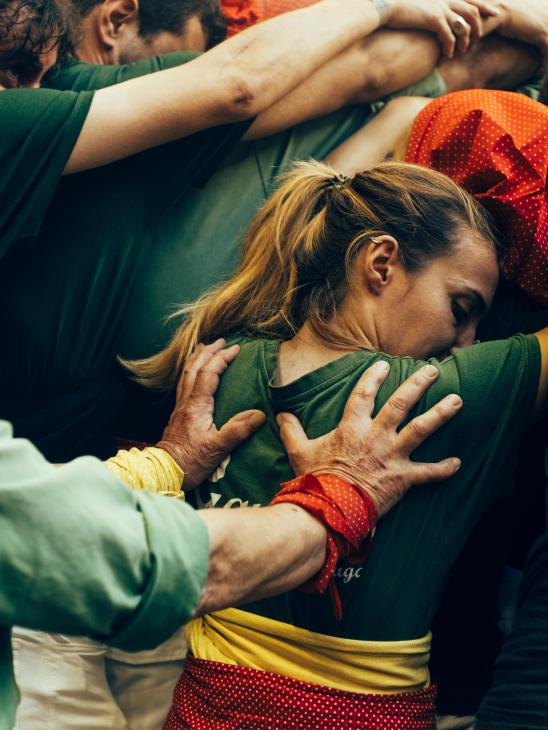
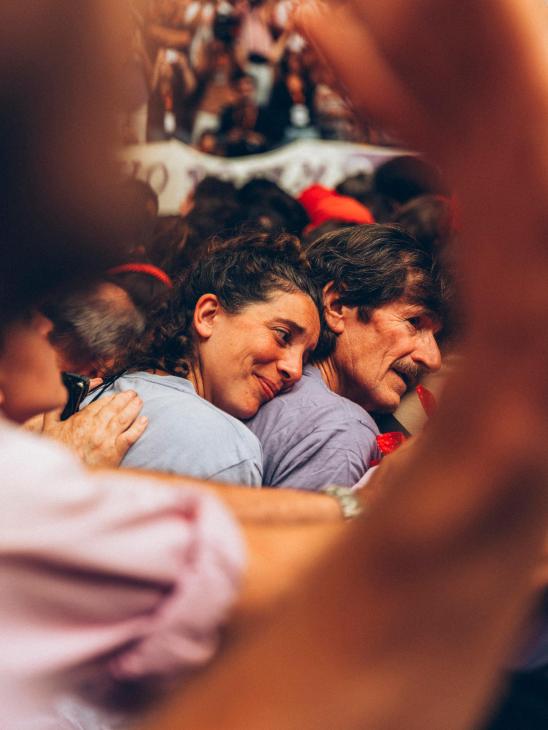


As competitors slowly pile into the centre of the Tarraco Arena Plaça, a former bullfighting ring that has held castells competitions since 1932, a voice on the loudspeakers introduces each colla, many of which have names that hint at the important role played by children: the Xiquets del Serrallo (Kids of El Serrallo); Marrecs de Salt (Brats from Salt); Nens del Vendrell (Children of El Vendrell). Children as young as five or six, whose job it is to climb up to the top of the tower, wear mouthguards and helmets. In pairs, participants help each other to wrap the all-important sash tightly around their waists. This crucial part of their outfit supports the lower back and provides grip for climbers on the ascent. A banner hanging on the edge of the arena reads, “Fent pinya, fas poble.” (“When you huddle together, you make a village.”)
Surveying the crowds from the top floor of the arena is Pere Ferrando, president of the jury. He is surrounded by several screens showing all the action. All colles receive a score based on the difficulty of their constructions, and alongside six other jurors, Ferrando will be marking the performances. There are about 40 different types of castells, each of which is only complete when the enxaneta (one of the smallest castellers) reaches the top of the tower and raises one hand. Extra points are given for a safe dismantling. But today is not only about rivalry. “What makes it interesting is that you don’t necessarily need to compete with another colla,” says Ferrando. “It’s also about surpassing yourself.” That said, he will be keeping a close eye on the tug of war between the two teams angling for the tallest castells: the Castellers de Vilafranca and the Colla Vella dels Xiquets de Valls. The former has dominated the competition since the mid-1990s, winning 11 of the past 13 editions, while the latter is the team threatening this dominance.
It’s mid-afternoon, and the time has come for the Castellers de Sant Cugat to attempt their first tower – an eight-storey construction with four castellers per tier. Pie, the group leader, calls out instructions from the bottom as the stadium watches on. Every step is perfectly synchronised to complete the tower as quickly and safely as possible. As soon as the fourth storey is complete, eight-year-old Candela Casas begins her ascent, stepping on a sea of arms and heads. “I climb up by holding on to sashes, grabbing shoulders and legs,” she says when Monocle meets her backstage. She’s not scared of heights, she says, but it’s important to not look down and to stay focused. When she reaches the top and lifts up her left hand, the stadium breaks into applause. But it’s only when it’s clear that the tower will not crumble, and that everyone is safe, that the castellers begin to jump up and down, exchanging hugs and kisses. When asked what the best thing about castells is, Casas replies without hesitation, “To enjoy yourself!”
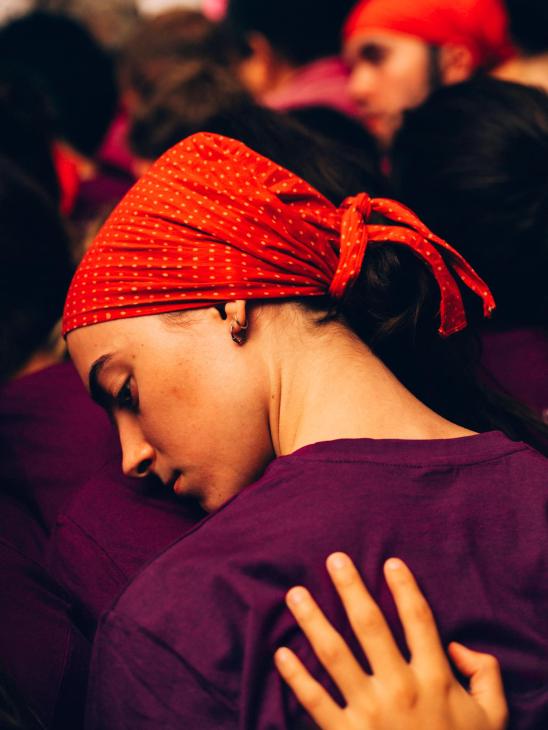

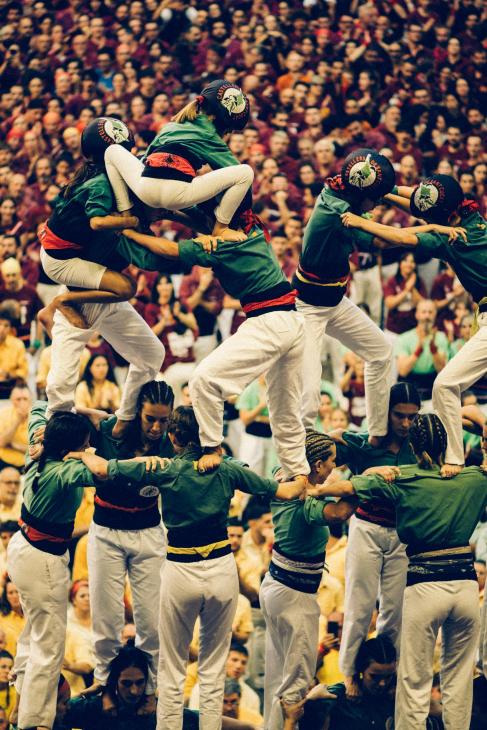

Many participants liken the experience to being part of a huge family. For Maricarmen Álvarez, who is watching nervously from her front-row seat, that is quite literally the case. She is here to support her two daughters and six grandchildren, ranging between the ages of 12 and 23. They are all taking part in the competition with the blue-shirted Xiquets del Serrallo from the Tarragona fishing neighbourhood. “It’s very hard for me to watch,” says Álvarez, pausing to point out every family member as they take their positions in the tower. “Come on, you’re almost there,” she says, cheering on as the youngest reaches the top. “Oh God, please don’t let them fall.”
Of course, not every tower can defy gravity. Though the pinya does act as a cushion and serious accidents are rare, the risk involved in castells is what makes the feat of collaboration so enthralling. Álvarez is acutely aware that this is the price to pay for the strong sense of belonging and community that castells provide. She knows that it’s the collective bravery and unconditional trust placed in others that has kept the tradition alive. “My late husband was a casteller and my great-grandchildren will probably be castellers,” she says with a sigh. “It’s passed down from generation to generation; it’s in their blood.”
Making his way through the crowd is Tarragona’s mayor, Rubén Viñuelas. When you grow up here, he says, castells are never far away. “Part of daily life is going out for a vermouth and watching castells,” he says, referencing the celebrations of Sant Magí and the Santa Tecla Festival, which take place in August and September. “Tarragona is the capital of castells, so this event means a lot to us. We pay homage to this way of life. Those of us who grew up here understand what this means and we love to see people from around the world watch on with excitement.”
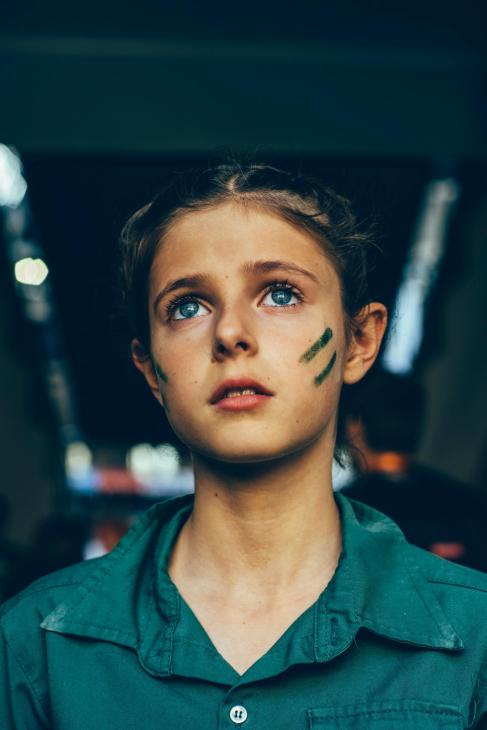

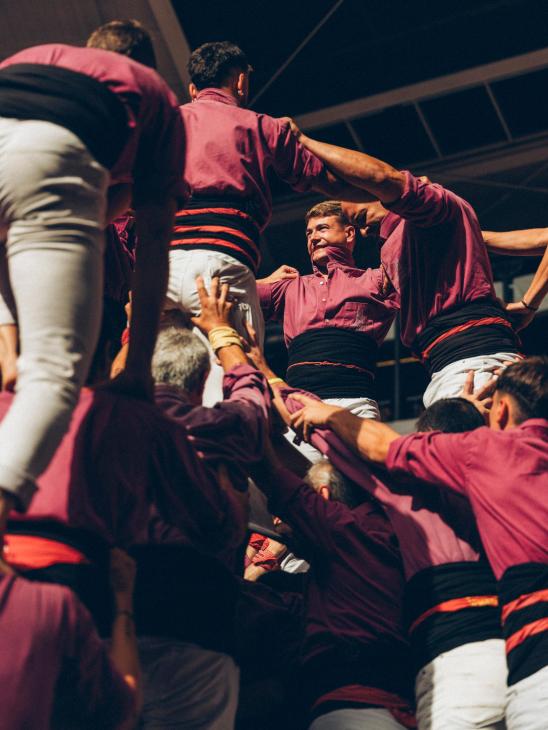
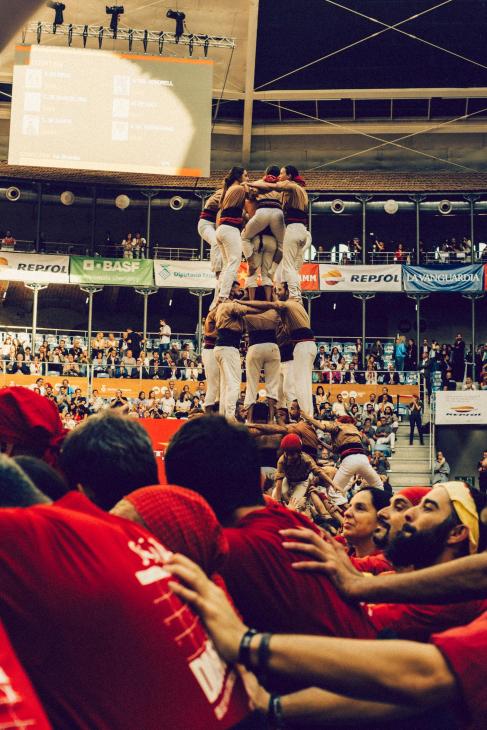
As a strong expression of Catalan identity, castells often go hand in hand with a sense of regional pride that can be tied to Catalonia’s independence movement, which came to a head with an ultimately unsuccessful declaration of independence in 2017. The competition begins with everyone singing “Els Segadors”, Catalonia’s national anthem, with hands on hearts and fists in the air. Inevitably, this is followed by calls for “Independència!” Some see castells as a metaphor for the region’s strong sense of unity. “There’s the cultural aspect of making castells – it’s about looking after our language and the traditions that have been around for hundreds of years,” says Víctor Biete, president of the Castellers de Sant Cugat. Of course, that doesn’t mean that the activity is incompatible with wanting to remain in a united Spain. And while castells have grown in popularity in recent years, the push for independence has suffered some setbacks. For the first time in more than a decade, the Catalan nationalist parties failed to secure a majority of seats in the regional parliament earlier this year. The pro-union Socialist Party, of which Viñuelas is a member, now leads the Catalan government after years in opposition.

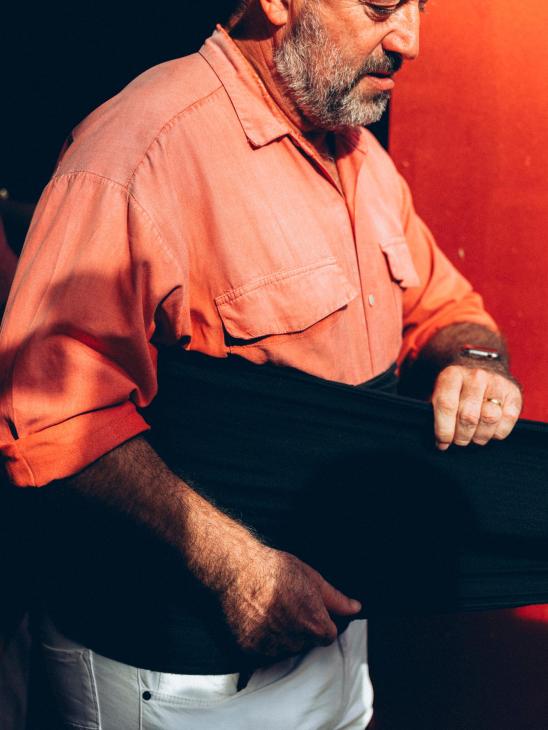
A few streets away, a parallel event is taking place in front of the town hall. In recent decades, castells have expanded beyond Catalonia’s borders. Today several international colles – from London, Paris, Berlin and Copenhagen – have gathered here before heading to the arena to support the Catalan teams. The Xiquets de Copenhagen were founded in the Danish capital in 2014, and Marta Trius, a PhD student, joined them a year ago. “When you’re abroad, the social dimension becomes even more important,” she says. “When you move abroad you have to find your family and this is like having a family.”
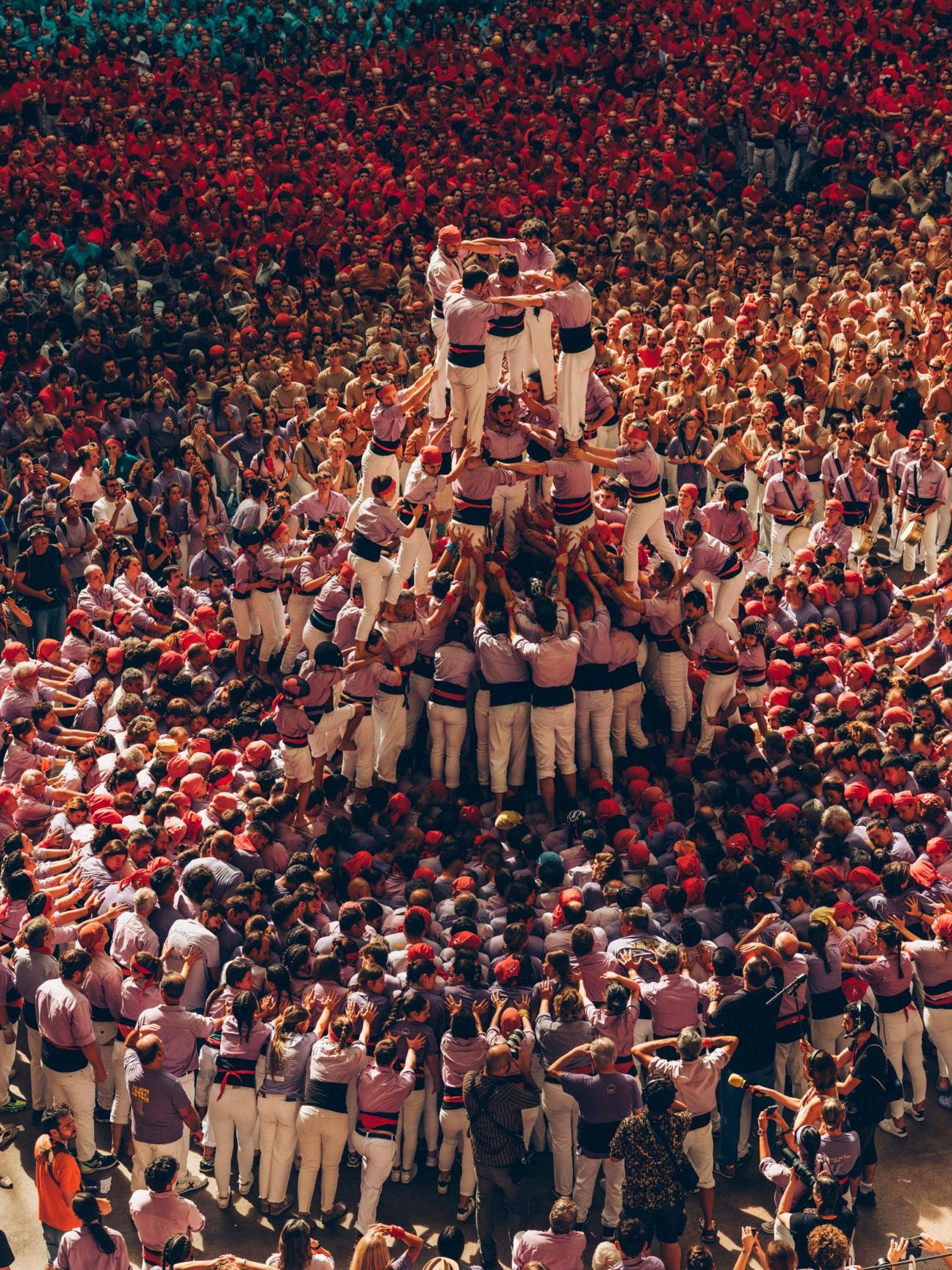
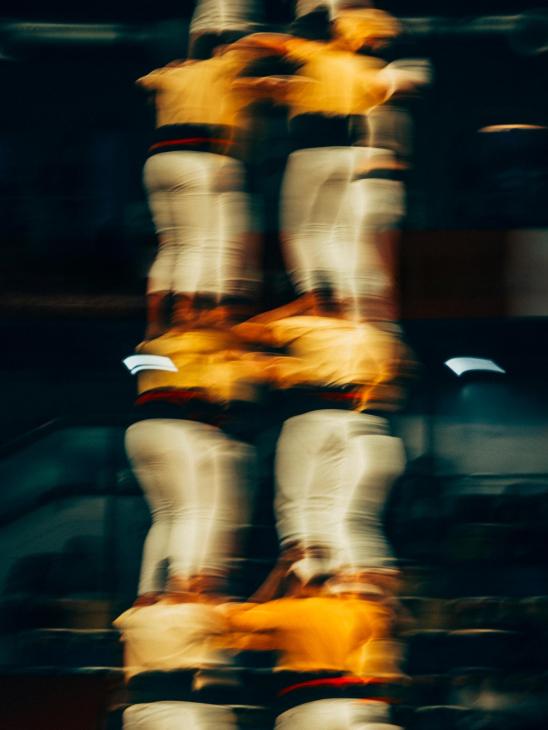
Back in the arena, Viñuelas says that the global appeal of castells is due to the teamwork and inclusivity involved. “It’s a piece of Catalonia that we are exporting to the rest of the world, with all its symbolism,” he says. “Everyone has a function in society – the elderly, men, women, children – just like in castells. And in the end, everything depends on the youngsters; on little boys or girls who rise high above everyone else to complete the tower.” In the end, the Castellers de Vilafranca triumphed, taking home its 13th title. For the other, there’s always next time: you’re only as good as your last castell.
Can fashion still be original if it’s trying to please an algorithm?
For any fashion editor, the quarterly trip to the Fondazione Prada in Milan to take in the latest collections by Miuccia Prada and her co-artistic director Raf Simons is one of the highlights of any fashion week. You never know what to expect. It’s a treat to hear Mrs Prada talk about the ideas, conversations and visual references that informed her latest collection.
Surrounded by journalists clutching voice recorders, the Italian design doyenne always keeps her cool and shares insights into her creativity. This season she spoke about her desire to work against social-media algorithms. But how? One way is to present a different idea for every look, rather than a cohesive theme that could be replicated online. “We wanted to add a human touch,” she said, adding that humanity often equals unpredictability.
Weeks later, I’m still thinking about that brief backstage encounter. At a time when so many fashion collections and images are criticised for looking homogenous and algorithm-friendly, can design still be original? And can we still dress in a way that feels personal? It would be easy to adopt a negative outlook and give up on originality. But then again, there might be a simple solution: seeking style inspiration away from the screen.
As we enter the gifting season, seek the unpredictable – like the elusive Mrs Prada – and try to find out more about the products that you’re buying. Behind every item are stories of entrepreneurship, craft and human relationships between designers and makers. Our fashion pages feature collections of such best-in-class products to start you off.
Western leaders shouldn’t allow themselves to be pushed around by Donald Trump
How would you like your country’s leader to act if intimidated? As the US’s traditional allies consider their response to the election of Donald Trump, it’s a pertinent question.
Emmanuel Macron, the French president, claims that Europe must stop being a herbivore and become an omnivore so as to avoid consumption by the world’s carnivores. It’s no secret that most of Washington’s partners in Europe and Asia were hoping for and even anticipating a Democratic victory. I attended a media roundtable in London on the evening of 5 November featuring some of the most illustrious names in foreign affairs journalism. All of those who offered a prediction on the outcome of the vote said that Kamala Harris would win and far more time was devoted to discussing her potential appointees than Trump’s. Thankfully, no one will suffer as a result of that faulty guesswork – but the same cannot be said for any diplomats or government officials who are inadequately prepared.
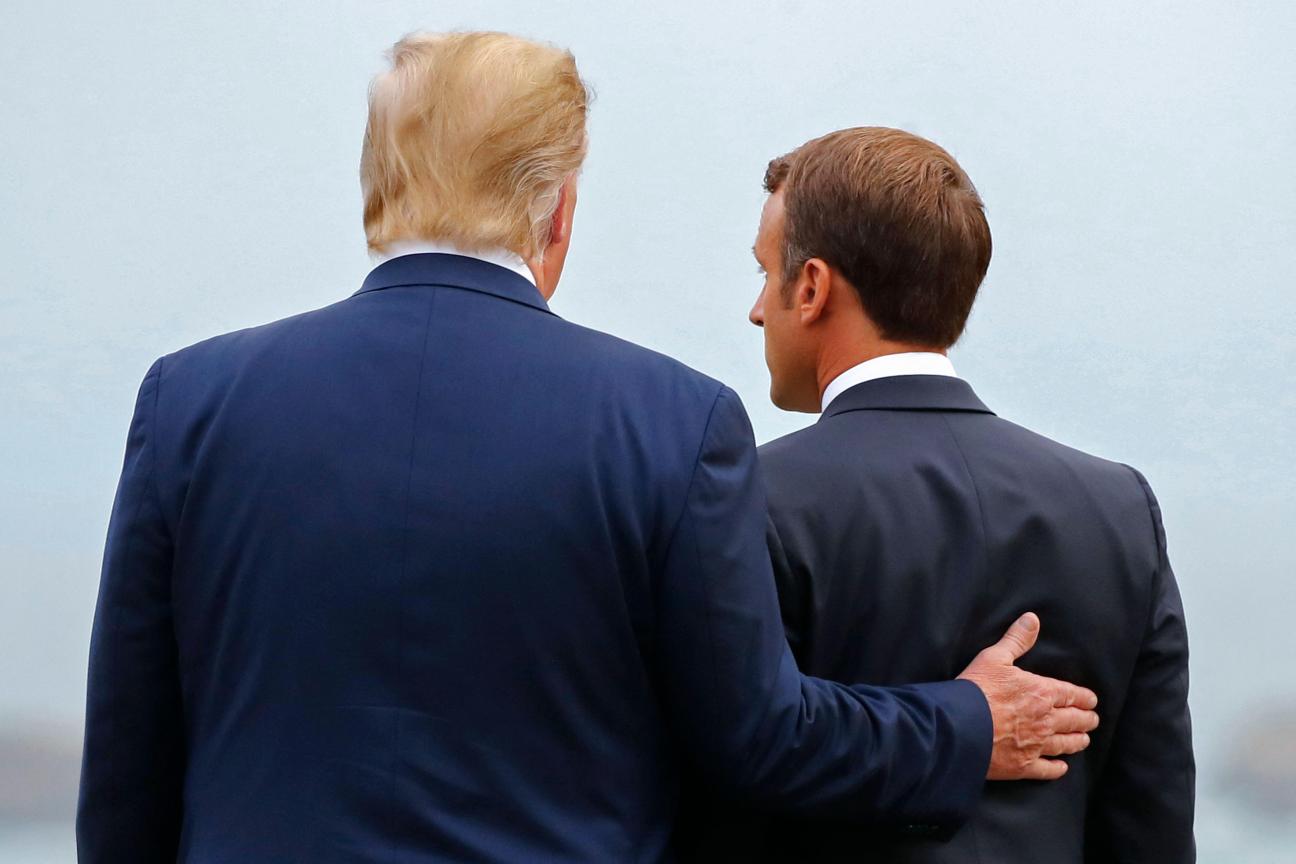
Had they sought advice in the aftermath of the shock result, they would have found no shortage of purveyors. Much of what most commentators say boils down to an insistence that leaders should indulge the new president’s allegedly transactional nature and narcissistic tendencies – that he must be flattered and bribed into doing the right thing. But this betrays the same cynicism that has led to the election of politicians such as Trump, who have exploited voters’ antipathy towards the institutions of government and their leaders, who he has labelled as dishonest and corrupt. What is more dishonest and corrupt than kowtowing to someone who you believe to be wrong?
Of course, we don’t know how Trump will treat the likes of France when he begins work on 20 January. Portentous warnings of a vengeful isolationist could well be overblown. But if the president does use intimidation and threats to force Washington’s erstwhile friends to do his bidding, those same friends should not be cowed. Foreign relations, especially those conducted by the world’s economic and military hegemon, have always been transactional. Even the Marshall Plan, often presented as proof of the US’s inherent nobility, had cynical motives – namely, curbing the influence of the Soviet Union in Western Europe.
Moreover, though the US has often claimed to be acting selflessly, while invoking its self-declared exceptionalism, no country is exceptional when it comes to how it should treat others. One need only look at the number of nationalist strongmen currently in power across the globe to understand that America’s situation in 2025 is far from sui generis. Each of these leaders has preached their country’s innate superiority in order to win elections. And while it’s true that none of them are running as powerful a nation as the US, neither are they bound by the checks and balances of that country’s constitution.
What should the US’s allies do if they are faced with a combative Trump? What they think is right, of course. This might sound idealistic but it will protect their countries (and careers) in the long term. Much of the present crisis in liberal democracy stems from the fact that voters are so enraged by their leaders’ prevarication on certain issues that they are drawn to those who they believe are at least genuine. It is in the darkness between the official explanation and the concealed truth that populism festers and metastasises. Trump is not the first US president whose election has confounded the country’s allies; nor will he be the last. He will only be in the job for another four years but the damage done to voters’ faith in politicians who find themselves lying to placate him will take far longer to repair. Let’s hope it doesn’t come to that.
The merits of soft power should not be underestimated
One of the things that distinguishes soft power from hard power is that the former is a two-way relationship. The point of hard power – tanks, fighter jets, the proverbial sending of the marines – is that you don’t ask the permission of whoever you’re menacing. Soft power works best when the party on the receiving end is a willing participant. In October the annual Brics summit was held in Kazan, Russia. It was portrayed by Russia as a defiant diplomatic triumph for Vladimir Putin. Putin is, in theory, a pariah: an imperialist warlord wanted for war crimes. But 24 world leaders – far beyond the official membership of Brics – attended.
But it is striking how few of the participating countries regard Russia as a trustworthy ally and how strapped for actual friends many of them are. It was, to a large extent, a gathering of the “soft power-less”. These countries might be rich, fearsome or undeniably (if infuriatingly) important but they command little affection. Russia, to cite an obvious example, has serially squandered its formidable soft-power arsenal – glorious literature, fabulous music, scientific prowess – on demented ideological projects, often involving the coercion of reluctant neighbours. Moscow now has clients and customers, flunkies and cronies, hostages and victims but few, if any, friends.
Western policymakers have recently been fretting about the posse that Russia is assembling to challenge Western hegemony. Often characterised as the Axis of Upheaval, it is generally held to include Russia, Iran, North Korea and China: four countries united by little beyond the fact that they dislike and suspect the West more than they dislike and suspect each other. The regimes of all four rule by fear. Many of their people would leave in a heartbeat.
All of the Axis of Upheaval might well dismiss soft power as an effete and decadent notion, scoffing that there is a clue in the adjective “soft”. It was a predecessor of Putin’s who is reported to have snorted, when warned of the (considerable) soft-power influence of the Vatican, “How many divisions has the Pope?” But presenting an unrelentingly combative visage to the world will only get you so far. Hard power is a willingness to fight – and any idiot can do that. Soft power is having something worth fighting for.
Andrew Mueller hosts ‘The Foreign Desk’ on Monocle Radio.