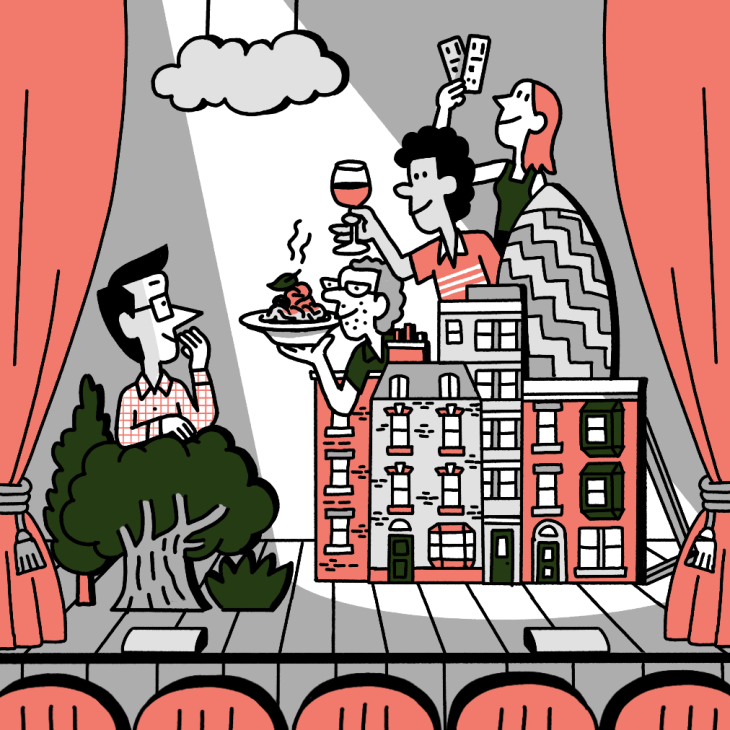
Cities are like theatres, we the actors. What part do you want to play?
Ask not whether your favourite city placed in Monocle’s Quality of Life Survey, ask what you can do for your city (and friends).
He lives in a bucolic spot in the English countryside, in the sort of village that gets cast in 1930s period dramas. Miss Marple would be very at home in one of the cottages on the high street with their rose-framed front doors. And he loves it. But 20 years ago, he lived in central London and was something of a nightclub fiend.
The other day we were having a catch up after way too long and he was – as many rural converts from the capital are prone to – banging on about how London has changed, and for the worse. “It used to be so much more fun but now when I come here it just seems tough, dirty and definitely not fun.” At this point I needed to trip up his rant. “Do you really think that the city has stopped being fun? Or could it perhaps be that you have?” I asked with a friendly smile. He laughed and agreed that it might be true.
Cities are not fixed things – of course they change. But so do we and how we judge a city depends on so many personal things that no mayor can hope to address. A city can have the best restaurant scene in the world, for example, but it matters not an avocado on toast if you don’t have friends or a lover to dine out with. From theatre nights to Sundays in the park, you need a social network to get the most out of living in London, New York or Paris. And as we get older, those networks can be harder to build. So suddenly someone transplanted to a new job in Berlin in their thirties will tell you what a miserable place the city is, when all they really mean is that they have not found the human keys to unlock the city for them.
The July/August issue of Monocle has just landed on newsstands, and it contains our annual survey of the 20 best cities to call home. The ranking always causes a lot of debate. But when someone is definitely opposed to a city having ranked, yet it clearly does well on the metrics, I often wonder what else is at play. Can an entire city and all its residents really be cast off as “boring”? Or does the person passing judgement have a habit of surrounding themselves with dull people?
Now many of my favourite cities in the world have not made the list this year – and might never. It would be hard for me to sneak Beirut onto the chart, or Palma, or indeed London. Monocle’s editorial HQ city suffers in our survey because of the level of street crime and the housing crisis – but it’s still a place that I love. And the reason is simple – it’s the people I know that make London work for me. My neighbours, my colleagues, work contacts and old and new friends offer me a thousand ways to penetrate the capital’s sometimes steely carapace. Without them, perhaps I would also say, “London’s not fun anymore.”
To make the most of a city, to understand and also love it, you need to find yourself cast in its script; its ever-involving narrative. This is the thing that turns a metropolis from liveable to loveable. When I was in my twenties, I used to watch Woody Allen movies more or less on repeat: Manhattan, Hannah and Her Sisters, Annie Hall. The characters in these movies lead New York lives that embraced all the city had to offer – cinema, Central Park, going to museums, dating. And I wanted some of that sense of belonging, even if it was to be found across the Atlantic in London.
So when you read our survey, especially if you feel your hackles twitching, remember that cities are theatres and we are the players. Monocle can tell you where crime is low, where green space abounds and where cultural institutions are free and glorious. But in the end, all these cities are just scenery. It’s down to all of us to step onto the stage, to play a part.