In Florence, Italian tradition is being kept alive through a new renaissance
The Tuscan capital has long attracted visitors with the promise of timeless wonders – but look closer and you’ll also find a forward-looking city that’s eager to serve up fresh, contemporary delights.
To travel to Florence is to accept that you are walking a well-trodden path, one that has been prominent on the map since the 18th century, when the Grand Tour was considered an educational rite of passage. The home of the Renaissance, the Medici banking family and luxury fashion house Ferragamo, it draws a crowd that appreciates art history and chianti in equal measure.
From her scallop shell, Botticelli’s gold-haired Venus beckons about 8,000 people to the Uffizi Gallery every day. Michelangelo’s David watches over the city – from the full-scale replica in Piazza della Signoria to the fridge-magnet versions sold at kiosks and souvenir shops – while the original can be found at the Galleria dell’Accademia. Churches and basilicas are adorned with works by Giotto, Ghirlandaio and Masaccio.
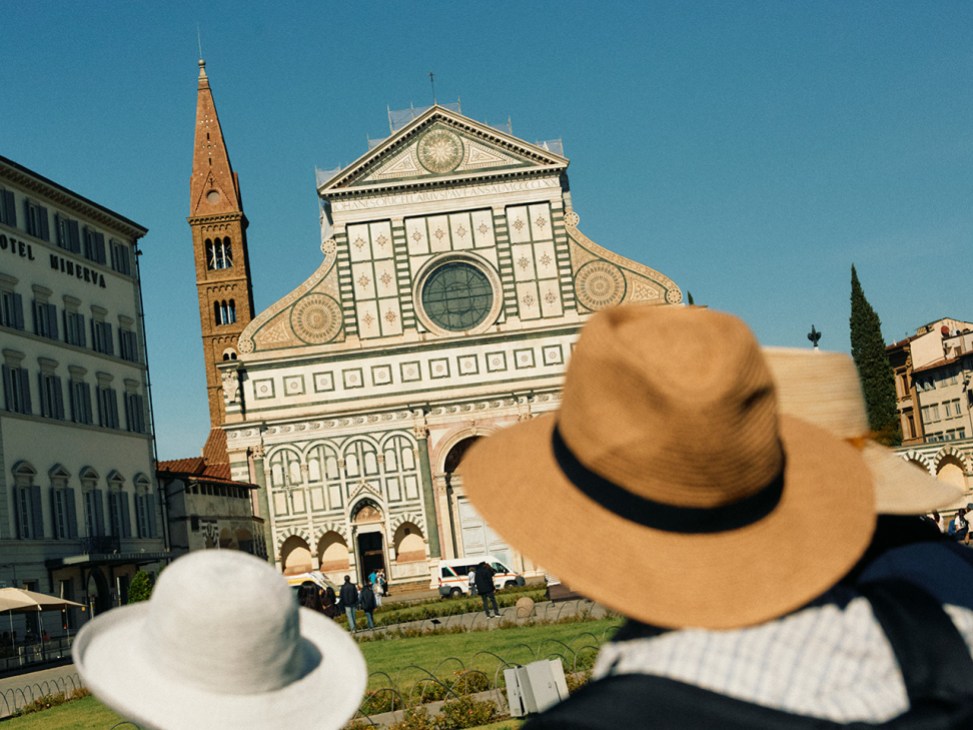
Few cities possess the cultural heft of Florence. There’s a reason why Stendhal syndrome – or culture shock, as it’s sometimes known – was first diagnosed here. More than 10 million tourists pass through the city every year, far outnumbering its population of 362,000. Though it’s tempting to shirk the crowded museums and streets of the old town, to do so entirely would be to miss the point. After all, who’s above admiring the canonical works of the High Renaissance maestros? But a little black book of contacts is also a necessity: many residents understandably feel the urge to guard their favourite addresses.
Florentine twins Marina Serena and Cesare Achille Cacciapuoti have created an antidote to the proliferation of restaurants, cafés and shops designed to cater to tourists. In their annual magazine and on their website Italy Segreta, the duo vet places that are run by locals and publish stories dedicated to all things Bel Paese – from food and hospitality to the cultural mores of Italian society.
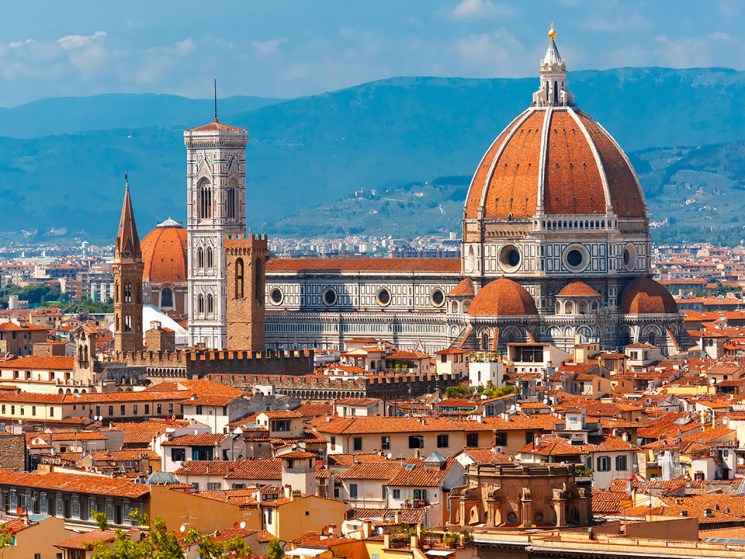
“Since we cannot control travel, globalisation or the economy, we tell stories about the places that we want to support and bring to the world an Italy that we feel represented by,” says Marina when Monocle meets her at the company’s top-floor office in the heart of the city. From our perch, Filippo Brunelleschi’s 15th-century duomo is so close that it feels as though you could reach out and touch its terracotta tiles.
“If we bring business to residents, it creates a virtuous cycle with more places that also cater to the people of Florence, rather than gelato stands and souvenir shops,” says Cesare, with his miniature schnauzer, Mina (named after the Italian singer), by his side. “If visitors come to Italy without knowing what’s authentic, they end up in places that promote the wrong idea of the country. We’re gatekeepers not of our address books but of reality, of locality.”
Another guiding principle of Italy Segreta is to champion a new cohort of creatives and entrepreneurs, be it the people featured in the pages of the magazine or the photographers and writers who bring the stories to life. “Italy is conceptualised as being old,” says Marina. Cesare agrees. “We need to give space to the younger generations to do things that are up to the standard of what was done in the past,” he says. “Take Italian design. It’s internationally recognised but mostly for what was created in the 1970s.”
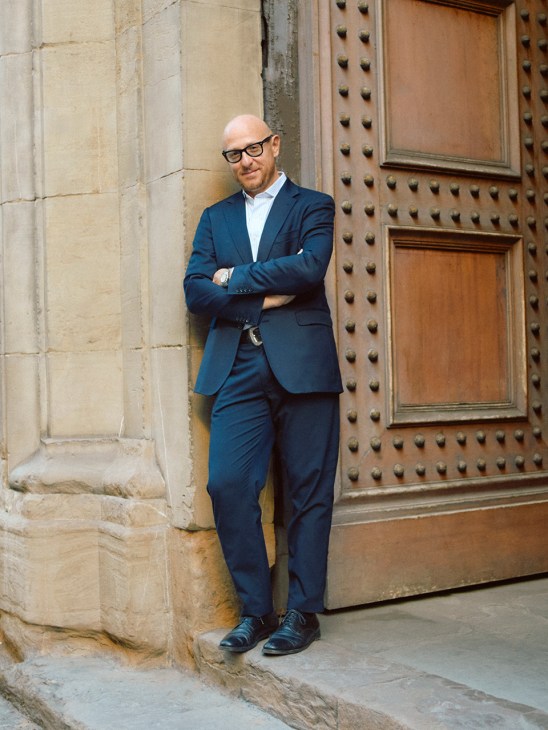

A discerning approach to travel makes sense in Florence, where an abundance of humdrum recommendations can be tricky to sift through. It’s an ethos to which Canadian-born banker Pierre Ferland subscribes. In 2024 he c0-opened This Time Tomorrow, an eight-suite hotel in the residential neighbourhood of Le Cure. “I travel so much for work that when I arrive in a city for a short break I just want to be told what I can’t miss,” he says as he gives Monocle a tour of the rooms, which feature restored frescoes and artworks including a 17th-century tapestry.
Before guests arrive, they are encouraged to complete a questionnaire that will help This Time Tomorrow’s affable resident curator, Eric Veroliemeulen, to tailor an itinerary, with restaurant bookings, private winery tours and more. “If a guest is interested in art, I’ll introduce them to a local sculptor or maybe organise a tour of the Uffizi with the head of the art history department at the British Institute of Florence,” says Veroliemeulen. Originally from the Netherlands, he moved to Florence 15 years ago to work in hospitality. “Cutting through the noise – that’s the real meaning of curation,” says Ferland.
The next morning, Monocle heads to the Palazzo Strozzi before the museum’s opening hours to meet its director general, Arturo Galansino. On display until late January is an exhibition dedicated to Fra Angelico, the 15th-century Dominican friar who painted biblical scenes with a devotion and lightness of touch that continues to intrigue to this day. “This show isn’t once in a lifetime, it’s once in history,” he says as we gaze at the gilded wings of an angel that has flown down from heaven to deliver the Annunciation to Mary.
As part of the show, Galansino led a campaign to restore 28 of Fra Angelico’s works and reunited altarpieces that hadn’t been exhibited together since they were disassembled centuries ago. “Some of these loans have never been seen and will never be loaned again,” he says. “If you did a regular Old Masters show in Florence, no one would come because there are too many in town. You need to create something unbelievable, unprecedented and unrepeatable to stand out.”
Since taking charge of the museum 10 years ago, Galansino has helped to shape Florence’s contemporary art scene too – no small feat in a city that tends to prefer romanticising the past over looking to the future. “The city has been imprisoned by the Renaissance legacy,” he says. “People used to think that Florence had nothing to do with contemporary art.” In recent years, the Palazzo Strozzi has hosted exhibitions including a retrospective on US abstract expressionist Helen Frankenthaler, as well as inviting Anselm Kiefer, Anish Kapoor and Tracey Emin to exhibit site-specific installations in the museum’s courtyard. “The risk is that this city becomes a Disneyland of the Renaissance. We’re trying to bring a new gaze on culture.”
Soon, the doors open to the public and a crowd quietly streams in. A friar in a puffer jacket, with an audio guide gripped tightly to his ear, stands in contemplation in front of an altarpiece depicting Christ’s descent from his cross.

After we leave the Palazzo Strozzi, we wend our way towards the Arno and stop by Todo Modo, a bookshop, café and enoteca run by husband-and-wife duo Maddalena Fossombroni and Pietro Torrigiani. Since Todo Modo was founded in 2014, the business has evolved to include an annual book fair called Testo, a publishing imprint, a radio station and a kiosk near Fiesole, a residential area in northeastern Florence. “We felt that there was a need for a place where residents could meet and discuss books,” says Fossombroni. Her husband agrees. “We’re Florentine by birth and could see the people who we grew up with leaving the city,” he adds. “Now we have created a little community. We hand out postcards to our customers and last summer we received more than 100 back from across the globe.”
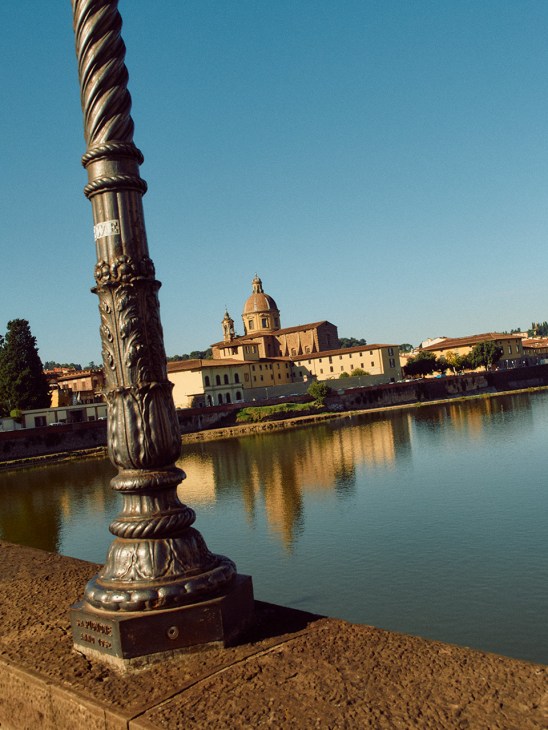
As we cross the river on the Ponte alla Carraia, a lone rower passes beneath us. From the bridge, you can see the grand palazzi that line the Arno, near the Chiesa di San Salvatore in Ognissanti, where Botticelli is buried. As a rule of thumb, it’s best to avoid bottlenecks at either end of the Ponte Vecchio, where gold shops draw crowds in search of glittering souvenirs. An exception is if you’re crossing via the Vasari Corridor, the elevated passageway that links Palazzo Vecchio to Palazzo Pitti via the Uffizi – once the commute of Cosimo I de’ Medici in the 16th century. (Yes, really.)
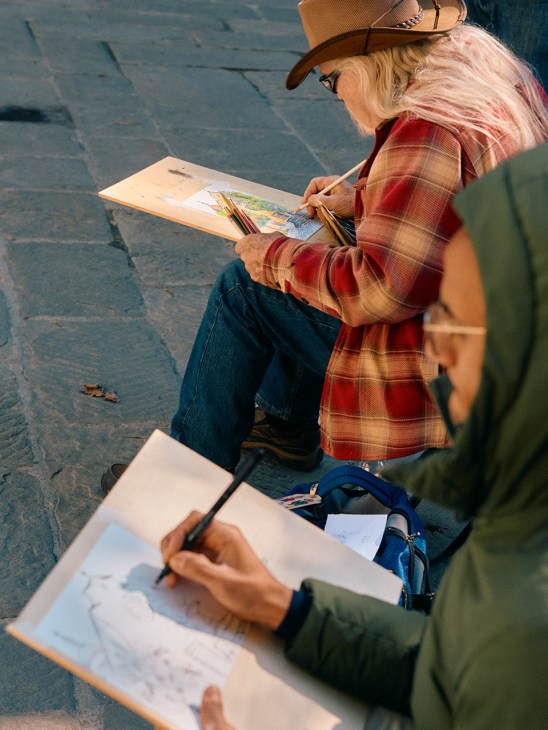
On the Oltrarno side of Florence, there’s a bohemian sensibility with wood-panelled trattorias lining Borgo San Iacopo and workshops specialising in brass or picture framing mingling with art galleries. In the square facing Santo Spirito, old men in cowboy hats sketch the white-washed, curlicued façade of the Augustinian church that gives the piazza its name.
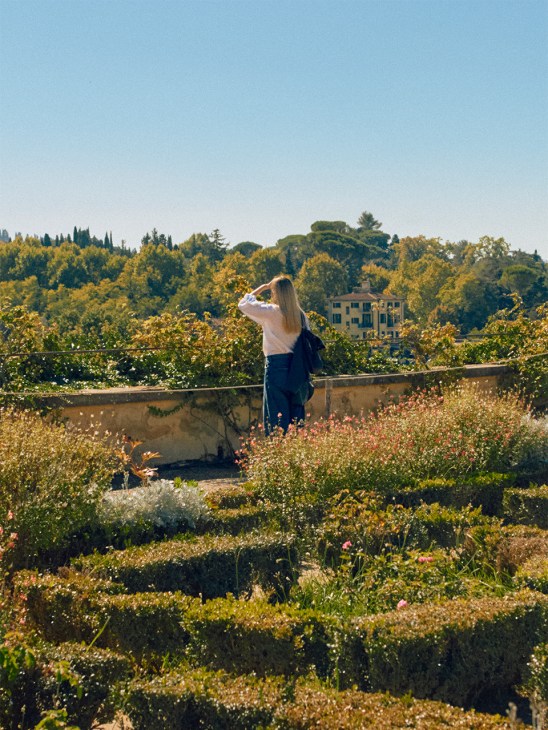
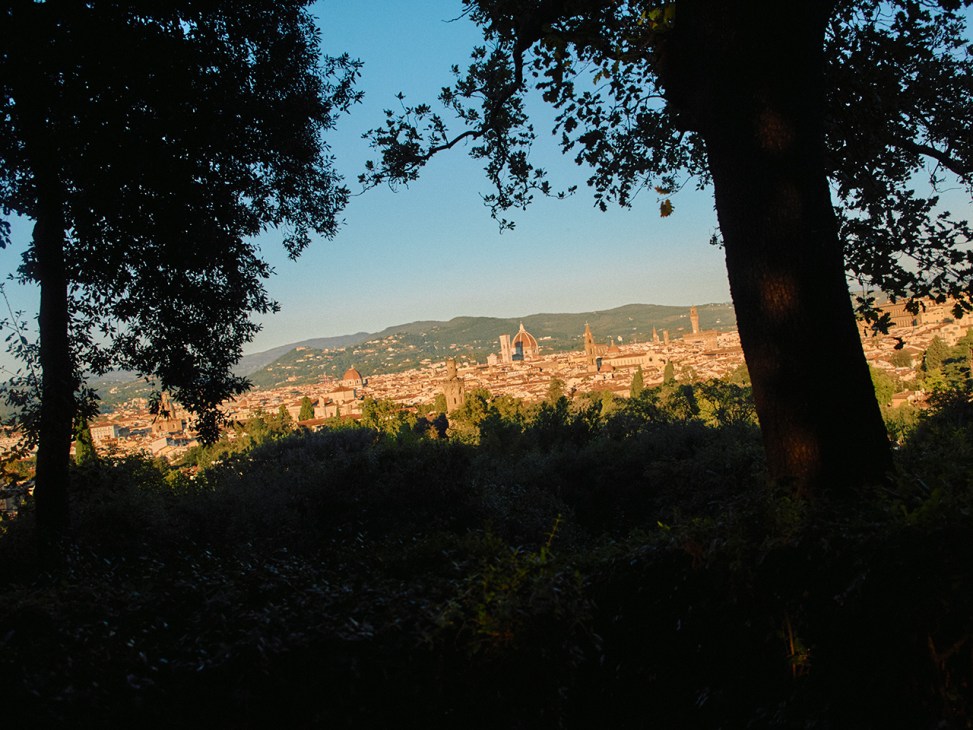
We make a detour through the Boboli Gardens, where we spot a resident reading a copy of daily newspaper Il Foglio while reclining on a deckchair that has been artfully positioned in a patch of sun; gardeners, meanwhile, tend to the lemon trees that surround a stone statue of Neptune. From the vantage point of the elevated gardens, the city’s geographical limits can be seen as buildings give way to rolling hills. Here, the charm of Florence is on full display, the city’s gentle character captured by its ochre-hued streets and church spires. Chaotic Rome and secretive Milan, with its closed-off courtyards, feel an eternity away.
In the nearby San Frediano neighbourhood, we stop at Cucina, a restaurant run by architects-turned-restaurateurs Simonetta Fiamminghi and Giuseppe Bartolini. “Our food is the food of our grandmothers, of memory,” says Fiamminghi. She is returning from the market, carrying crates of produce to the kitchen. Bartolini hands us an espresso and begins to explain what food and architecture have in common. “We represent on the table a landscape of farms and wineries,” he says. “The process of combining ingredients to transform and make a new thing is what you do in design – it’s all about material and form. But perfection is not our goal. What we do is home cooking and food is our opportunity to offer love.” Tucked away on a street lined with Liberty-style townhouses, Cucina is one of Florence’s best-kept secrets – run for locals by locals.




A few blocks south is the former convent of San Francesco di Paola, repurposed as a series of apartments that are home to an international mix of people who now call Florence home. In the property’s communal garden, we meet German-born art-gallery director and author Felicitas Ehrhardt, whose doctoral thesis examined the history of the former monastery of San Francesco di Paola, named after the 15th-century saint. “I first came to Florence after university, when I worked at the Goethe-Institut,” she says, her hair pulled back in a French twist. “I kept returning. It’s difficult to leave when you’re surrounded by so much beauty.”
In the summer, when fireflies light up the long grass, Ehrhardt and her neighbours arrange outdoor film screenings. Every year, the residents gather to pick olives from the property’s small grove to make oil. “Some places have true anima and soul, a power of place,” she says. Ehrhardt admits that it can be hard to live in the present when surrounded by so much history but adds, “You can’t live in the past. It can become baggage. You have to liberate yourself and create something new.”
Before departing, Monocle braves the queues at the Uffizi to stop by Botticelli’s “The Birth of Venus”. Whatever the time of day, admirers can be found in front of the whimsical 540-year-old painting. The Greek goddess covers herself with her hair, as a female figure rushes to wrap her in a floral cloak. Venus gazes back, an expression of knowing serenity amid the chaos caused by her beauty.
Where to visit, eat, drink, stay and shop in Florence, Italy
Visit
Museo Marino Marini
Discover the works of 20th-century Tuscan sculptor Marino Marini in a renovated church.
Piazza San Pancrazio
Visit
Museo Sant’Orsola
A new addition to Florence’s arts scene, set in a 14th-century convent and expected to be fully renovated by 2026.
Via Guelfa, 21
Visit
Palazzo Strozzi
This art museum in a historic building offers Old Masters alongside contemporary exhibitions.
Piazza degli Strozzi
Eat
Cucina
Home-cooked dishes are made from produce sourced from the market every morning.
Via Giano della Bella, 3/r
Eat
Il Santo Bevitore
Reimagined Tuscan dishes are served in a former coach house with vaulted ceilings and dark-wood panels.
Via Santo Spirito, 64/r
Stay
This Time Tomorrow
Follow a tailor-made itinerary crafted by the team behind this eight-suite hotel.
Viale Don Giovanni Minzoni, 3
Stay
Portrait Firenze
Owned by the Ferragamo family, this 37-key hotel overlooks the Arno and features sleek interiors by Italian architect Michele Bönan.
Lungarno degli Acciaiuoli, 4
Stay
Villa Cora
Once owned by Napoleon III’s widow, Empress Eugénie, this villa is a gilded, Baroque time capsule.
Viale Machiavelli, 18
Drink
Il Santino
This lively enoteca specialises in Tuscan wines, paired with sharing plates of cured meats and cheese.
Via Santo Spirito, 60/r
Shop
Loretta Caponi
Stop by this couture house to stock up on crisp bedding embroidered with delicate motifs.
Via delle Belle Donne, 28/r
Shop
Biscottificio Antonio Mattei
Manufacturers of twice-baked almond cantucci biscuits since 1858.
Via Porta Rossa, 76/r
Shop
Officina Profumo – Farmaceutica di Santa Maria Novella
Established by Dominican friars more than 800 years ago, this ancient apothecary lives on thanks to its offering of perfumes, candles and soaps.
Via della Scala, 16
Food Neighbourhoods #374: Florence
Monocle’s Ivan Carvalho is in Florence to discover the culinary treasures of a city that’s best known for its cultural offerings. Amid its wealth of Renaissance art and architecture, the Tuscan capital has its…