New York’s 10 best lesser-known bookshops
From West Village stalwarts to hidden living-room selections, this Monocle guide celebrates New York’s independent booksellers, specialist collections and the city’s enduring literary culture beyond the more obvious big names.
New York has always been a bibliophile’s city. Most jobs at newspapers, magazines and publishers in the US are here, and despite the eye-watering rents, it remains one of the best places in the world to make it as a writer. No wonder, then, that the city also teems with savvy booksellers.
While bricks-and-mortar bookshops in New York don’t enjoy particular tax breaks or subsidies, they do have the advantage of sky-high foot traffic by people generally keen on browsing. Thanks to the city’s literary reputation, tourists often gravitate towards books as souvenirs. Plus, it doesn’t hurt that bookshops can be some of the quietest places to escape to in Manhattan.
There are the big chains and the used-books juggernauts but once you’ve been to The Strand, take the time to explore some smaller, more specialised addresses. Here we pick ten of our favourite of the lesser-known outlets, including an artists’ bookshop, a bookshop for children, a culinary bookshop, a bookshop for French-speakers and even a bookshop in a private living room. The beauty of New York is that almost any niche, no matter how off-centre, can find enough adherents to support a brisk business.
1.
Three Lives & Company
Set on a quaint corner of the West Village, Three Lives & Company packs plenty of literary clout into its 60-odd sq m. With a small display of new releases that reflects the tastes of the historically bookish neighbourhood, this is where you will reliably find the novel that is about to become the talk of the town.
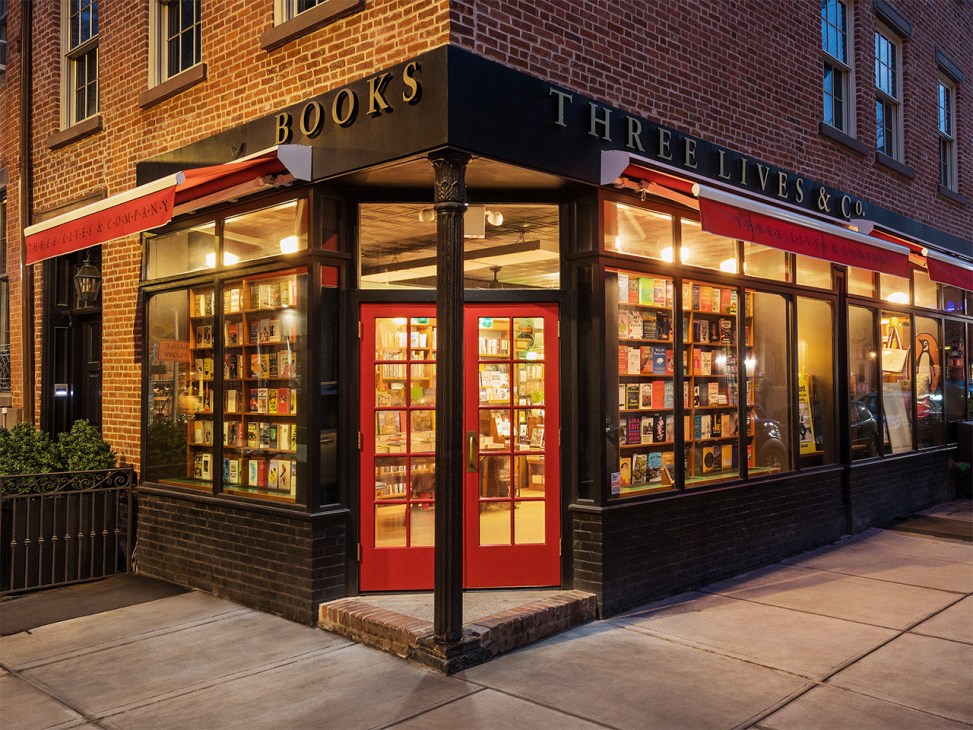
Three Lives was founded in 1978 by three women: the couple Jill Dunbar and Jenny Feder, and a friend, Helene Webb. In 2001, it was taken over by Toby Cox, who worked in publishing and had been a regular at the store. “At the time of my realisation that I wanted to switch to bookselling, they told me that they were looking to sell,” he says. Cox has preserved the store’s old fixtures, as well as the refined but generalist selection on the shelves.
Mainly because of spatial constraints, Three Lives only organises book signings at breakfast time, with authors and readers mingling over coffee and scones. Guests have included Zadie Smith and Ocean Vuong, while Karl Ove Knausgaard is stopping by in January. “These are authors that pack a big hall,” says Cox. “They seem to love it here.”
Neighbourhood trivia: The team once made use of roadworks outside to bury a Penguin Classics edition of Gertrude Stein’s Three Lives under the sidewalk.
Most anticipated new releases: This is Where the Serpent Lives by Daniyal Mueenuddin and Vigil by George Saunders, both January 2026.
Recommended novel by a West Village writer: Mitz by Sigrid Nunez, from 1998.
2.
Mast Books
This East Village bookshop intentionally defies easy categorisation. In the spare, glassed-in space, there are no labelled sections or promotional signs. The selection ranges from a memoir of a graffiti artist to a survey of photographer Luigi Ghirri, and from a manifesto on the art of listening to a tome on colour in 1970s interiors. The main through line is the personal taste of co-founder Bryan Leitgeb. “If you like one thing in the store,” he says, “there’s a good chance you’ll find a way to like almost everything.”
Together with his wife, James McKee, Leitgeb founded Mast in 2010. Today, the split between old and new titles is about 50-50, with both self-published artists’ books and choice titles from established publishers in the mix. The shelf space is tightly curated and always changing. “It is edited down so that each book speaks to the others,” says Leitgeb. “At its best, the store can create narratives just by the way that it’s organised.” It works: Mast is frequented by the young and culturally keen who spend hours poring through the titles and rarely walk away empty-handed.
Number of books on display: About 1,000.
Highlight of new publications: Greer Lankton: Could It Be Love from Magic Hour Press.
Good to note: The shop has decent opening hours: noon to 20.00, seven days per week.
3.
Peter Harrington
Fourth Avenue below Union Square was long known as Book Row, for the used-book shops that lined the street. While those businesses are largely gone, the city still has a large antiquarian trade – it has just migrated north, into townhouses on the Upper East Side. The latest addition to this rarefied world is Peter Harrington, the longstanding London dealer that opened a Manhattan outpost in September.
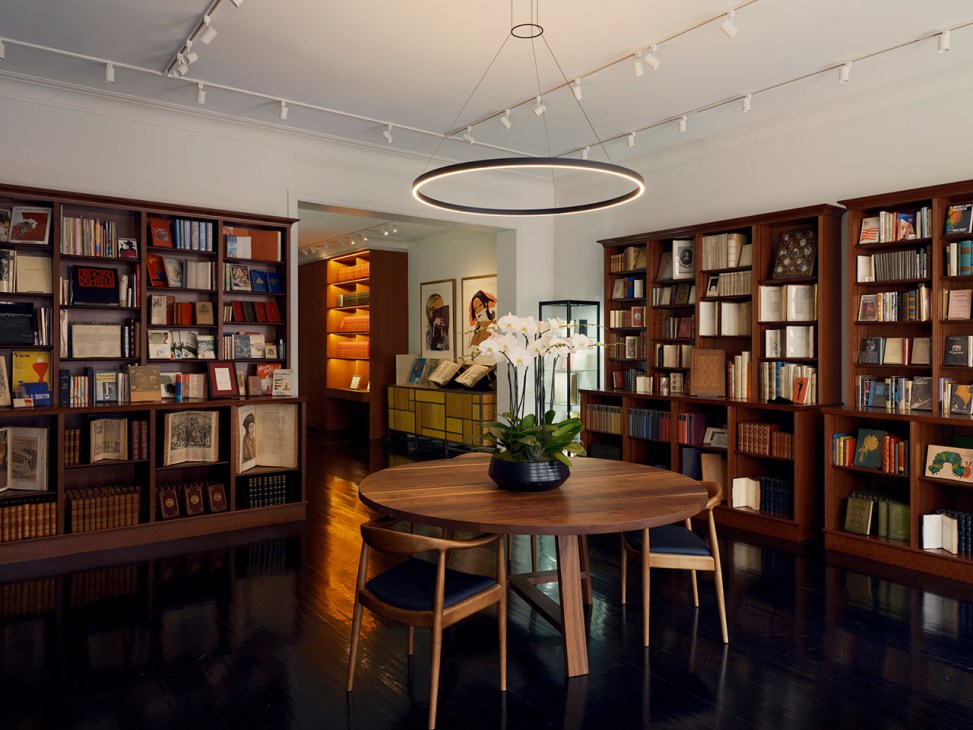
In a third-floor walk-up on 67th Street that was once inhabited by Audrey Hepburn, the shop contains a treasure trove spanning seven centuries of print. “We brought over the cream of what we have in London,” says manager Ben Houston. The inventory runs from handmade booklets from Hogarth Press, the publishing house founded by Virginia Woolf, to books bound by William Morris and all the way to 17th-century Shakespeare folios. There’s also plenty of Americana, including the first photocopy of Jack Kerouac’s typewritten manuscript of On the Road.
Peter Harrington is far from the stereotypical dusty antiquarian: the books all have price tags and visitors are welcome to sit down in a Hans Wegner chair to leaf through them. “People tend to stay for a long time,” says Houston. “Everyone can find something they love.”
Number of employees worldwide: 80
Most expensive item on display: Shakespeare’s Third Folio from 1664, priced at $1.35m (€1.15m).
Gift recommendation: A first edition of Joseph Heller’s Catch-22.
4.
Albertine Books
New York’s premier address for French literature is tucked inside a Gilded Age mansion on Fifth Avenue. Villa Albertine, named after the love interest in Marcel Proust’s In Search of Lost Time, has been the cultural arm of the French embassy since the 1950s. A bookshop for Francophone literature opened in 2014 after the last one in the city closed. Covering two floors in the back of the building, the serene space – with a hand-painted night sky gracing the ceiling – has become a sleeper hit in New York.
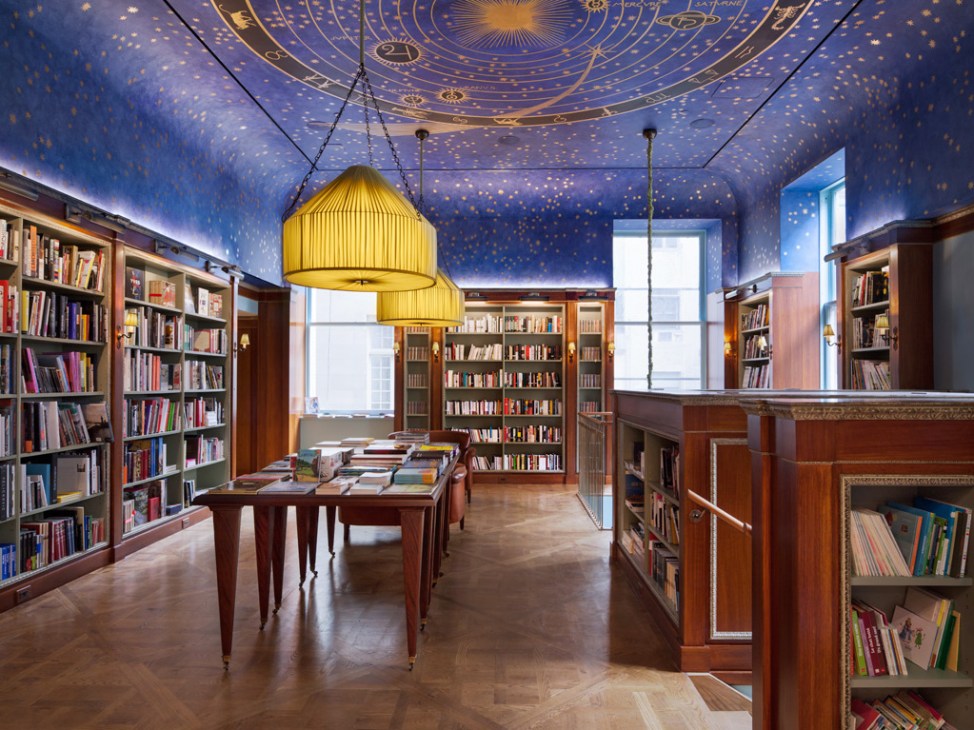
Albertine Books stocks about 14,000 titles, the majority of them in French, with a sizeable children’s section on the second floor. (A bronze statue of The Little Prince, seated on a wall facing Central Park, serves as advertisement out front). There is also a robust selection of translated French literature, as well as novels by James Baldwin, Ernest Hemingway and other writers with a strong connection to the country. Albertine hosts a monthly book club, with works always available in translation to accommodate French-speakers of all levels. “We necessarily have a limited audience,” says director Miriam Gordis. “But it’s a close-knit community.”
Pick of the 2025 rentrée littéraire: Les Forces by Laura Vazquez.
Best book for French learners: L’Etranger by Albert Camus.
Most popular event hosted: A talk with Annie Ernaux coincidentally took place two days after she won the Nobel Prize. “The line went down the block,” says Gordis.
5.
Kitchen Arts & Letters
This shop on Lexington Avenue claims to be the oldest in the country to specialise in cookbooks and food-related literature. Founded in 1983 by anthropologist Nach Waxman, Kitchen Arts & Letters has always taken a wide remit within the niche. “We want people to walk in and find things they didn’t even know existed,” says managing partner Matt Sartwell. “This shop is a cure for potential food ennui.”
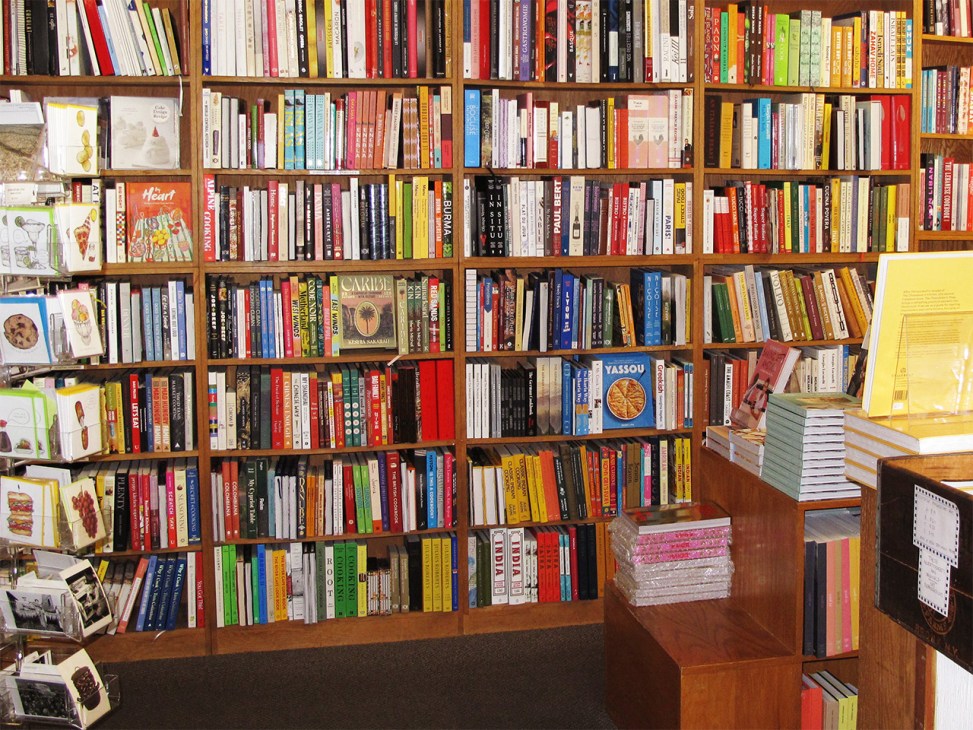
Kitchen Arts & Letters caters to chefs of all stripes: Julia Child was an early customer, but there are also cookbooks for amateurs, with a focus on smaller, independent publishers. Just as extensive is the literature related, even tangentially, to food. There are classics of the genre from Jean Anthelme Brillat-Savarin and MFK Fisher but also a book about the linguistics of menus and a zine about lampredotto, the Florentine tripe sandwich. The back room contains a reference archive of rare books that is only opened for special requests.
The shop’s speciality is a boon, as cooking has become one of the fastest-growing areas of publishing in recent years. “Books are forgiving,” says Sartwell. “If I spill something on the counter, it’s easier to replace a 35-dollar book than an 800-dollar phone.”
Books in stock: 11,000-12,000
Most-recommended cookbook: Cucina Fresca by Evan Kleiman and Viana La Place, a 1984 recipe book for make-ahead vegetable dishes that is still in print.
For food-adjacent literature: The Oysters of Locmariaquer by Eleanor Clark. “As if William Faulkner wrote a book about living in an oyster village in Brittany,” says Sartwell.
6.
Head Hi
Most bookshops pride themselves on their sheer quantity of books but Head Hi takes the opposite approach. Only a small number of publications are displayed at any one time; mostly brand-new releases on architecture and design that are stocked in very limited quantities. “It becomes a snapshot of contemporary culture,” says Alexandra Hodkowski, who founded the space with her partner, artist Alvaro Alcocer. “We’re both obsessed with what is happening right now.”
Head Hi was founded in 2018 after Alcocer, an artist and musician, and Hodkowski, a curator, came across a vacant space a block from their home in Fort Greene. The focus on the built environment reflects the industrial surroundings of Brooklyn Navy Yard, where many artists, architects and woodworkers have their studios. But the space welcomes a broad audience. “We tell people that you don’t have to be an architect to like architecture,” says Hodkowski. The eclectic programming includes listening parties and performances, as well as a biannual lamp show.
“We always loved record shops, bookshops and places where you pick up flyers and run into friends,” she says. “These alternative art spaces add so much cultural value to a city.”
Number of books on display: 150
Favourite publishers: Arquine, Lars Müller, Park Books.
From the in-house press: Days Without Number: New York City, a compendium of street photography by Giovanna Silva, published by Head Hi and Mousse Magazine.
7.
Books Are Magic
When Emma Straub and Michael Fusco-Straub opened Books Are Magic, a neighbourhood bookshop in Cobble Hill, the couple also had a one- and a three-year-old to take care of. “A big part of it was, ‘Where do we bring our children?’” says Straub. From day one, the bookshop catered to readers of all ages, with a kids’ section not much smaller than the one for adults.
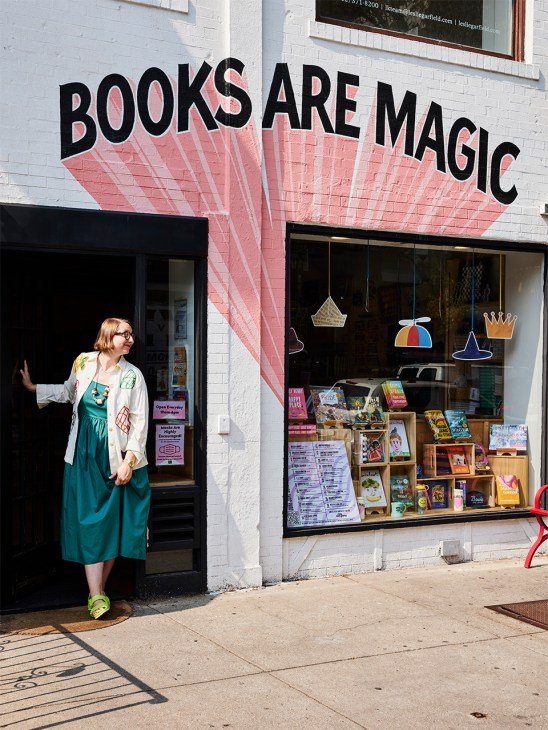
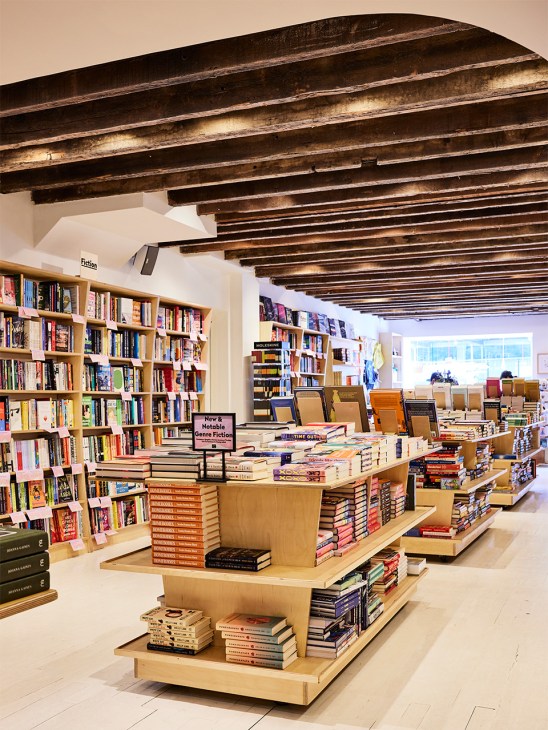
Books Are Magic is a popular stop on the high-profile book launch circuit – recent guests include Margaret Atwood and Patti Smith – but the most-loved events at the shop are story time sessions for kids. Any child who enters is welcome to write a so-called “shelf talker”, a handwritten recommendation that draws attention to a book. “The bar for entry is enthusiasm,” says Straub. “The key is not to talk down to kids but to treat them as full people, which they are.”
Books Are Magic now has a staff of about 30 and a second shop in Brooklyn Heights opened in 2022. Both shopfronts are easily recognisable with their colourful signage painted directly on the brick façade, as well the huddle of strollers parked out front.
Events hosted in 2025: 264, with a total of 16,496 attendees.
Children’s picture-book recommendation: Du Iz Tak by Carson Ellis.
Authors from the neighbourhood: Isaac Fitzgerald, Molly McGhee, Hernan Diaz, Jia Tolentino.
8.
Printed Matter
On 12 December 1975, a group of seven artists sent out a letter to their friends asking whether they had ever made an artists’ book, specifying that they didn’t mean catalogues. The packages they received in return became the basis for Printed Matter, which opened the following year. The shop and publishing press posited that books can, in themselves, be an art form too.
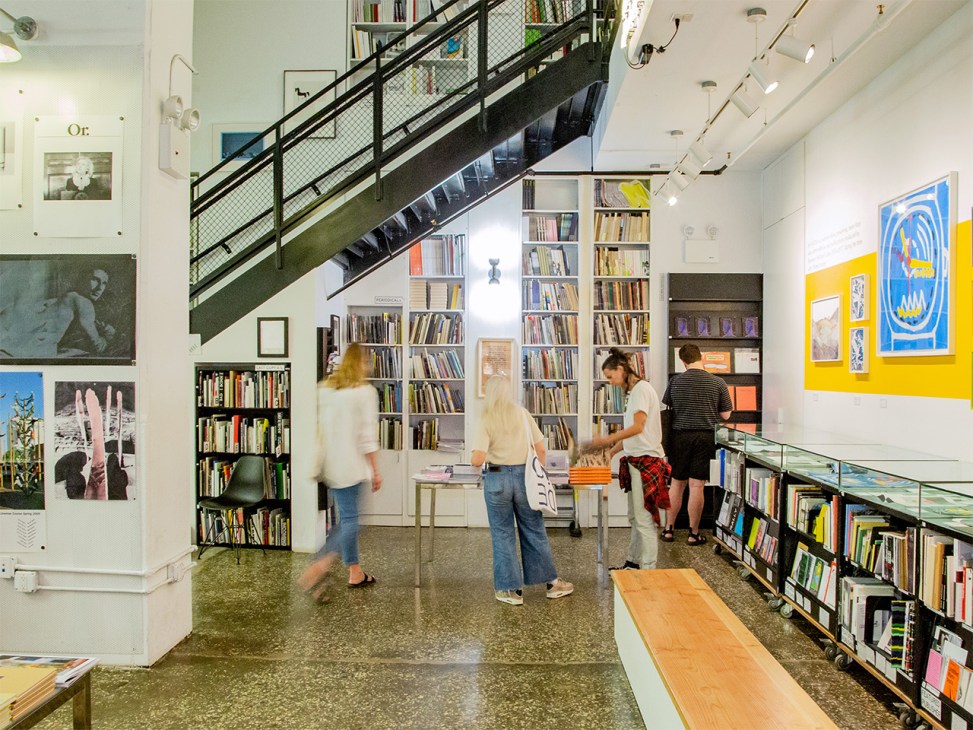
The first books included John Baldessari’s Throwing Three Balls in the Air to Get a Straight Line (Best of 36 Attempts), and Sol LeWitt’s Four Basic Kinds of Lines and Color, both simple and sublime works that have become classics of the genre (with collectors’ prices to match). Exactly 50 years later, Printed Matter still receives half-a-dozen submissions a day from artists around the world. The Chelsea shop lives up to its name: every available surface is covered with print.
Printed Matter also organises annual book fairs in New York and Los Angeles, which have grown into the main industry jamborees for the beguiling world of artists’ book publishing. “We understand how far-reaching our work has been,” says head of distribution Craig Mathis. “But in a weird sort of way, we still feel very scrappy.”
From the in-house press: Just in Case by Taysir Batniji.
Archival gem: LA Air by Bruce Nauman, which depicts smoggy skies in Los Angeles, sold for $10 (€8.50) in 1976 and is now listed for $500 (€427).
Favourite publishers: New York-based Khajistan Press, which publishes material that is taboo in the country it is sourced from, and Independent Paper Consortium, a French collective of zine- and book-making artists.
9.
McNally Jackson
McNally Jackson is the rare thing: a retail chain that has held onto its indie character. In 2004, Canadian-born Sarah McNally opened the first shop on Prince Street in Nolita. The company has since expanded into Rockefeller Center, South Street Seaport and two locations in Brooklyn. Many of the business strategies that McNally pioneered – giving staff the freedom to curate displays, paying as much attention to the backlist as to new releases and prioritising the sheer quantity of books – have been emulated by booksellers across the board.
Included in this literary empire are an in-house press that resurrects out-of-print gems, more than a dozen different book clubs (McNally’s own is wading through Infinite Jest, about 100 pages at a time) and a biannual book festival held for the first time this year. Crucially, in every shop there are tens of thousands of books, neatly lined up on hardwood shelves and deep leather armchairs to encourage getting lost in them.
Number of locations: 5
From the in-house press: New York Sketches by EB White.
2025 bestseller: I Regret Almost Everything by Keith McNally (no relation).
10.
High Valley Books
Inside a baby-blue clapboard house in Greenpoint, Brooklyn, is a mecca of print for the fashion designer, decorator, photographer or anybody aesthetically inclined. Its owner, Bill Hall, who lives upstairs with his family, started selling second-hand books more than 25 years ago. Today the home is packed to the rafters. There is one wall for fashion, one wall for photography, a nook each for architecture and interior design and a cellar crammed with back issues of Vogue and obscure German typography magazines. “When I dreamt of having a bookshop, I thought it would be art and literature,” says Hall. “Pretty soon, I was seduced by the decorative arts.”
High Valley Books is open by appointment but the living room still gets crowded, creating an informal salon for serendipitous encounters. Celebrities occasionally pop in – one recent incognito visitor turned out to be Frank Ocean. Everybody rummages through the same overstuffed bookshelves and piles of arcana. “This is fed by people in the creative industries,” says Hall. “It could only exist in New York.”
Underappreciated out-of-print magazine: Viva, published 1973-1980, with a young Anna Wintour as fashion editor.
Advice for aspiring book dealers: Keep your own collection away from the business. “Do not sell what you love out of penance for not succeeding right away,” says Hall.
Ballpark amount of inventory: More than 50,000.
Read next: Monocle’s complete city guide to and map of New York