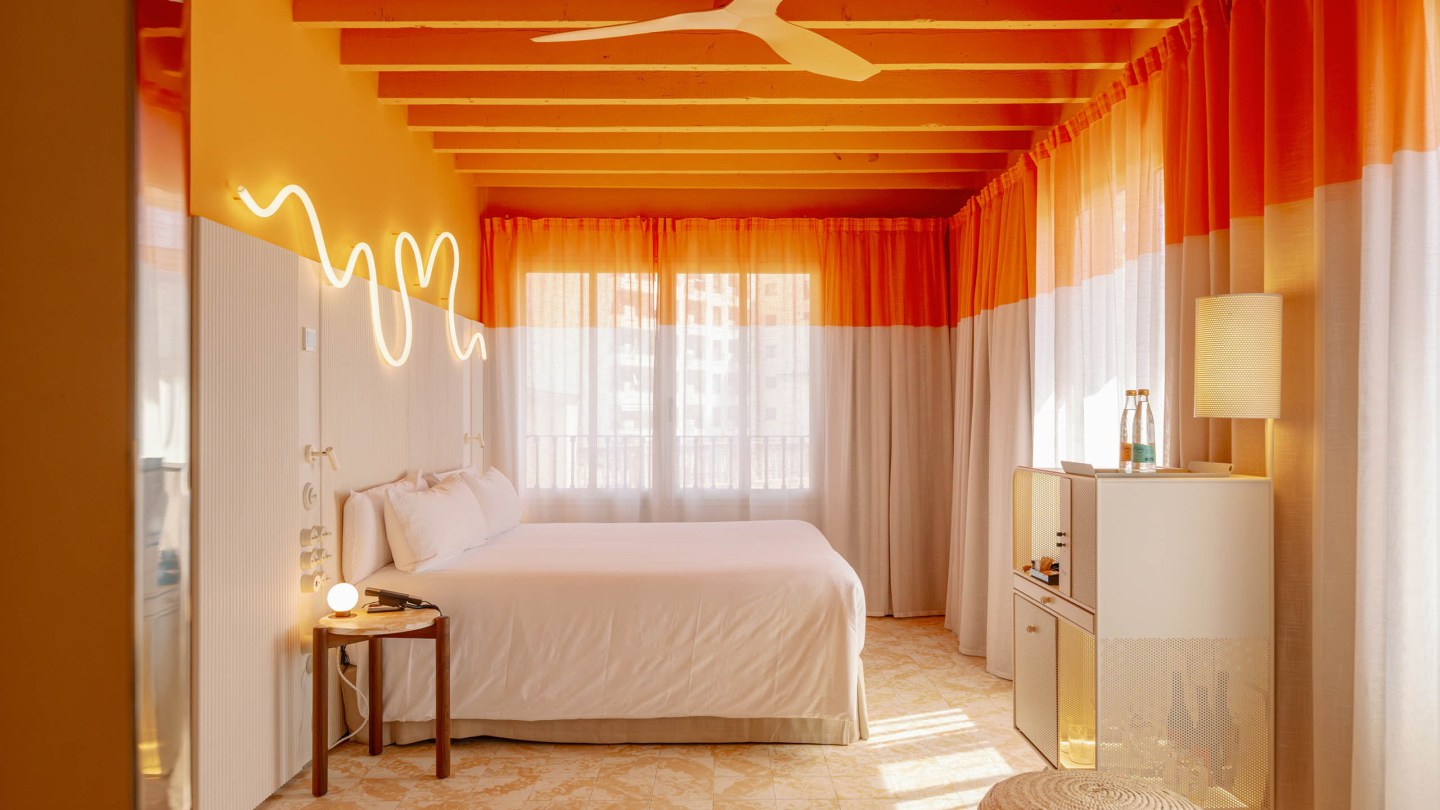
Terreno Barrio is Palma’s newest design hotel, with community engagement central to its strategy
Brought to life by Palma-based architects Ohlab, Terreno Barrio is bringing back welcome attention to a neighbourhood on the rise, from both visitors and local residents.
If you name your business after the neighbourhood that it serves, you had better be confident that you understand the area’s peculiarities so that you can weave yourself into the fabric of its residents’ daily lives. The Terreno Barrio Hotel in Palma de Mallorca taps into the energy of its namesake location, offering visitors and locals a dive into its distinctive design sensibilities and culture.
Wealthy families started building summer residences on the hills of Terreno in the 19th century. In its heyday between the 1950s and 1970s, stars such as Alain Delon, Grace Kelly and Marlene Dietrich would come here for drinks and dalliances. But when mass tourism brought a wall of hotels to the Paseo Marítimo, the streets above fell from memory. By the 1990s, Terreno had become a favourite spot for city folk who wanted to party a little too hard. Now, after decades of inertia, the neighbourhood is experiencing a renaissance.


Spotting an uptick in interest, Lydia Piñero acquired an apartment block designed in 1935 by local architect Francesc Casas (as well as the plot next door) to serve as the location for a new hotel. “You can see Bellver Castle from here,” she says, pointing at its turrets rising above the trees. “It dates to the 14th century and is one of the few circular medieval castles in Europe. The forest begins right behind and below us is the newly renovated Paseo Marítimo so it’s a beautiful area for walking.”
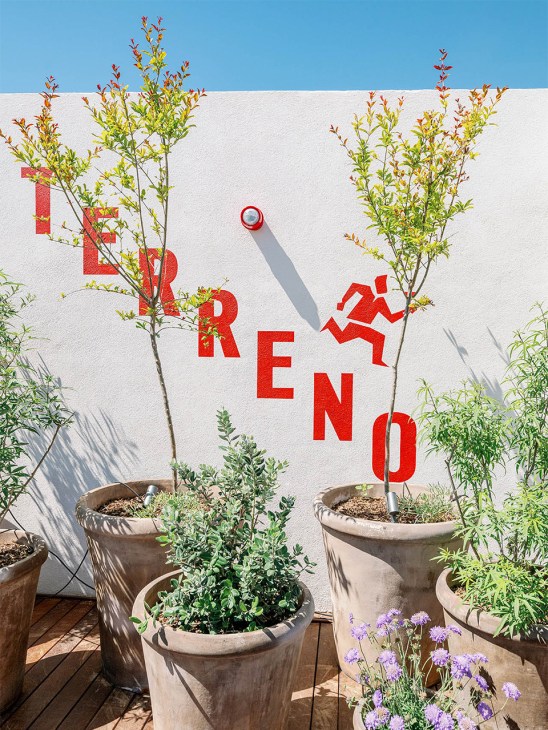
Piñero started a chain of creative conversations when she asked her friend José Taltavull to help shape the initial concept. She then brought Rafa Roses of Studio Roses on board to develop the hotel’s branding and graphic design. Instead of creating a generic hospitality identity, Roses drew on the visual culture of the neighbourhood, referencing old signs, local colours and memories of its past to build a graphic ecosystem belonging to the property and its area. Jaime Oliver and Paloma Hernaiz from Palma-based architects Ohlab were commissioned to translate this across the architecture and interiors, and together they built a master plan for a 41-room hotel with a gym, spa, cinema, rooftop pool and public amenities such as a café, a co-working space and a shop at ground level.
Oliver describes the project in terms of integration. “We see the old building with rooms and a restaurant as the stage and the new timber-clad edifice with more rooms and a multitude of amenities as the bazaar,” he says. “We have turned the private property between them into a public alley that connects the streets above to those below. We wanted it to work for the neighbourhood – not just for visitors but for locals too.”
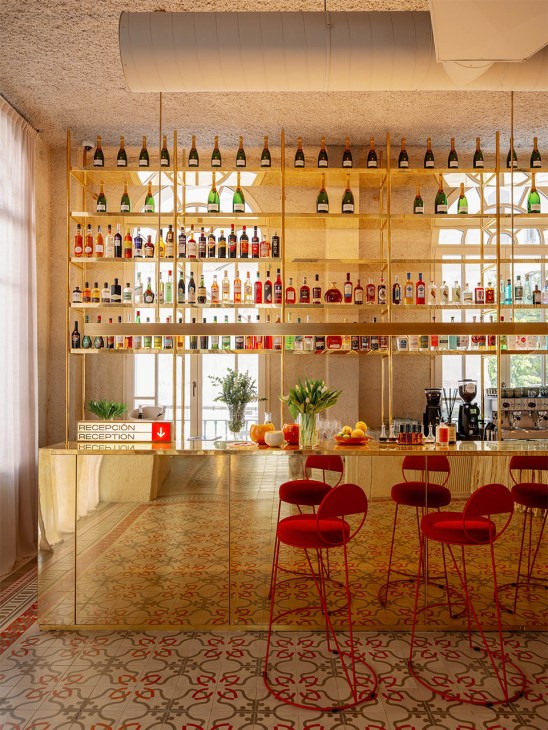
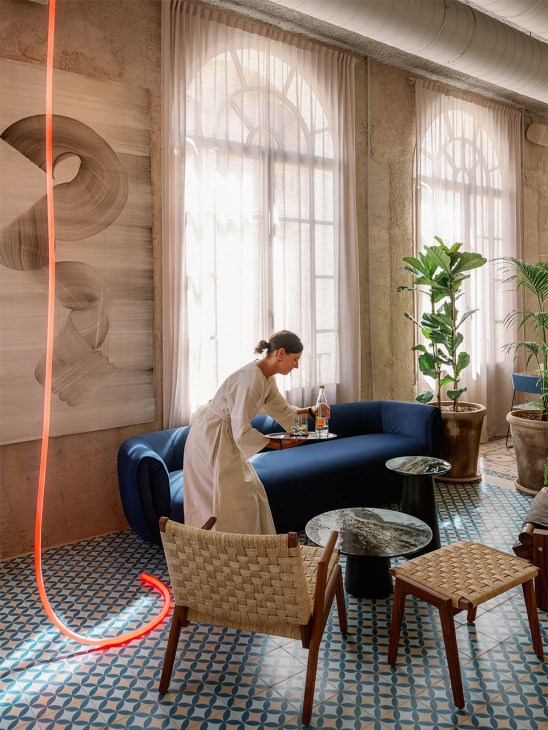
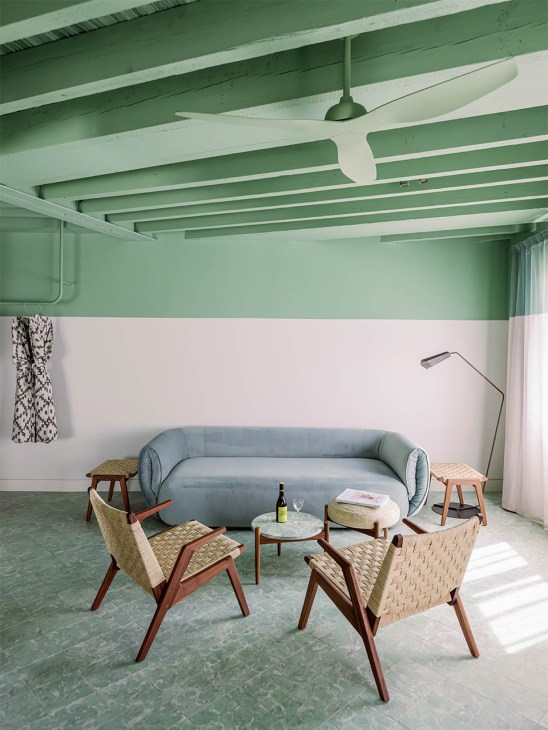
Ohlab took great pains to preserve the original 1935 property. Avoiding demolition can be considered a form of sustainability. The new building features a façade of vertical timber louvres that open and close automatically, letting in sunlight in the winter and blocking it in the summer. A natural cork wall clads the north face of the building, providing an insulating layer that helps to further control the atmospheric conditions inside.
Beyond considering how the hotel’s physical presence would affect its surroundings, Ohlab began compiling a roster of Mallorcan artists, artisans, designers and manufacturers to furnish and decorate it with a focus on material intelligence. Rubble from the demolished building that used to stand on the nextdoor plot – and that once housed an infamous nightclub with a colourful past – has been turned into terrazzo; the composite material can be found throughout the hotel’s bathrooms and communal areas. Meanwhile, French-Colombian artist Sylvia Sánchez Montoya has created a heavy curtain from unwanted Mallorcan sheep’s wool that veils the inner workings of the restaurant.
Ohlab designed a host of elements and commissioned local firms to bring its creations to life. The hotel’s brass bar counter, bottle rack, cold station and DJ counter, as well as the minibars, mirrors and open wardrobes in the rooms, were produced in collaboration with different local designers, including 2monos. Lamps in the restaurant, the nightclub and rooms were developed with lighting designers Contain. “We never use external consultants,” says Hernaiz. “We prefer to make it ourselves, working with local lighting designers because we think that it’s one of the most important elements.” The list of Mallorcan collaborators also includes Amarar, La Pecera, Adriane Escarfullery, Nico Guevara, Islas, Introvl and Huguet.
There is art at every turn. Again, craftspeople from the region were commissioned to adorn the hotel. Jaime’s brother, Pedro Oliver, hand-painted free-form motifs with accents in neon lights above the beds in each room, while Albert Pinya created murals, graffiti and, along with Pedro, sculptures in the public alley. Every detail has been considered and the local references extend to the food and drink. Beautifully packaged green olives from the island’s Valldemossa region, Mallorcan Mel Vici honey with a mini wooden drizzler and Cabraboc gin await guests on the shelves above the minibar. Brazilian chef Gabriel Conti – another friend of Piñero and Ohlab who made his home in Mallorca more than eight years ago – has created a menu for the restaurant, Destape, where favourites such as monkfish, turbot and tuna join Mallorcan beef on the open grill.
Oliver was keen to ensure that the approach to food and beverage was in keeping with the egalitarian concept. “Destape is slightly elevated and more refined but just below it we have the public thoroughfare with seating where anyone can grab a coffee and sit,” he says. “We even have a takeaway window planned for that alley. The important thing is to bring together the activators for the space and make it accessible for different budgets.”
Now that the guest rooms, the spa, Destape restaurant and the hotel’s invite-only nightclub, Dos Rombos, are open for bookings, the world is getting a glimpse of a new hospitality concept that is sure to give a fresh boost to the island’s economy. Time will tell but it already seems that Terreno has a worthy new resident – one that well deserves its moniker and place in the neighbourhood.
terrenohotel.com
Further reading:
The complete Monocle city guide to Palma
Ohlab’s House in the Mountains celebrates the overlooked beauty of Palma