In from the cold: A 45-hour train journey to remote Churchill, Canada in the depths of winter
Residents of Churchill have carved out a living amid the icy wilderness. But how will the region’s growth as a tourism destination and global trade route transform their relationship with its rugged beauty?
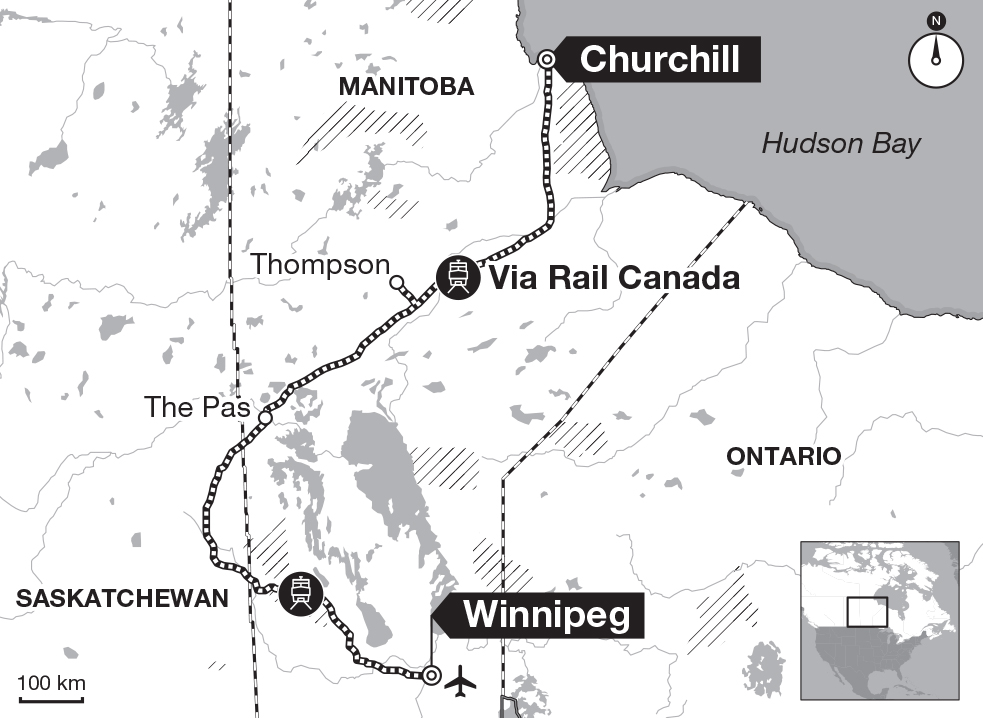
The Via Rail Canada website promises an “adventure of a lifetime” – a 1,700km train journey through boreal forest and Arctic tundra from Winnipeg to the subarctic port town of Churchill, the polar-bear capital of the world. It all sounds so swashbuckling, even when it’s the off season for bear spotting (at this time of year they’re out on the ice, hunting seals). After all, there’ll still be the northern lights and the end-of-the-world remoteness to enthral us. Monocle arrives at Winnipeg’s Union Station an hour early for the 12.05 train. The station is almost deserted and we only have a handful of travellers for company. There are no departure boards, no other trains and no shops (though thankfully there are a couple of vending machines). We end up sitting in this cold, echoey hall for almost seven hours; hour after hour, the train is delayed. It finally sets off at 17.45.


The route:
Winnipeg to Churchill
Riding the rails
The question arises soon after boarding: will the “magic” of Churchill that tourism websites tout be enough to justify this ride? The Hudson Bay Railway is not the Orient Express. The rail cars, built at the height of the Cold War in the 1950s, feel frozen in time. Made to service routes to remote places, their corridors are so narrow that only one person can pass at a time. The single-berth rooms – in a shade of mint green – might once have been considered a marvel of ergonomic design but are lacking by today’s standards. Every berth includes a chair facing a steel pull-down sink resembling those found in prison cells. A toilet, which doubles as a coffee table, is positioned in the centre of the cabin. At night the bed, on a hulking metal frame, slides out on top of the toilet. It’s like sleeping in the bathroom of a commuter train.
Attendant Tev Judd, who has worked on the rails for seven years, gives us a tour. Down the long hallway is a single shower, to be shared between the passengers. Past two sets of bunk beds are bathrooms and the dining car. “Just roll with it,” says Dave, a fellow passenger who works as a photographer for Via Rail Canada. He has done the trip once before and refuses to elaborate further.
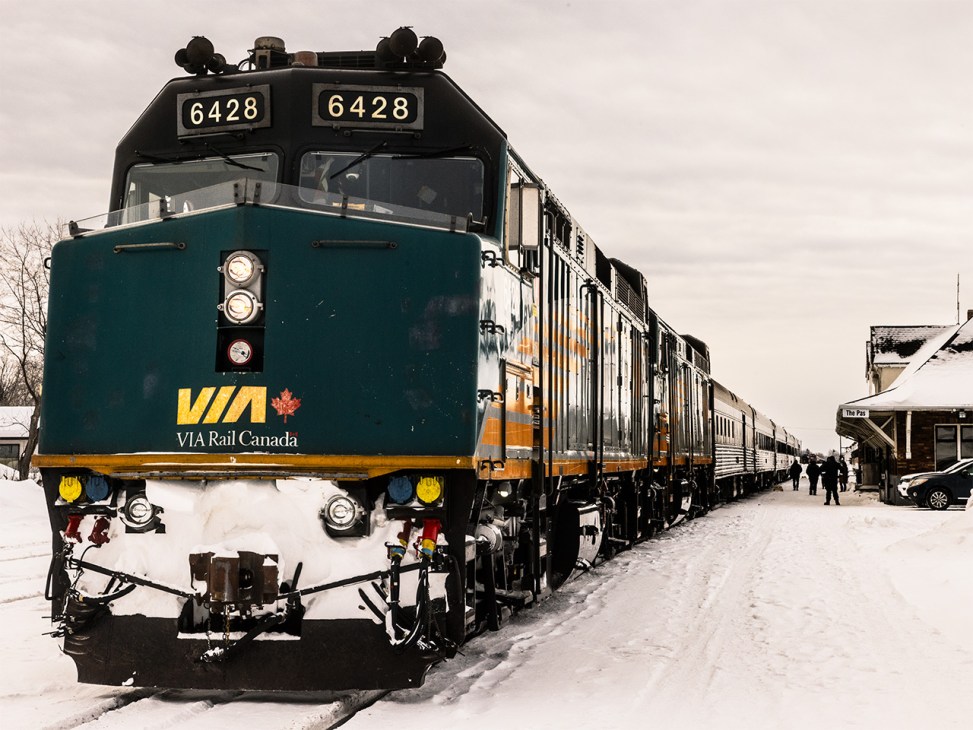
For the next two days, the train groans, shakes and rattles along, taking us further into the frozen wilderness at what feels like 30 miles (48km) an hour. It’s like a kids’ train at an amusement park but sometimes slower because in winter the steel tracks contract and can snap. In the tiny towns that we chug through, dogs run up to bark at the train – and then outrun it.
That first night, seven sleeper passengers linger at the metal tables in the fluorescently lit dining car and, unsurprisingly, are in no rush to return to their toilet-stall bedrooms. For dinner, Lana, the cook, recommends the microwaved butter chicken, though she has never tried it. “We bring our own food,” she says, a little disconcertingly. The next morning early birds Francine St Germaine and Michel Vinet are back in the dining car to watch the sunrise. A hot-pink halo forms over a patch of scrubby, tall pine trees like a UFO.
Vinet worked for Via Rail Canada for 28 years – freight from 1974 to 2004, then passenger service until 2013. His whole family has worked on the railroad. “I helped to rebuild this track and it’s the only one left that I haven’t ridden,” he says. “I have always wanted to go to Churchill to see its bears, northern lights and nature.” The train has a capacity of 124 people in coach and 14 with beds. Our train carries 13 in total: nine passengers in sleeper rooms and four crew. This doesn’t count those who get on and off along the way in the coach section.


The map in the carriage shows a string of communities that this single rail line stitches together. These range from small Indigenous towns with populations as small as 148 to Thompson, with about 12,300 residents. People take the train to stock up at the big-box shop in Thompson, then return with plastic bins filled with groceries, supplies, nappies and car parts. After Thompson, there are no roads leading to Churchill so, unless you fly, this is the only way to get there. That first morning, the other inmates have a not-terrible breakfast of scrambled eggs. Heidi, an Inuit woman who works for a non-profit company, is here from Ottawa. She’s on a long break from everyday life and is seeking to return to nature to reflect and reset.
Forest Gustavson, a cheerful, colourfully tattooed wildlife photographer, is making this journey to celebrate his birthday. “The ride gives you time to contemplate our role in the world,” he says. “And it prepares you for your arrival at Churchill, where there are three times more bears than people. Polar bears weigh 2,200lbs [998kg] and can be 15 feet [4.6 metres] tall. And they will hunt humans.” Across his forearm is a bright-green bear tattoo. His T-shirt, meanwhile, features a drawing of a bear and the word “hug”. “Churchill and the Northern Lights will change your life,” he says.
Julie Gaudet, Via Rail Canada’s service manager, has worked on the train for 27 years. She home-schooled her daughter in this dining car. To her, it’s a way of life. “We didn’t shut down during the coronavirus pandemic,” she says. “We couldn’t. This is an essential line.” Aside from service suspensions caused by severe flooding – notably in 2017 – the line has kept running. Today the weather outside is icy yet crisp. Stripped of comfort and connection to the rest of the world, this collection of strangers bands together in the dining car while the landscape rolls by.
Day one
Churchill, minus 30C
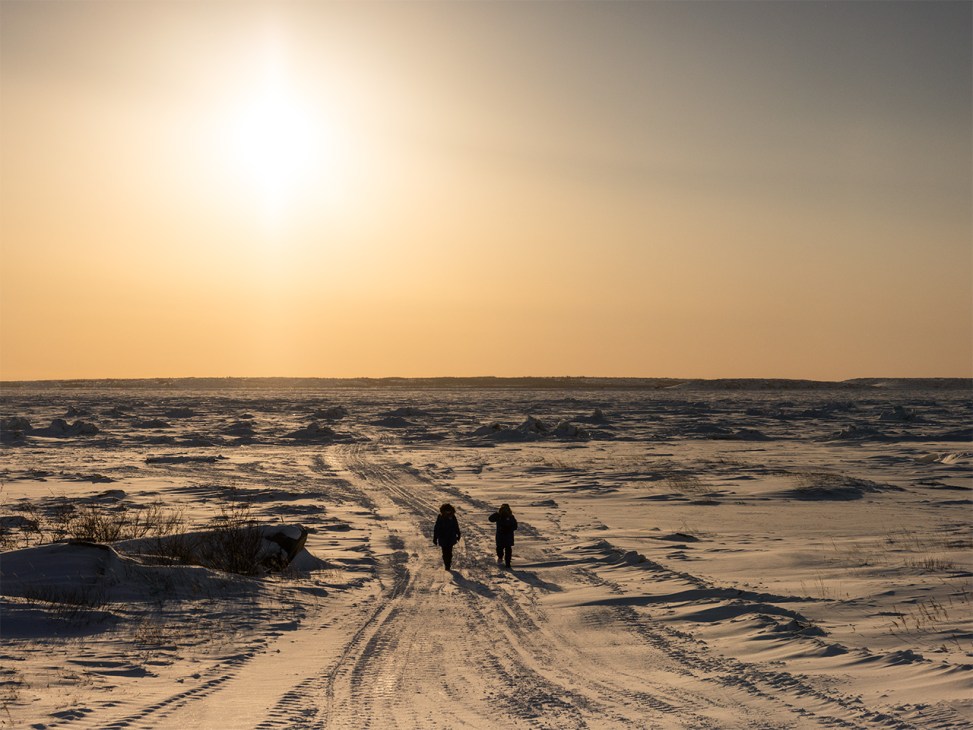
It feels like a miracle when we actually arrive in Churchill – though the train pulls in at 14.40, instead of the scheduled 09.00. By this point, we have been on board for 45 hours. A brilliant white light greets us: blinding sunshine bouncing off miles of sea ice and snow piled as high as buildings. The cold is difficult to describe. It slices and stabs all over your body at once. The shock of it drags you into the present. You are here. You are alive. So pay attention!


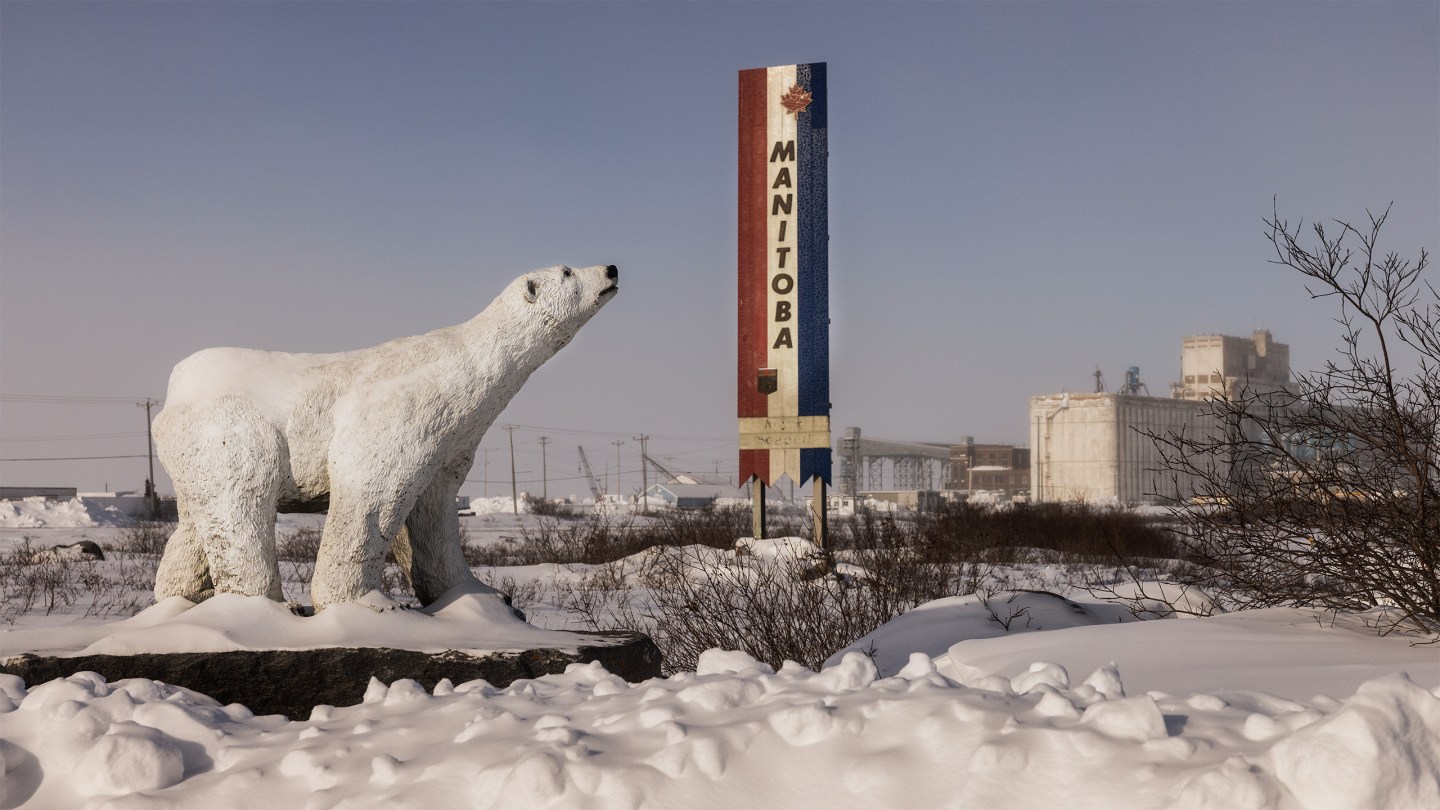
Thankfully, Discover Churchill vans are waiting with heat blasting inside. This is a frontier town, laid out in a grid, with low square blobs of buildings covered in snow. In the 1700s it was the Hudson Bay Company’s fur-trading post. It later evolved into a northern grain port after the railway arrived in 1929. During the Cold War, when the town was home to a military outpost, its resident population soared to 5,000 (today it’s 870). The port operated as a naval base until the 1960s, before reinventing itself as the polar-bear capital of the world. When we visit, the bears are everywhere – just not living specimens. We spot a stuffed one at the train station. Images of them are painted on garages and buildings, and shown on TV at bars and in hotel lobbies. On those screens, we watch them sparring or frolicking in a field of purple flowers; we see mother bears and baby bears being adorable.
In Churchill, you can only safely walk or ride your bike outside in winter, when the bears are away hunting seals. “People know to leave their cars unlocked,” says train attendant Judd. “That way, if you see a polar bear, you can jump in anyone’s car.” Our guide, Drew Hamilton, starts every tour with safety instructions. “Don’t go anywhere alone, ever. Stay away from the beach. No swimming. No jogging. Take this number for Polar Bear Alert: 204675BEAR. If you call, they’ll be there in two minutes. After 22.00, it’s four minutes.”
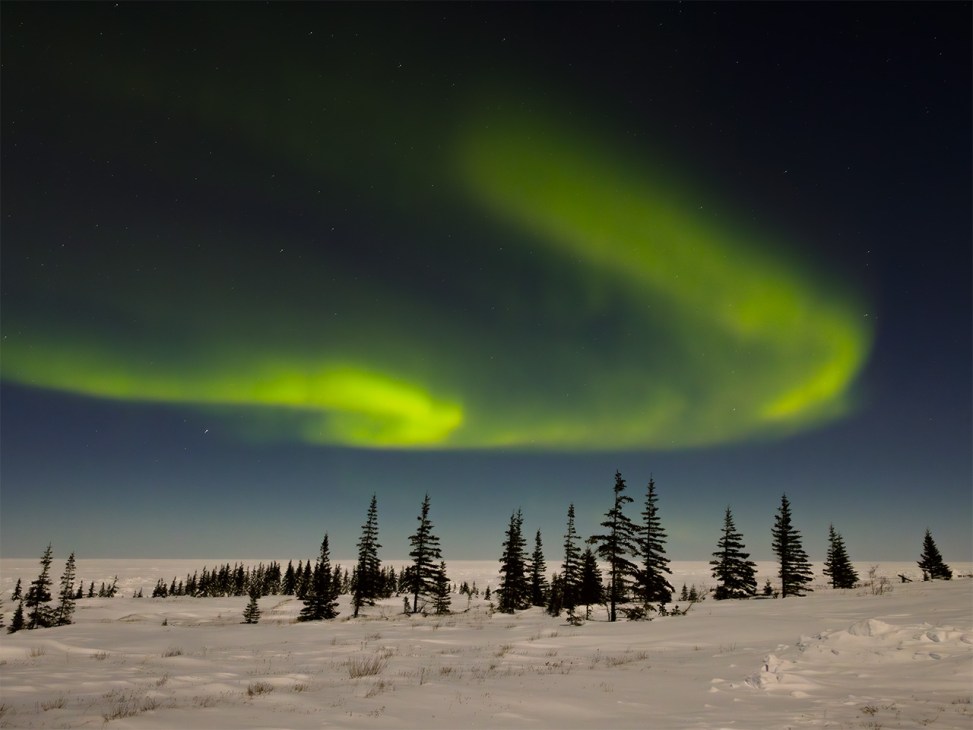
Hamilton drives us to all of the town’s notable sites, from the murals on brick buildings and the abandoned grain elevator that looms over Churchill like a ghost to the bear-holding facility. Then we head to the edge of Hudson Bay, where the sea has frozen in waves for as far as you can see. This wintry outpost is indeed stunning – and even more so from inside a warm van. But we all sacrifice our comfort to get out and have our pictures taken in front of the most popular tourist attraction here, the polar-bear crossing sign. Later that evening, we witness the northern lights: fluorescent green wisps dancing against a black sky amid twinkling stars. While we jump up and down in the crunching snow to keep warm, the air tastes so clean that we gulp it in, even though it’s so frigid that it hurts to breathe.
Day two
Churchill, minus 34.5C
“This is cold even for us,” says Christine Lee, the manager of the Blueberry Inn. We layer up for a two-minute walk across the street to speak to Brooke Biddlecombe at the Churchill HQ of conservation organisation Polar Bears International, where she is a research fellow and polar-bear ecologist working for the University of Alberta. She is investigating the co-existence of tourism and bears in the Churchill area, studying how the animals react depending on the distance of tourist vehicles. “There is no textbook for living with polar bears,” she says. “If I’m walking around town, I always have a bear flare with me. It’s like a firework – a good deterrent. And don’t ever run. They have caught people. Maulings are rare but they do happen.”
Churchill has an impressive alert system. Repeat offenders – bears that keep looking for food in town – get sent to the holding facility, or “bear jail”, in a former aeroplane hangar that can hold as many as 20 animals. “When they’re inside, they can have water but no food,” says Biddlecombe. “It’s designed to be a negative experience and is remarkably effective. They’re kept for two weeks or more and then relocated by helicopter and marked with green paint so we can track them in case they return.”
“I had no interest in working in the Arctic,” says Biddlecombe. “But I fell in love with it. Every organism fights to exist here. The trees that you see fight hard to survive and you respect them. Many things feel remarkable to witness. Polar bears aren’t friendly. All of the bears that I have met have been immobilised. We find bears by helicopter, immobilise them, collect samples and measurements, and fit them with satellite collars that they wear for two years. Their heads have very soft fur but the rest is coarse and translucent. Males fight a lot. During mating season, weaker males give up and can die. Adult males eat cubs.”
If Biddlecombe is working to protect bear habitats as tourism grows, what will happen when this boom-and-bust town starts to boom again? We meet Chris Avery, the president and CEO of the Arctic Gateway Group, which was formed after the train tracks were washed away by the 2017 floods and Omnitrax, the rail operator at the time, refused to repair them. For 18 months, there was no train. No road connects Churchill to the rest of Manitoba. Fuel, food and other supplies had to be flown or shipped in. Prices skyrocketed. In response, 29 First Nations and 12 northern communities launched the Arctic Gateway Group in 2018 and convinced the federal government to buy back the rail and port. “Think of us like a start-up with a 100-year-old port,” says Avery. “This is Canada’s only Arctic deep-sea port that’s serviced by rail. It already exists. Now, Churchill is strategically more important to drive trade to Europe. The port supports our sovereignty in the north [from US tariffs] and lets us build a legacy. And the town wants stable year-round employment. Tourism alone will not provide the same generational opportunity.”


There are hard limits to attracting visitors. As we found out while getting here, even rail travel can be a gamble. “We don’t use the train for our tours,” says Alex de Vries, the co-owner of Discover Churchill. “Flights are more reliable but expensive. We do 275 package tours a year but could do more. From the summer to autumn, the population swells to 1,500.” According to the Arctic Gateway Group, the next phase for the town will be “led by stewardship”. The port project has the support of Canada’s prime minister, Mark Carney, its minister of energy and natural resources, Tim Hodgson, and the premier of Manitoba, Wab Kinew – but everyone in Churchill knows the cost of national ambition. Dave Daley, who runs tour company Wapusk Adventures, sits on the board that oversees the Arctic Gateway Project. “We have to weigh any economic benefits with the environmental damage,” he says. “The last time southern Canada got involved up here, 80 per cent of the Churchill River was diverted for hydroelectricity. We lost our river, our fish and our recreation.”
But Churchill is now positioned for growth, not as a military outpost or grain terminal but as an Arctic trade route owned by northern communities. Avery asks the same question that Biddlecombe is asking in the field: what will growth do to the animals that we love? In a place where everyone can tell you about the Arctic hare who lives in town, the future cannot be measured in terms of export tonnage and shipping lanes alone. The question isn’t whether Churchill can grow but whether it can do so without nature becoming an afterthought.


Hamilton takes us to the airport for our flight back to Winnipeg. It feels like a going-away party as almost everyone we have met over the past two days is here, picking up relatives, collecting deliveries or flying out themselves. One of our train companions, photographer Gustavson, was right: Churchill does change you. People here orient themselves by the animals, the weather, the light and the community. The cold doesn’t allow for pretence. It reminds me of the astronauts in Samantha Harvey’s book Orbital. “The Earth is the answer to every question,” she wrote. I didn’t meet a bear but I like to think that I’ll be back.