Though various countries stake claims to Antarctica, the continent remains beyond anyone’s grasp
On expedition to Antarctica, Monocle encounters an icy continent where the borders are anything but frozen.
Think you know what Argentina and Chile look like on a map? Think again. Official versions of the two nations’ maps include large swaths of Antarctica, parts of which overlap with each other. And it’s not just Buenos Aires and Santiago that claim parts of this glaciated continent that is populated with penguins, seals and the occasional boffin. The UK claims much of the same part of Antarctica as the two South American countries, while Australia, France, New Zealand and Norway claim other chunks.
The origins of territorial claims over the continent are the international-law equivalent of a curiosity shop. Argentina and Chile base theirs on a half-a-millennia-old papal bull and a treaty that divided the southern hemisphere into Spanish- and Portuguese-speaking domains. The British claim is based in part on the exploits of famous polar explorers such as Scott and Shackleton. Other countries’ claims derive from things such as the location of old whaling stations, or the control “asserted” by dropping weights with national flags out of planes. Their salience convinces few experts. “No existing claim to sovereignty appears to be definitely well founded under international law,” says Patrizia Vigni, an associate professor of international law at the University of Siena.
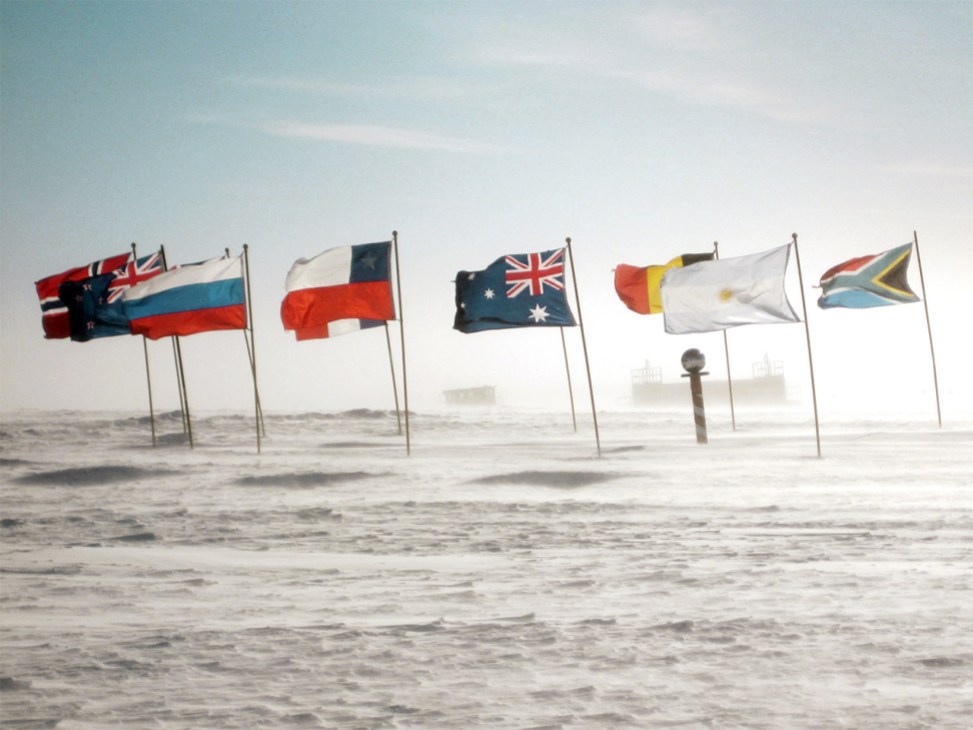
No country owns Antarctica. The 1959 Antarctic Treaty froze any territorial claims while designating the continent as a demilitarised zone to be used only for scientific purposes. Some 30 countries have research stations there, over which they fly ostentatiously large flags. While the treaty is lauded as an example of international law in practice, it does not stop countries from engaging in all sorts of sideline gambits. The tussle over Greenland, the warming of the oceans and the promise of minerals under the ice have focused newfound attention on who could control Antarctica in the future. Exploitation of the continent’s mineral resources is prohibited, though this might be on the table when the environmental provisions of the treaty open up for revision in 2048.
Nomenclature is one strategy that countries use to assert that claimed territories are extensions of the national soul. When Monocle travels by boat from Argentina to Antarctica, it’s diplomatically safer to call the forefinger of land that extends up to South America “the peninsula”, rather than have to choose from the buffet of Argentinian, Chilean and British names (Tierra de San Martin, O’Higgins Land or Graham Land). Americans call part of the same trackless spit the Palmer Peninsula.
Other tactics hark back to the heroic age of Arctic exploration. Argentina, Chile and the UK issue polar-themed stamps sold in Antarctic post offices, dependable tourist stops on the cruise-ship itinerary. The apotheosis of all this shadow competition is King George Island in the South Shetland Islands, site of the continent’s only commercial airport. The one thing identifiably British about King George is the name; the muddy island is a bizarre fusion of cruise-ship tourists and staff, day trippers, Chilean construction workers and bank tellers, as well as scientists from Brazil, China, Chile, Poland, Russia, South Korea and Uruguay bundled in all-weather coats, national flags prominent on their shoulders. The island offers a choice of places to worship. There is a Catholic chapel at the Chilean settlement and an Orthodox church at the Russian base, two of eight religious buildings on the continent. Custom mileposts written in Spanish and Cyrillic indicate how far the bases are from various world capitals.
King George Island offers a global choice of lightning-fast mobile internet. As Monocle clambers out of the boat to get our flight, we receive welcome text messages from networks in Chile and Uruguay. An American tourist showed us a stern message that he’d received about data use after finding himself roaming on a Russian phone network.
The Antarctic Airways flight from King George to Punta Arenas, Chile, takes two hours. When Monocle arrives we’re escorted as part of a small group to border control. Upon asking an official why the others had not been so treated, we’re told that there is no need: King George Island is Chilean territory and so they have effectively taken a domestic flight. It just goes to show that while the 1959 treaty bars countries from making new territorial claims, this does not stop some from having speculative punts at claiming a slice of Antarctica. The latest to do so? Iran in 2024.
Gordon Peake is a writer and Monocle contributor. For more opinion, analysis and insight, subscribe to Monocle today.