Trump’s disdain for Nato is nothing new – for Europe to assume otherwise is to live in denial
Donald Trump has destroyed the world order and left Europe to fight for itself in the process. How many more red flags does the continent need?
On 2 September 1987, readers of The Washington Post, The New York Times and The Boston Globe beheld a full-page advertisement placed by property developer and celebrity blowhard Donald Trump. The ad took the form of an open letter, headlined “There’s nothing wrong with America’s Foreign Defense Policy that a little backbone can’t cure.” Then, as now, Trump was somewhat capricious with his capitalisations.
The text, loftily addressed “To the American People”, was a fanfare of a theme that has become familiar: that the US spends fortunes to protect idle, ungrateful allies. Amusingly in the current context, Trump was particularly vexed by US policy in the Persian Gulf, “an area of only marginal significance to the United States”. But his resentment was broad. “Why,” he demanded, “are these nations not paying the United States for the human lives and billions of dollars we are losing to protect their interests?” The world, he feared, was “laughing at America’s politicians.” Imagine that.
The letter did not mention Nato specifically, though at that point Trump might not have heard of it: he had not previously expressed any great interest in foreign policy and had certainly never seemed the type to think it worth spending $94,801 (about $273,000 today) to address the nation on the subject. But he had clearly come to believe that the US should detach itself from the alliances that it had built during the Cold War. Coincidentally, Trump had only recently returned from his first visit to Moscow.
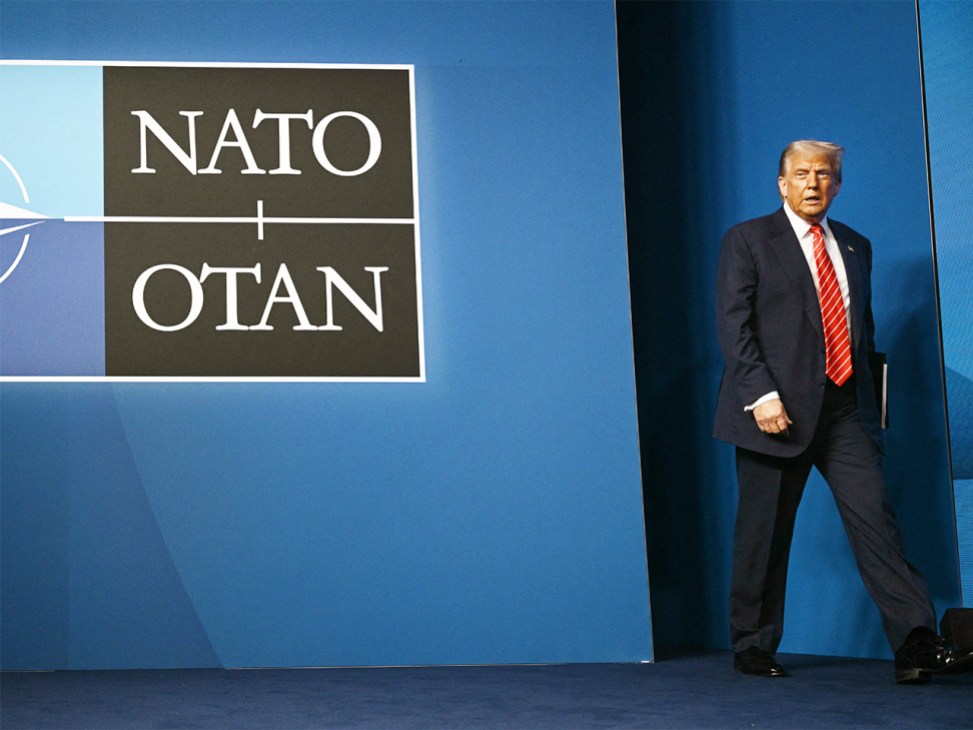
Since Trump emerged as a potential, then actual, presidential candidate, disdain for Nato has been a recurrent motif. This has built to an especially petulant pitch in recent weeks as the other members of the alliance ignored Trump’s commands to participate in whatever the US believes itself to be doing in Iran. Earlier this week, the president sneered at Nato as “a paper tiger” and whined again that he was denied the prize of Greenland. He now knows that the Danish and other European troops deployed to Greenland after he threatened to seize it were under orders to resist any American invasion. It seems not to have occurred to Trump that when you threaten your allies, compel them to scramble soldiers to defend their territory from you, then deride their contributions to your country’s previous wars, they might be less inclined to turn up for your next one.
It’s not as easy for Trump to withdraw the US from Nato as he might prefer. In 2023, in anticipation of a possible Trump restoration, then-president Joe Biden signed into law a measure that prevents his successors from pulling the US out of Nato without the agreement of two thirds of the US Senate: one of the bill’s co-sponsors, incidentally, was then-senator Marco Rubio, now Trump’s secretary of state. But as everyone well understands, all that really matters is whether the US would react in the event of Article V-level crisis – a Russian lunge for the Suwalki Gap, little green men in Narva. As long as Trump is president, that decision is his – and nobody, friend or foe, has the least idea what the US would actually do.
This is usefully discombobulating to Nato’s antagonists. And this is no way for Nato’s members to live: more than one current European office-holder has muttered to me words to the effect that you cannot defend a continent continually adjusting for the possibility that American voters might elect to Earth’s most powerful office someone untethered to convention and unmoored from reality.
The one thing that Trump has been right about is that Europe has, since the Second World War, taken a decades-long nap beneath a stars-and-stripes-spangled umbrella. Europe can – and should – hope that the transatlantic alliance will hold but the continent absolutely has to act on the assumption that it won’t.
Europeans have had 40 years of warnings of what Donald Trump thinks of them. And they should know better than most that nothing lasts forever: among the European countries now members of Nato and/or the EU, it is difficult to find a pair who haven’t fought each other at some point. But despite facing an uncertain future they have the advantage that, at least for the moment, they’re all on the same side.
Andrew Mueller is the host of Monocle Radio’s global-affairs show ‘The Foreign Desk’. For more opinion, analysis and insight, subscribe to Monocle today.