Irish neutrality is a weak spot for Europe that Putin could use to his advantage
It’s possible that Europe narrowly missed its 21st-century Archduke Franz Ferdinand moment last week. As Ukraine’s official Airbus ACJ319 approached Dublin Airport, the crew aboard the Irish Naval Service craft LÉ William Butler Yeats spotted several drones aloft in the no-fly zone protecting president Volodymyr Zelensky’s flight path. It is unclear as of this writing who launched the drones or from where or what their intentions were. However, Zelensky’s aircraft arrived earlier than scheduled, possibly forestalling any further mischief.
Interference with Zelensky’s jet would obviously have been serious but the location might have made it more so – indeed, the location might have encouraged it. The Republic of Ireland, though a member of the EU, is not a member of Nato and therefore not protected by Article 5 of the Nato treaty, making it an obvious vulnerability for any adversary of Europe and/or the wider Western alliance to test – not least because it is barely defended at all.
Ireland’s reluctance to apply for Nato membership is borne of a long tradition of neutrality. Ireland sat out the Second World War, though many Irish people did not: at least 80,000 joined the British military to do what Ireland’s government would not. Ireland has also been reluctant to enter into any formal military alliance with the UK – historically regarded as a colonial overlord.
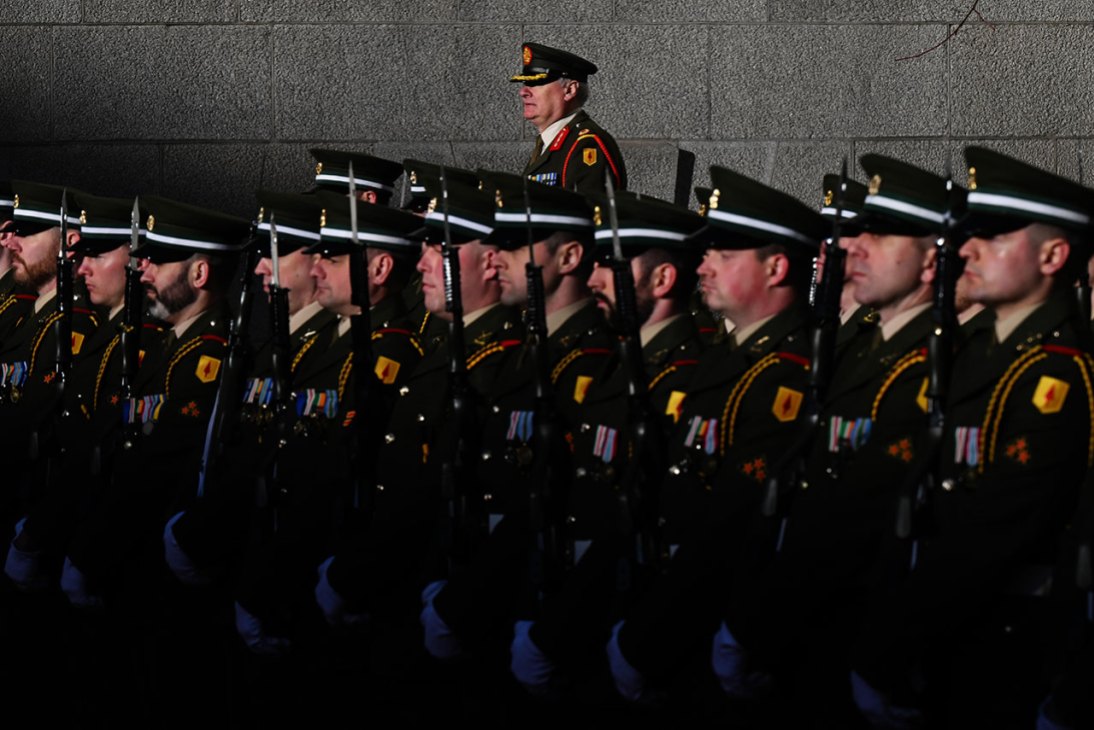
The ridiculous irony into which Ireland has painted itself is that it is now almost entirely reliant for protection from external threats on the UK’s Royal Navy and Royal Air Force. Ireland’s own military is pitiful. It has an army of perhaps 6,000 full-time troops. Its air-combat capacity amounts to eight Pilatus PC-9M trainers, which have propellers on the front. It has no military radar system. Both these derelictions are allegedly being addressed but the fact that they need to be addressed reflects decades of astonishing complacency.
Ireland’s navy has not much improved since The Dubliners mocked it in song in 1968 (“When the captain he blows on his whistle/All the sailors go home for their tea” etc). It is certainly woefully under-equipped for a country that presides over a maritime exclusive economic zone nearly 10 times Ireland’s size, through which pass about 75 per cent of all the northern hemisphere’s data cables. LÉ William Butler Yeats is one of only four offshore patrol vessels, all quaintly named after famous Irish writers (we can assume that the crew of LÉ James Joyce has heard all the jokes about interminable and convoluted journeys that everybody only pretends to understand).
Ireland has a population roughly the same size as that of Norway or Finland and a GDP bigger than either. Granted, Norway and Finland both have land borders with Russia but the differences in how seriously Ireland takes its – and Europe’s – defence are stark. Earlier this year, Norway took delivery of the final pair of its order of 52 F-35 fighter jets, while Lockheed Martin finished work on the first of 64 F-35s for Finland. Not counting upgrades or ongoing operational expenses, each of those aircraft cost about €160m.
Ireland recently announced a 2026 defence budget – army, navy and air force – of €1.49bn, or equivalent to about nine F-35s, and grandly proclaimed this as a record. It is nowhere near enough to pay for an answer to the question: if you were Vladimir Putin, which weak spot would you poke?
Andrew Mueller is the host of ‘The Foreign Desk’ on Monocle Radio and a regular Monocle contributor. For more opinion, analysis and insight, subscribe to Monocle today.