Amid sanctions, strikes and economic stagnation, life goes on in Russia’s resort city of Sochi
The once glamorous Russian Riviera is looking worse for wear. But as the country contends with a faltering economy and drone attacks in its war with Ukraine, many Russians are carrying on.
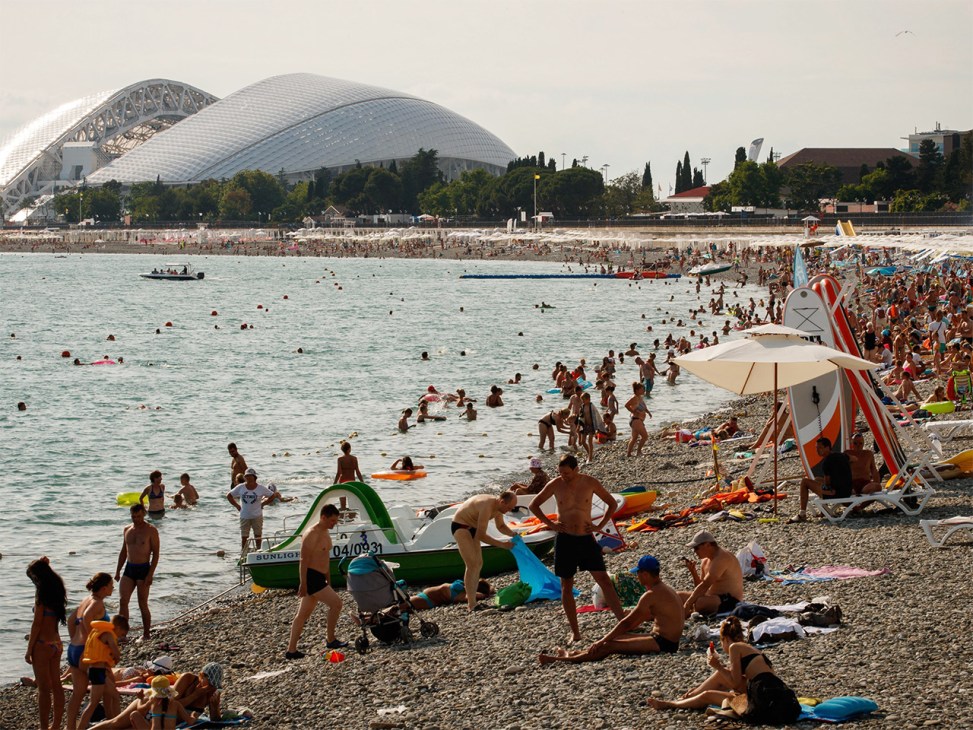
Tourists in Sochi tend to ignore the air-raid sirens after the third time that they hear them. The Russian resort’s beaches are usually more crowded at this time of year. But even as temperatures have risen and thunderstorms cleared, this subtropical corner of the Black Sea has experienced a lacklustre start to the high season. Tour operators complain that intensifying Ukrainian drone attacks and the attendant shutdowns of the city’s airport have reduced domestic demand by as much as 30 per cent year on year. Piles of unused sunloungers are scattered across the city’s stony beaches and the wide, 7km-long seaside promenade is eerily quiet.
“It’s like we’re living in Israel, minus the health care,” says Valeria, a lifestyle journalist who lives in central Sochi with her husband and one-year-old son. When the half-deserted beaches are evacuated, holiday-goers crowd together on the promenade. Those who have made it here won’t let the war ruin their holiday. Inflation isn’t helping Sochi to fill its beaches either, as the Russian economy nears recession and wages stagnate.
A night in a standard sea-view room at the Swissôtel Resort will cost RUB22,300 (€260), though the city is awash with far cheaper and bleaker lodging options. Before the war, it was sometimes cheaper for Russians to go on all-inclusive trips to Antalya or Sharm-el-Sheikh – and it definitely is now. Still, back then, Sochi maintained its status as the country’s premier summer resort, a place for the great and the good to be seen, if just for one weekend in July. Its climate, its mountains and the infrastructure left behind after the 2014 Winter Olympics all contributed to the resort attracting as many as eight million visitors a year. This year, however, only around two and a half million have come, with many wealthier visitors staying away. Non-EU Balkan states and China have become the premier spots for Russians who are not welcome elsewhere.
The war in Ukraine, which is approaching its fifth year, has also hit Sochi’s rival Black Sea destinations Anapa and Tuapse. Before 2022, these were among the more affordable options for domestic travellers; some were drawn to the former’s unique wine treatments, known as oenotherapy. Visitors today will definitely need some self-administered wine therapy to brave the bridge that connects Crimea, another popular pre-2022 holiday destination, to the Russian mainland. Like many Black Sea oil refineries, ports and tankers, the bridge has been struck twice by Ukrainian drones since the full-scale invasion. Because of the dangers that fuel trucks face when using the road, there is now a severe shortage in Crimea. Some hotels have even tried to lure tourists back with the promise of free petrol.
War’s shadow looms over Sochi. But as with elsewhere in Russia, most people have buried their heads firmly in the sand – which is easy to do here, given the beaches and the bars. New cafés and restaurants continue to open in this hilly, chaotic town. Porto-Franco promises a patriotic Russian take on Ukrainian-Jewish cuisine; Brot! crafts sandwiches; Lino Caffetteria offers all-day breakfasts. A museum with a 500 sq m diorama depicting the entirety of human history has just opened on Chernomorskaya Street in one of the city’s oldest districts. As in other cities, Backrooms and Obsession, two much-hyped indie-horror movies, have just hit the local cinemas. Despite sanctions and major Hollywood studios’ boycott of Russia, foreign films are still screened – sometimes as pirated copies with the state’s blessing; at others, because local distributors have managed to buy the rights directly.
In the mountains that surround the city sits Krasnaya Polyana, a chain of high-end Olympic villages and ski resorts. Up here, the sirens are a reassuringly distant wail. Locals sometimes call this stretch the “Moscow ghetto” because of the number of wealthy Muscovites who come here for spa treatments and esoteric pseudo-spiritual practices such as tarot reading. Sveta, a massage therapist who specialises in using leeches, says that she has never seen a quieter season than this one. “Getting here is harder, planes are cancelled and some are afraid,” she says. “But actually everything is quite peaceful.” Still, as soon as Sveta has time off, she hotfoots it to the much cheaper (and safer) Republic of Abkhazia, a Russian-backed breakaway region of Georgia only a few hours’ drive away.
Among the Russians holidaying in Krasnaya Polyana this summer is Alexander, one of thousands of convicted murderers pardoned by Vladimir Putin after fighting in Ukraine. He now recruits mercenaries from around the world to fight in the Russian army. Alexander and his girlfriend, an exotic dancer, spent their weekend eating, hiking and visiting a llama farm. “It was quite soothing,” he says. Even though the Telegram app is now banned in Russia, it remains the main messenger and information hub thanks to VPNs, with local group chats buzzing with mundane enquiries. People are looking for ballet and yoga coaches, tennis buddies and nail artists, and sharing videos of bears wandering into villages. Every so often, someone will ask whether it’s safe to travel to Sochi. Another will point out that many of the country’s top officials own properties in the area, including Putin, so there’s nothing to worry about. But Russia’s president hasn’t been seen in Sochi since 2024. These days, he spends his downtime in a bunker.