Sweden’s first psychological defence strategy readies citizens for the worst
The first-ever national strategy of its kind makes a bid to strengthen resilience against foreign interference and disinformation.
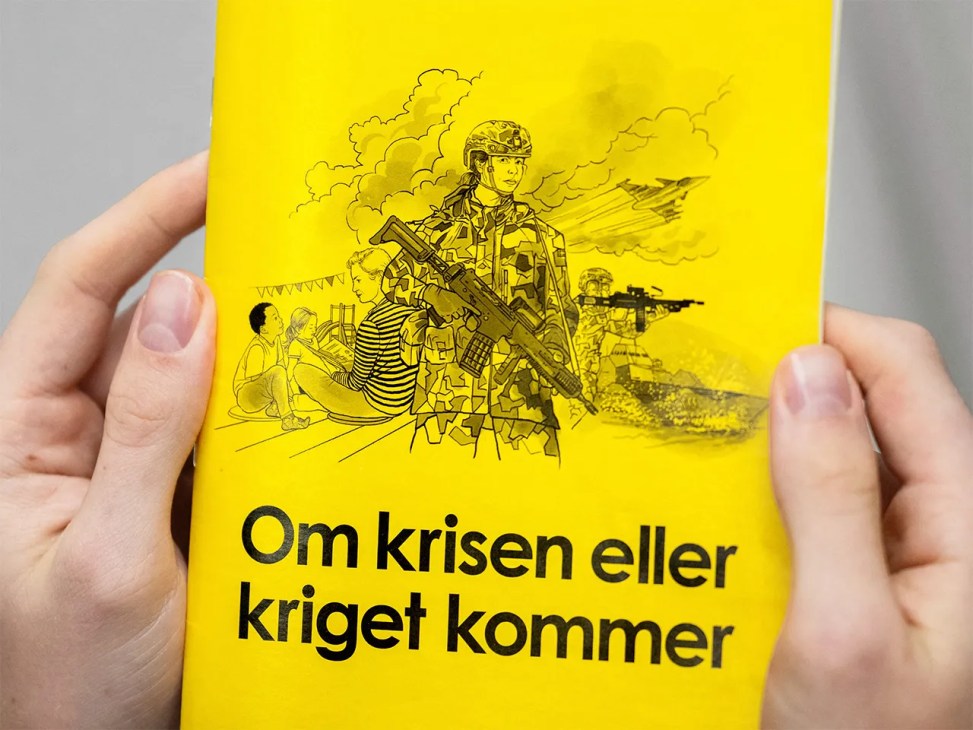
In October 2024 every Swedish household – more than five million – was sent a bracing pamphlet entitled “In Case Of Crisis Or War”. Prepared by the Swedish Civil Contingencies Agency, it offered counsel on household preparedness – which foods to stash, how much water to store – and how to respond if the balloon, of one sort or another, went up.
It wasn’t the first time that Sweden’s government published such a thing – the tradition dates back to 1943, as the country sat out the war then consuming the rest of Europe. But the latest edition acknowledges lessons learned from the coronavirus pandemic and the fact that Sweden is no longer a neutral country but instead a member of Nato committed by treaty to the defence of 31 other countries. The most sobering injunction reads “If Sweden is attacked, we will never surrender. Any suggestion to the contrary is false.”
Sweden has taken another step towards making flesh this spirit of resilience with the announcement of its first national strategy for psychological defence. Launching the strategy, Sweden’s minister of civil defence, Carl-Oskar Bohlin, spoke of a need to strengthen Sweden’s “resilience in the cognitive domain”. The country has grasped that there are – especially now – many more ways to threaten, unnerve or undermine a country than pointing missiles at its capital or arraying troops along its borders. The first of the four pillars of the new strategy for psychological defence is “work against undue influence of information”.
Sweden has – like pretty much every other western country, whether those countries understand it or believe it or not – been a regular target of Russian disinformation campaigns. This goes back years: from 2015 to 2016, state-owned Russian news outlet Sputnik operated a Swedish language service, in which, according to Sweden’s Institute of International Affairs, it published roughly 4,000 articles, many of them negative stories about the EU and/or Nato. Not coincidentally, in 2022, Sweden’s Ministry of Defence established a Psychological Defence Agency, tasked with resisting foreign-influence operations.
The Russian threat to Sweden has since grown somewhat more sophisticated and aggressive. In the past couple of years Russian hackers have targeted Swedish digital services and energy infrastructure but disinformation campaigns are ongoing. They’re cheap, easy, deniable – and, so long as people remain eager to consume whatever nonsense reinforces their prejudices, effective. Earlier this year, Russian media floated the false and, you would hope, obviously absurd story that King Carl XVI Gustaf, having taken the trouble to visit Ukraine, refused to shake the hand of Volodymyr Zelensky in order to express some obscure grudge over the 1709 Battle of Poltava, in which the army of Carl XVI Gustaf’s predecessor Charles XII got clobbered by the legions of Peter the Great. The director-general of the Psychological Defence Agency, Magnus Hjort, responded with admirable clarity: “Absolutely nobody cares about this in Sweden.”
The national strategy for psychological defence is part of a minor blizzard of related initiatives from Sweden in recent weeks. Stockholm has also announced the creation of a new foreign-intelligence service to be known as the UND, its first national strategy for ensuring security of supply, and its intention to increase access to civilian shooting ranges. The Nordic nation’s European neighbours and allies might chafe at any suggestion that they take lessons in this sort of stuff from a country that hasn’t fought a war since a minor scuffle with Norway in 1814 but they – we – should. Sweden is taking seriously one of the most basic principles of resilience, military and otherwise: better to have it and not need it, than need it and not have it.
Andrew Mueller is a regular Monocle contributor and host of ‘The Foreign Desk’ on Monocle Radio. For more opinion, analysis and insight, subscribe today.