How to age in a dignified way: know your neighbours
Co-housing developer Town hopes that building intergenerational communities will help people to live better. We spoke to founding director Jonny Anstead to learn about the company’s people-centric design and how it improves individual wellbeing.
Is there an antidote to loneliness in our cities? If you ask the Danes, the answer could be co-housing: a community‑led way of living that can improve quality of life while also making urban life more affordable. The concept places single-family homes around shared common areas, giving residents central places to gather, garden and play. With more opportunities to build neighbourly connections, co-housing has been shown to decrease feelings of loneliness in older residents, as well as help young families offset childcare.
Co-housing schemes have begun gaining traction in the UK, with 30-plus projects already established in the country and more than 60 currently in development. Development company Town is spearheading housing builds across the UK and currently has five communities in the works. Monocle spoke to Jonny Anstead, one of the business’s founding directors, about how Town works and how co-housing can improve the quality of life for people from all generations and walks of life.
This conversation has been edited for clarity and length. Listen to the full version of this interview on The Urbanist.
What is co-housing?
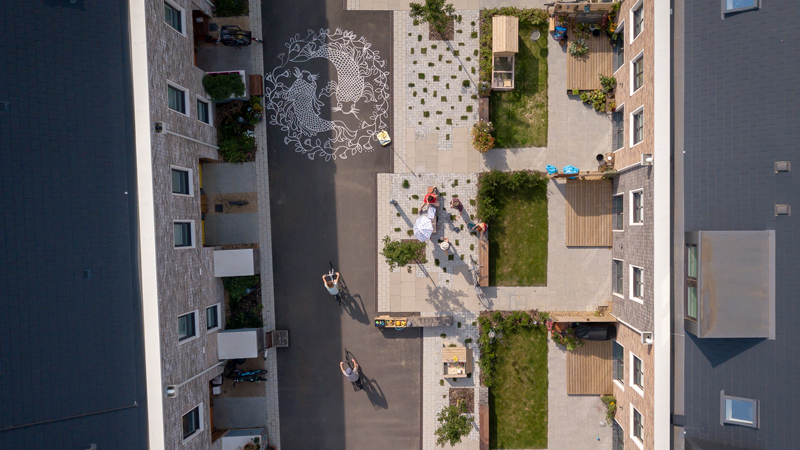
Co-housing is a very simple idea: it’s a community where you know your neighbours. It’s a bit like an old village, where you are familiar with the people living around you. You can rely on them to help you with problems that we all face in life. The basic idea being that people have their own home but, in addition, they have shared spaces, such as a common house where they can cook and eat together, as well as some shared outdoor areas for gardening, children’s play and other uses.
Is that different from what some people might describe as a co-operative?
The idea of [co-housing is around] co-operative behaviours, living among other people and drawing on one another for support. Co-operative [housing] can mean something a little more specific, in terms of the financial model of a community where things are owned jointly. In the case of co-housing, the usual model is that homes are owned privately but in addition to those private homes, there’s a level of community ownership of these shared spaces.
Let’s talk about Town, which you co-founded in 2014. Tell us about that journey and why you decided to set it up.
We set up Town because we saw shortcomings in the way that housing is planned, designed and built. There’s a mismatch between the quality of housing that is delivered in the UK and the way that people want to live. Housing reflects some of the problems that we have as a society: people are lonely and feel isolated. For children growing up in the kind of housing that we create, there’s a real shortcoming in their quality of life. Some 100 years ago, children had opportunities to play outside, to explore the world independently of their grown ups. These days, [it’s more likely] that they will be inside [looking at] screens and the outside world is something to be feared rather than explored. We saw an opportunity to create a form of housing that would [challenge] some of those ideas.
On ‘The Urbanist’ we talk a lot about the importance of people-centric design and designing places that are at scale – but that’s often difficult to deliver. You seem to have found a way to bring things down to a much more relatable sense of living, both socially and in the built environment.
[Our] model of co-housing is built around scale, which makes some of those things easier. Co-housing is typically between 20 and 45 homes. At that scale, you can achieve a lot of things but first and foremost you can know your neighbours. The modern co-housing movement, which originated in Denmark, talks about social maths of design – the idea being that at these scales, you can share spaces, assets and resources because you have that familiarity with the people around you.
Let’s now dive into some of the projects of these co-housing communities that you have worked on. What are some that come to mind and what do you particularly like about each of them?
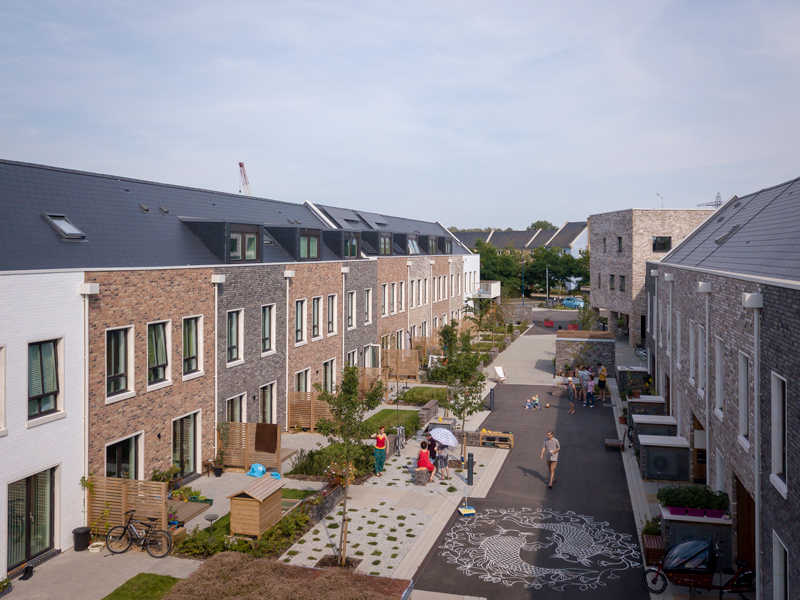
There is one completed scheme that Town delivered directly. [It’s] called Marmalade Lane and it’s a 42-home project in Orchard Park near Cambridge that was completed in 2020. It is made up of about 100 people. It’s an intergenerational co-housing community that has a diverse mix of individuals, from people who live on their own to families with young children and so on. Residents can actually benefit from having different kinds of people around them. For instance, at Marmalade Lane, adults who have little ones report that it’s nice having other adults around who can take on some of the burdens of childcare.
You mentioned that this is an intergenerational community. Tell us more about how helping older people feel like they’re part of a community enhances their quality of life.
We’re all living longer. We’re all ageing. The question of how we grow older in a way that is dignified, while maintaining quality of life and addressing the risks of isolation, which become greater as you grow older, is critical. [This is] not just within co-housing but as a society. Co-housing is a valuable model because it means that as you become older and as your needs change, you have people around you who can address some of your day-to-day needs. They’re not carers in an official sense but what they will be able to do is look out for each other. If someone is unwell, [the community] will be able to support them. They can spot if somebody hasn’t been around very much and address isolation before it becomes a real issue.
How involved are the residents in planning their own community?
A lot of co-housing communities have come from people getting together, looking for a site and working together on bringing [the community] forward. Our model consists of a few different ways of doing it. In some cases, we work with groups that already exist [and] we act as a developer. We help them plan their community. We appoint a design team and we have design sessions [where we collaborate with the future residents]. We collectively set the brief and then set the design for the community.
Listen to the full version of this interview on The Urbanist.