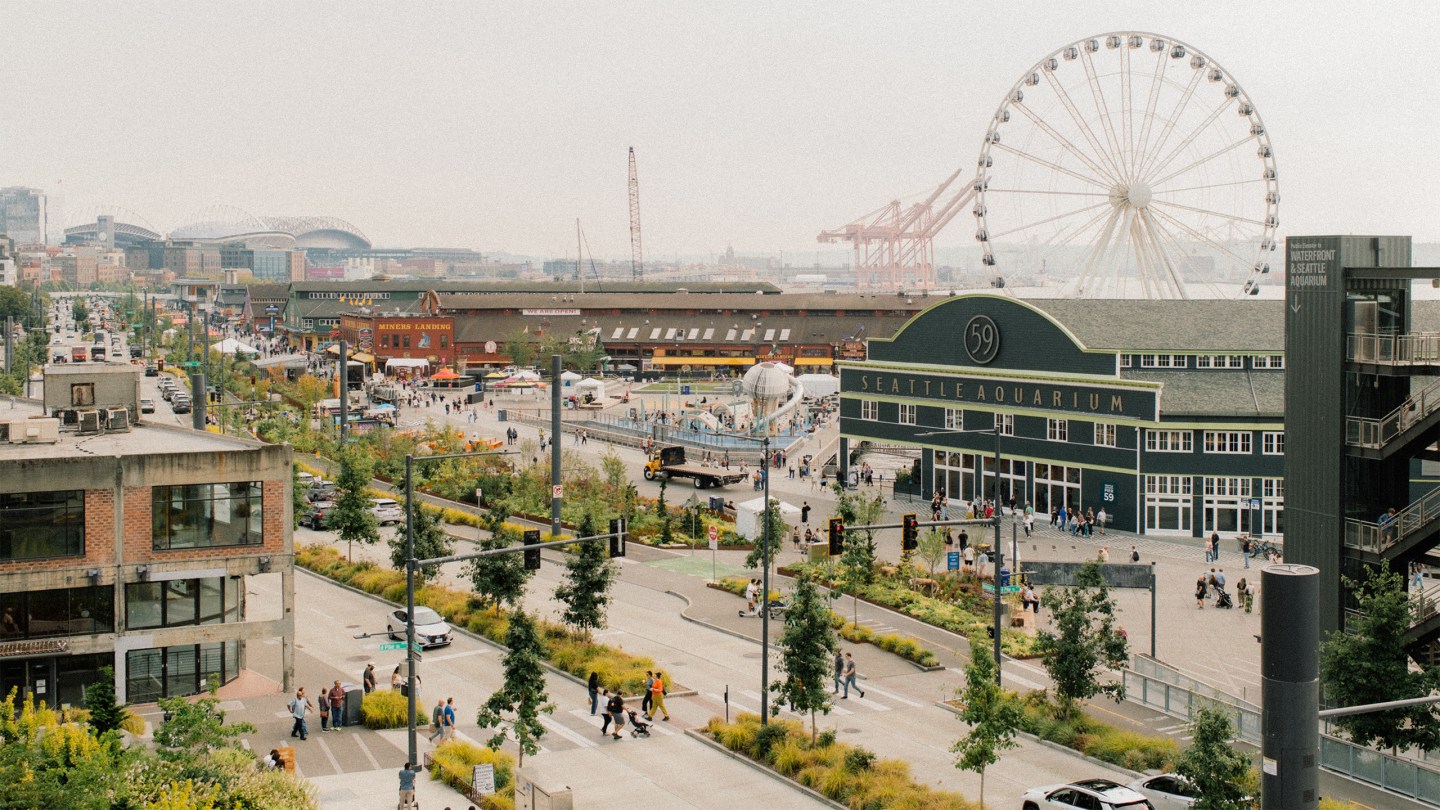
Seattle’s Waterfront Park shows why replacing highways with public parks is urbanism at its best
Seattle’s ailing downtown has been renovated by reconnecting residents to a long-ignored waterfront, transforming what was once an elevated highway, damaged by an earthquake, into a park replete with seating, play areas and viewpoints.
Seattle Waterfront Park by Field Operations
Monocle Design Awards 2026: Best in urbanism, USA
The tidal waters of Puget Sound churn a blend of Pacific Ocean and glacier-fed rivers. The result is an estuary that teems with life, from Chinook salmon to Orca whales. But for decades, Seattle – the urban core of the Puget Sound region – was cut off from this briny admixture by the Alaskan Way Viaduct elevated highway, which blocked downtown from the water’s edge.
It took a magnitude 6.8 earthquake in 2001 to inflict a fatal blow to the concrete behemoth and another two decades of political wrangling to determine the waterfront’s fate. Today the dust has settled – the elevated highway has come down and an eight-hectare park has arisen in its place, designed by New York-based Field Operations. Monocle meets the firm’s founding partner and CEO, James Corner, atop the site’s signature feature: the Overlook Walk, a collaboration with LMN Architects. The award-winning landscape architect meanders inconspicuously amidst the tourists and locals taking in the panorama. People crowd the Salish Steps, a cascading set of stairs with a view of the downtown skyline. “It was always our intention to splice nature with the city – a merger of Seattle urbanism with Puget Sound naturalism,” he says.
The result is a testament to the power of design in shaping a city’s fortune. The park is an instant classic that has reinvigorated an ailing West Coast downtown and a proving ground for ecological recovery in an urban industrial setting. As pedestrians wander down boardwalks, Corner muses on the project’s early days. At preliminary meetings, citizens spoke up in favour of keeping the highway or against building a park. “There was a lot of resistance because of a lack of confidence that Seattle knows how to manage public spaces,” he says. A seasoned professional, Corner was unfazed. In 2012 the Field Operations team rolled out a series of renderings that slowly won over sceptics with a vision of piers, play areas, tree-lined cycling paths and places to access the water.


The plan proved to be the ace in the hole for local officials, as they built public support for a new tax and sought philanthropic donations to fund the $806m (€687m) undertaking that spanned seven mayors. “They just had an amazing sales pitch,” says Angela Brady, director of the city’s Office of the Waterfront, Civic Projects & Sound Transit, who moved her team from a municipal tower to the water’s edge to work more seamlessly with Field Operations. “We’ve built exactly the vision that they put together,” she says, though Corner notes a few omissions, such as a proposed mist cloud in lieu of the jellyfish-themed playground, a floating pool barge and a rooftop space atop the ferry terminal, which were axed for budgetary or other considerations.
The park covers 26 city blocks along 2.4km of prime waterfront. Ferries, water taxis and tour boats dock on the piers, while terminals for cargo vessels and cruise ships bookend the park. With the natural deepwater harbour of Elliott Bay, Seattle is very much a working waterfront, a feature Field Operations did not want to hide. That attitude comes across in the material choices, such as the exposed aggregate used for the promenade that forms the central pedestrian artery. “Let’s not create overly stylised, fussy or effete pavement,” says Corner. “Let’s do something that reflects tough, gritty Seattle – its working, pragmatic character.”
And yet, ecological considerations inadvertently created a distinctive look underfoot. The project’s high price tag includes massive underwater engineering work to rebuild the crumbling Elliott Bay seawall that shores up landfill (significant portions of downtown Seattle is built upon filled tidal flats). Field Operations designed the panels with ribbed walls and shelves to mimic natural habitat. The end result is a bustling ecosystem of algae, barnacles, mussels and kelp that attract migrating salmon. Key to the success is a diagonal pattern of purplish glass panes embedded in the promenade, set at the right orientation to maximise sunlight capture.
Clever angles benefit humans as well as fish. Field Operations positioned street furniture – from wooden benches hewn from massive timber beams, a nod to the port’s history, to new porch swings – to face the view of Elliott Bay rather than align with the north-south orientation of the adjacent roadway. “When the viaduct was here, the city was cut off from this massive asset,” says Corner. “They knew the bay was there but they didn’t pay any attention to it as a thing of incredible scenic beauty.”
fieldoperations.net