Nine highlights from Salone del Mobile 2026 and the rest of Milan Design Week
This year’s Milan Design Week was buzzing with optimism despite the challenges facing the sector. We toured the city’s halls and stalls to glean the insights on the opportunities in the industry today.
The annual Milan Design Week is the industry’s most significant event and the Salone del Mobile trade fair – its main attraction – draws more than 300,000 attendees to the Lombard capital. In 2025 the fair and activities connected to it generated €278m.
This year, alongside displays of design excellence by automotive brands, fashion labels and cultural institutions, fresh products were launched and ideas for future designs presented in the city’s showrooms, galleries and houses. We report from the city and fair, and present the perspectives of curators, furniture CEOs, architects and designers on everything from the importance of the home to the power of industry.
Material Value
6:AM Glassworks
Milan
The homegrown design brand making a case for the versatility – and increasing relevance – of glass.


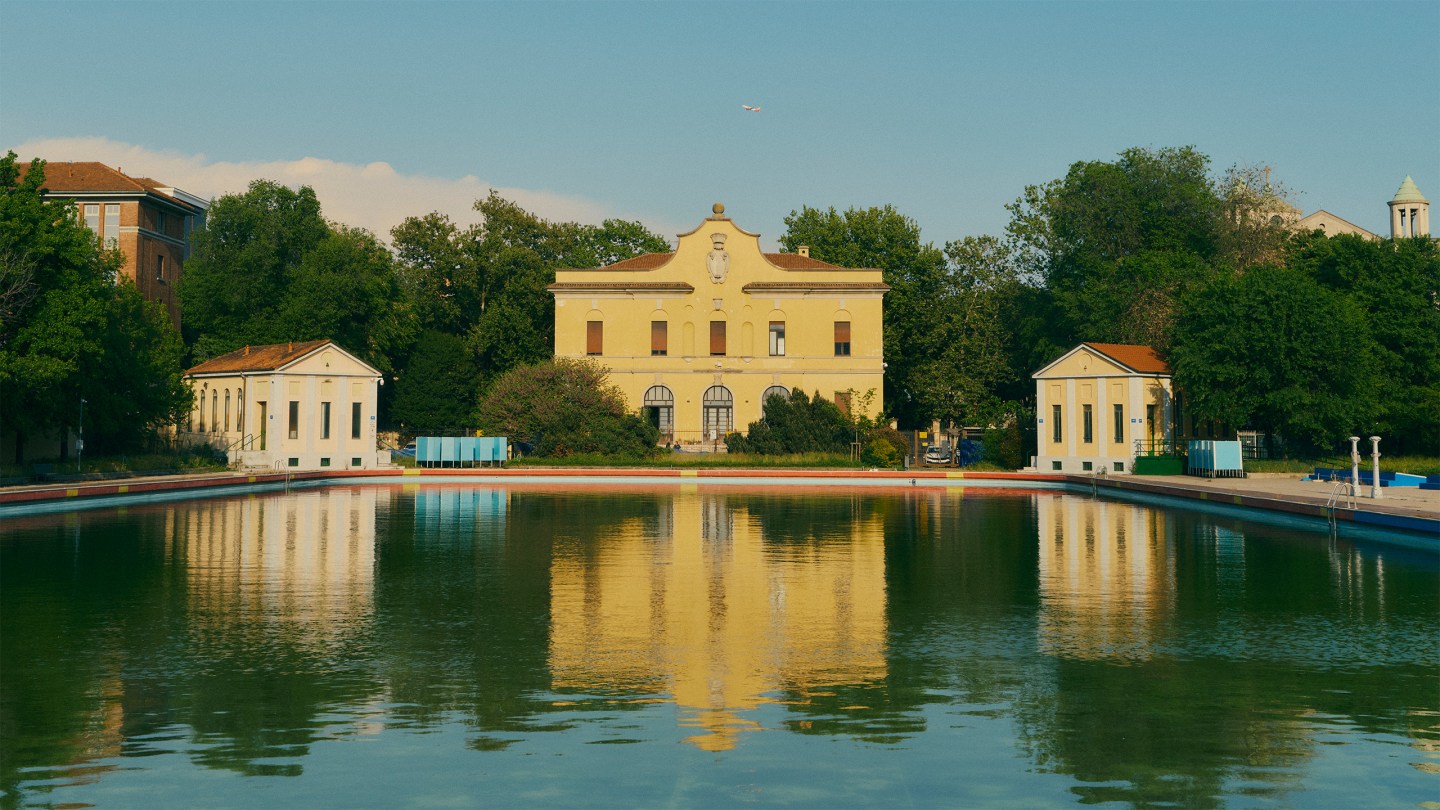
As people turn away from environmentally harmful materials such as plastic, there’s plenty of renewed interest in glass. This was clear at the Milan Design Week show from 6:AM Glassworks, held in the long-closed changing rooms of Piscina Romano swimming pool. “Glass was the only translucent material for interiors and lighting before plastic,” said Francesco Palù, who co-founded the brand with Edoardo Pandolfo in 2020. “People are looking for sustainable alternatives again.”
This year’s show – the studio’s second solo outing at Milan Design Week – featured its Murano-made pieces, including the new limited-edition Paysage and Lina lights, designed by Hannes Peer, and screen-printed additions to the Quadrato wall lights. Among the highlights were the Batch floor-to-ceiling blown-glass cubes, originally premiered at a Bottega Veneta runway show, and the clever recycling of cylindrical offcuts from a 6:AM Glassworks palo-santo burner into concrete panels. “Glass is already part of buildings,” said Palù. “Our goal is to bring a new language to it.”
6am.glass
Home Comforts
Casa Milana
Milan
Why a creative studio is showcasing its work in its founders’ home.


Husband-and-wife duo Mario Milana and Gabriella Campagna informally established creative studio Casa Milana when they lived in New York. The idea travelled with them when they moved to Milana’s home city, Milan, a few years ago. Today, Casa Milana is about transmitting ideas and values as much as furniture. The couple’s home – two knocked-through period apartments in the Brera neighbourhood – blurs the line between a residence and a design studio that shows Milana’s work.
“First, it’s our home,” Milana told Monocle when we visited. “It’s what we put out in the world. We try to push slow living and presence – and design is a medium for that.”
Dotted with Milana’s furniture and vintage pieces, the residence is impeccably appointed. It’s also a setting in which furniture is intended not only to be seen but to be touched and experienced. “Even when we lived in New York and only loosely called our home Casa Milana, we would invite people to sit on the furniture,” said Campagna.
We took a seat in front of Milana’s Void coffee-table system for Ranieri. Made with lava stone, it’s designed to change according to the user’s requirements – as is the Frequenza bookcase system, with its slidable, reconfigurable shelves. Elsewhere, a new collaboration with Beni Rugs gives additional warmth to the home.
Many pieces are reminders that our lives are constantly evolving and the contents of a well-designed home should accommodate this. Flexibility is a big part of our lives,” said Milana.
casamilana.it
Power of nostalgia
B&B Italia
Como
The executive chairman of the Italian design giant is confident that furniture’s emotional resonance will help the sector weather the geopolitical storm.
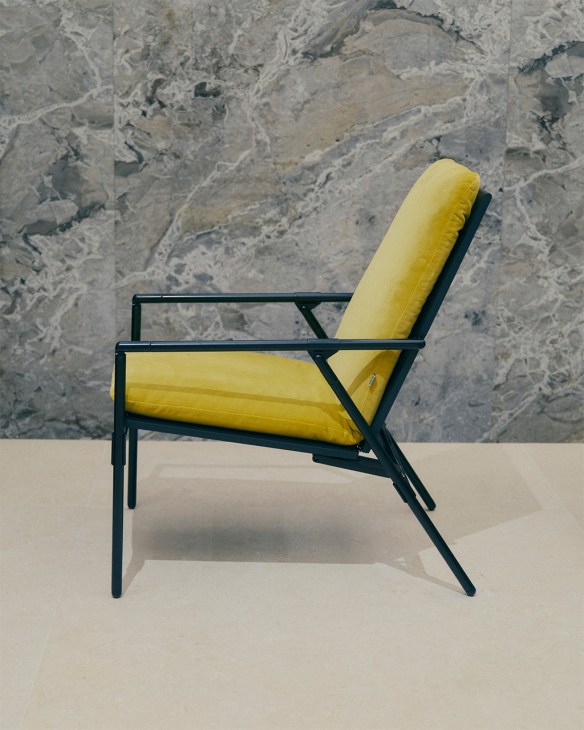
Though global tensions and war have been causing turbulence in the design sector, Piero Gandini, the executive chairman of Flos B&B Italia Group, remained hopeful. “The industry is flexible by nature, with many channels and ways to market,” he said. Gandini’s group generated €888m in gross merchandise value revenue in 2024. His confidence was reflected in B&B Italia’s decision to return to Salone del Mobile this year after decades away. Here, the brand relaunched Nena, a folding armchair designed by Richard Sapper in 1984.
The Nena’s return added a touch of nostalgia to the showcase – many will have fond memories of the chair in homes throughout the 1980s and 1990s. “The industry is sustained by the emotional value that people attach to design,” said Gandini. “That leaves us in a good position. We’re not in danger like steel companies, where there’s less of a desire.”
bebitalia.com
Meet the producers
Koyori
Tokyo
Munetoshi Koda’s furniture firm is seeking to increase international awareness of Japan’s manufacturing prowess through smart collaborations with international designers.


“We have 4,500 furniture makers in Japan but only four or five have a global profile,” said Munetoshi Koda. It’s something that he has been working to change since establishing Koyori in 2022. The brand brings together several leading Japanese manufacturers, producing furniture in collaboration with makers across the country. It focuses on regions and cities that are known for specialised woodworking skills.
Koda hopes to put Japan’s craftsmanship on the global stage by partnering factories with top furniture designers, including Paris-based Ronan Bouroullec, Copenhagen’s GamFratesi and Belgian architect Vincent Van Duysen, who launched his first collection with Koyori at Salone del Mobile this year. “Vincent’s design philosophy resonates with ours,” said Koda, adding that Van Duysen had long been on his list of potential collaborators. “There are similarities with a Japanese way of thinking.” The result was a collection called Hinode (Sunrise), with six pieces including a lounge chair, a stool and a coffee table in oak or walnut.
Koda gave Van Duysen a loose brief, asking him to conceive a chair as “a crucial product for wooden furniture makers”. The subtle curves called for top-level manufacturing, which Koda hopes will emphasise the skill of Japan’s makers.
koyori-jp.com
Beneath the surface
Gallotti & Radice
Brianza
By focusing on a single material, the northern Italian brand explored a diversity of cultural perspectives.
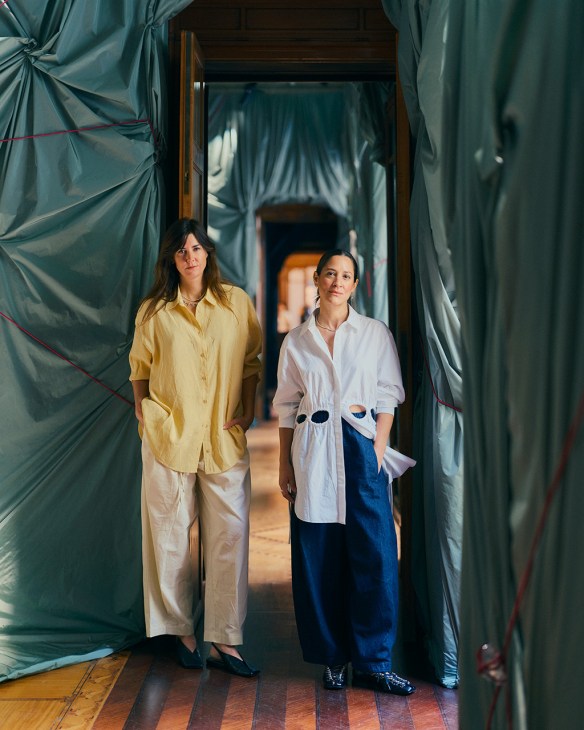
A good group showcase needs a clear organising principle. For Brianza-based brand Gallotti & Radice’s Milan Design Week presentation, Tales in Glass, held at the Palazzo Meli Lupi di Soragna, six female designers from across the globe worked in a common medium: glass. The result was a series of pieces reinterpreting the material through each designer’s cultural lens, from a low table by Los Angeles- and Uruguay-based Estudio Persona to British-Nigerian designer Miminat Shodeinde’s Elege console of stacked glass panes.
“Every material has its complexities, intricacies and joys,” said Shodeinde. “You can do so much with glass. I made a table of stacked bricks of coloured glass representing strength and tactility.”
All of the pieces were developed with Gallotti & Radice, which turns 70 this year. The brand’s back catalogue reveals a long history of working with glass, incorporating precious metals, hand lacquering or colouring. It’s proof that honing in on an idea is often key to perfecting it.
gallottiradice.it
Mixing and matching
Interni Venosta
Milan
How to confidently blend design of different eras and styles.
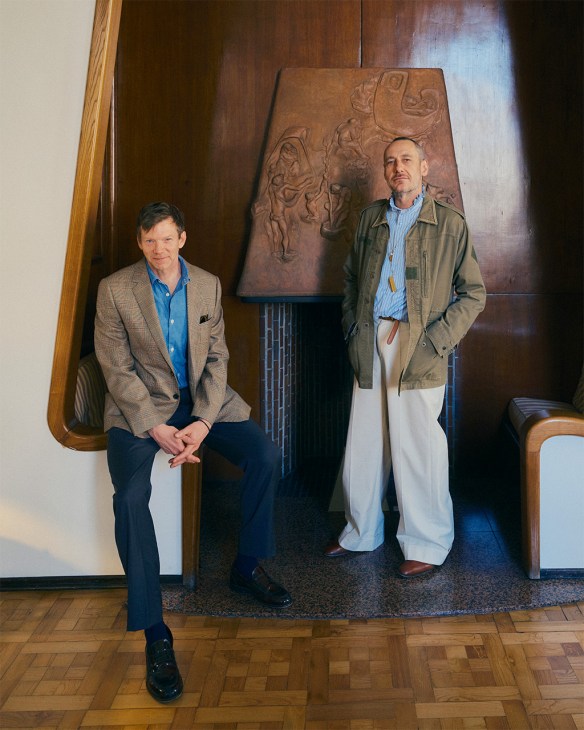
Britt Moran and Emiliano Salci, who co-founded Milanbased design powerhouse Dimorestudio in 2003, also launched homeware brand Interni Venosta in 2024. During Milan Design Week, Moran welcomed Monocle into an apartment in the fashionable Quadrilatero della Moda area, designed by Italian architect Osvaldo Borsani in the late 1940s. “It has never been open to the public,” he said. “The entire home is beautiful.” Here, he and Salci presented the latest Interni Venosta range. “It’s an intellectual collection,” he said.
The setting was clearly significant: Borsani’s ornamental room dividers, built-in seating and sculptural bas-relief fireplace were juxtaposed with the clean lines of Interni Venosta’s work: think burnished-brass and polished-steel vases, upholstered leather seating and lacquered and burl-wood surfaces. The presentation neither deferred to Borsani’s legacy nor competed with it. Rather, it offered a considered, sleek counterpoint to his warmth and craft – showing that mixing furniture and objects from different eras is about choosing works that confidently, quietly complement each other.
internivenosta.co
Perfect Balance
RedDuo
Milan
The design studio offering a still point in the bustle of Milan Design Week.


When it comes to designing furniture or curating a space, RedDuo’s Fabiola di Virgilio and Andrea Rosso usually meet in the middle. Rosso loves colour while Di Virgilio favours more neutral tones. Partners in both life and work, they balance each other’s tastes. For this year’s Milan Design Week, the studio – founded in 2020 – presented RedDuo Galleria, a showcase of their partnerships, including with Belgian rug maker JOV and lighting brand Leucos. “We pick partners that are close to our style,” Rosso told Monocle.
The show was held inside the Porta Genova apartment where the couple lived before they moved to Città Studi. The choice of location made for a refreshing change from the grandiose palazzi in which some other practices chose to showcase their work. Rosso described the space as “a little bit Palm Springs, a little bit Japan” – a mood that was complemented by everything from Bitossi ceramics to marble from Del Savio 1910. Midcentury pieces were borrowed from Demos Mobilia gallery.
Aiming to create an exhibition where people would want to linger, the duo decided to make the show accessible by appointment only. “You need to see the space when it’s almost empty,” says Di Virgilio. Some returned to the gallery for a second look, while a couple from South Korea was there for three hours. Visiting the show was a chance to gain a more intimate understanding of both the studio and the duo’s evolution along the way.
redduo.it
On Reflection
Deyan Sudjic
London
In collaboration with the Rosewood Hotel Group, the London-based curator explored the cultural and historical value of objects, through the work of Milan-based designer Andrea Branzi.
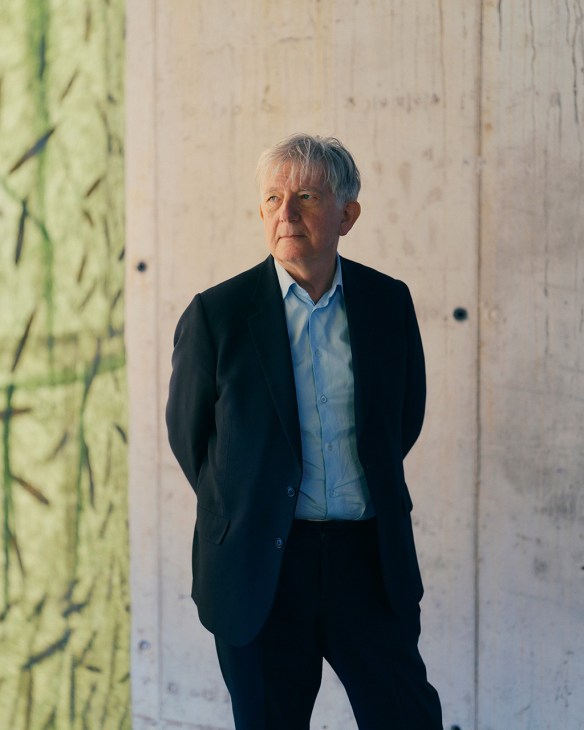
“It’s important for the next generation of designers to not always consume the next thing,” Deyan Sudjic told Monocle. “It’s important to reflect, think about what has been done before and realise that there is a history to things.” The curator and director emeritus of London’s Design Museum was in Milan for an exhibition that he developed with hotel brand Rosewood, celebrating the life and legacy of the late Milan-based designer Andrea Branzi, who was a pioneer of Italian radical design in the 20th century.
Branzi’s work championed the notion that design is about creating objects that carry meaning and both reflect and critique culture – an idea that’s still relevant today. “Branzi saw design as something that can ask questions,” said Sudjic. “He was suggesting that we can feel emotions through objects – the things that we measure our daily life with.” For emerging designers, it’s a rallying cry to put people at the heart of any design process.
rosewoodhotels.com
Realm of the Senses
Annabelle Schneider, USM & Snøhetta
New York
How artists and designers can use dramatic scenography to help us commune with the world around us.


How can we use design to disconnect from the digital world? That’s the challenge that New York-based Swiss artist Annabelle Schneider sought to address with her “Renaissance of the Real” installation during Milan Design Week. “This is about tactility and the imperfect, and the moment of surprise that you can’t capture in the digital,” she said. “It’s critiquing the feeling of how we use technology.”
Created in partnership with Swiss furniture firm USM and Norway- and US-based architecture studio Snøhetta, it featured the former’s rectilinear furniture as a framework around which bulbous textiles appeared to float, held aloft by fans that pushed air into the structure. The effect was womb-like, with shadows from the garden dancing across the textile and enhanced by the changing natural light. “You have the formality of USM and its grid-like, systematic approach to design, then you have this bubble that unexpectedly pushes against it,” said Snøhetta’s Anne-Rachel Schifmann. The contrast prompted visitors to put down their phones to make sense of the interior world that they had entered.
annabelleschneider.com; snohetta.com; usm.com
Nation Building
Visteria Foundation
Warsaw
How design can help to tell a country’s story on a global stage.
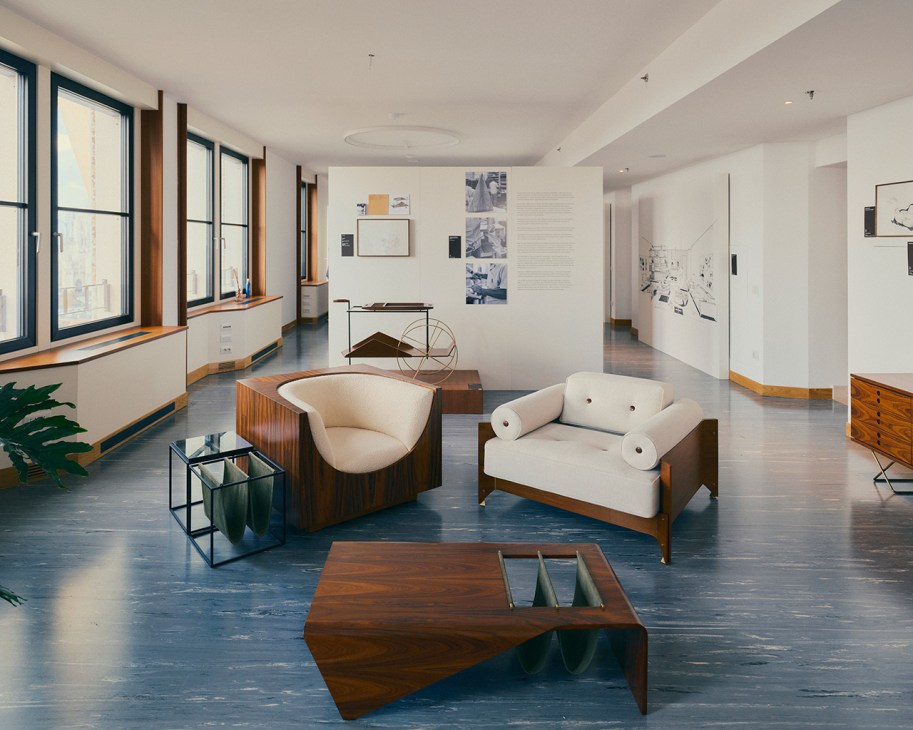
Poland took centre stage at Milan Design Week with two exhibitions from the Visteria Foundation, a cultural institution that promotes the country’s design and craft. Queues snaked around the Torre Velasca to see the two shows. One, in partnership with furniture brand ETEL, told the story of Polishborn designer Jorge Zalszupin, who emigrated to Brazil and became associated with the South American nation’s modernist movement. The other examined how modernism took shape in Poland and featured contemporary designers from the country, including Tomek Rygalik, responding to the movement’s ideals. “It was about trying to combat bigger societal issues,” said Rygalik. “For us, it took hold during the communist years so it became about preserving the values of delight and beauty, and envisaging a more hopeful future. That’s something that we’re still looking at today.”
The pieces on display underscored the importance of looking at the ways in which a nation’s shared experience is embodied in the work of its designers – and that of its prodigal children (such as Zalszupin). Dipping into this heritage can offer a guidebook for the future, building on past struggles and successes.
visteriafoundation.pl