From headwinds to high spirits at Farnborough International Airshow
The combination of unpredictable geopolitics and oil prices don’t bode well for aviation. And yet if the recent Farnborough International Airshow is anything to go by, the industry’s spirits are sky high.
Considering the crises that aviation is currently facing, you would think the industry would be more dour. But the energy at the recent Farnborough International Airshow was upbeat. You might even call it buzzing. Part of this could be explained by a defence industry in full swing, selling and developing the combat aircraft and systems of the future. Even considering the latest developments in the Gulf – with oil supply newly under pressure and prices again on the rise – the airlines and aircraft manufacturers looked surprisingly optimistic as well.
Emirates showed up in typical fashion with its newest airplane, an A350-900, showing off some nice new innovations for passengers, including a novel headrest for economy class questionably dubbed “U Dream” that might finally put an end to the neck pain of long journeys.
Embraer displayed its latest E195-E2 regional jet for Porter Airlines, which made the long trip to the UK from its headquarters in São José dos Campos, Brazil, before the plane joins the airline’s rotation. Although the show might not have seen airline orders at the rate of past shows, its 353 firm aircraft orders and 12 options beat the event’s 2024 total. Splashy Saudi start-up Riyadh Air signed up for heaps of new airplanes, while Philippine Airlines committed to even more A350-1000s to fuel its long-haul ambitions. And we saw some more niche orders as well: Uganda put its name down for a handful of Boeings for the first time in its history, while Bermudair made Airbus happy by signing up 10 of its A220-300 aircraft.
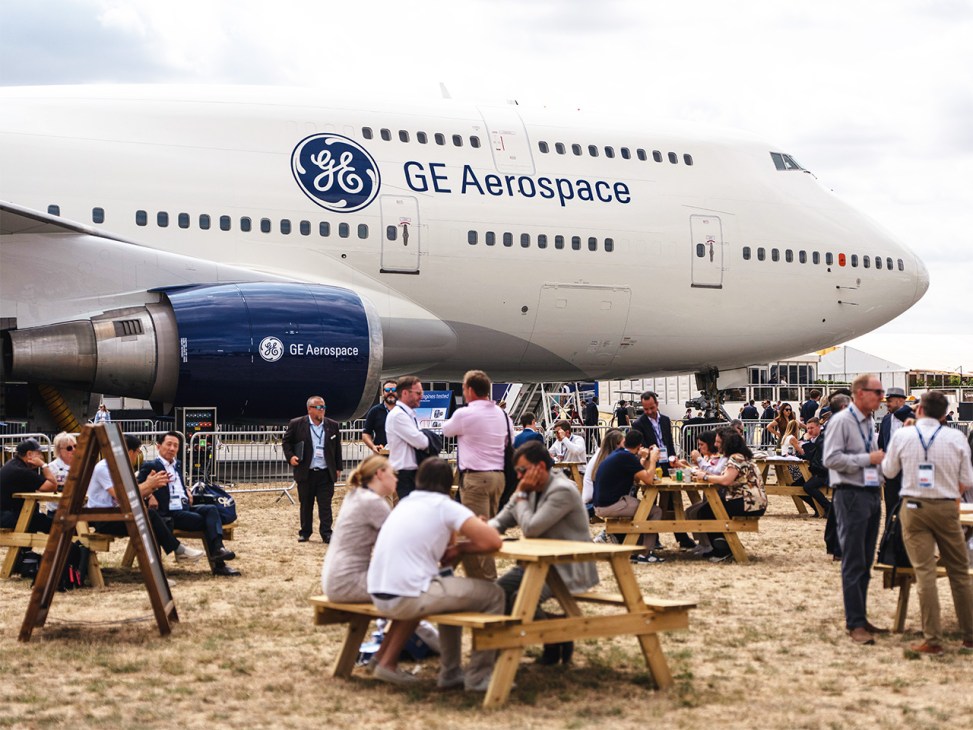
The industry is focused on bringing new technology to aircraft. Engine-maker GE Aerospace brought its 747 testbed, which is often seen flying around with experimental engines tacked on to a wing, to talk about some of the next frontiers in propulsion. Of particular interest is the Open Fan concept, which essentially removes the casing around the engine and ends up looking a lot more like a simple propeller. Manufacturers are considering new methods of electrification and the adoption of other clean energy power sources such as hydrogen.
Over on the defence side, talk continues to centre on unmanned aircraft. But this is not simply more of the exploding drones that we’ve seen used increasingly in warfare. Rather, the big players want to create combat systems that use uncrewed aircraft in combination with traditional fighter jets and other aircraft to augment and improve capabilities (and using the latest in AI to bring it all together). Increasingly, the role of the fighter pilot seems to be more a director and decision-maker, while robotic flying assistants crunch complex streams of data and intel to help provide desired outcomes. BAE Systems unveiled one such British-designed Collaborative Combat Aircraft (CCA) at the show, dubbed the Brontanax, which is made to work alongside fighters such as the Eurofighter and F-35.
While the optimism at the show might make aerospace players look like they’re putting their heads in the sand, in the context of the past few decades, it makes more sense. Crises and shocks to aviation come and go with some regularity, from spiking oil prices and travel restrictions to regularly shifting airspace closures. In other words, aviation is rather accustomed to all this. And though current tensions in the Gulf seem as if they could spiral out of control, aviation is a long game – not least because aircraft need to be ordered, suppliers locked in and plans made years in advance. The industry is clearly betting that it will weather this storm. When the clouds clear, it’ll need to be ready.
Gabriel Leigh is a regular Monocle contributor. For more opinion, analysis and insight, subscribe to Monocle today.