From battery-powered trains to sleeper services, here are the ideas shaping the future of rail at Innotrans 2026
At Innotrans, the world’s largest rail-transport trade fair, the floor was abuzz with talk of AI. But beyond apps, exhibitors focused on comfort, efficiency and style.
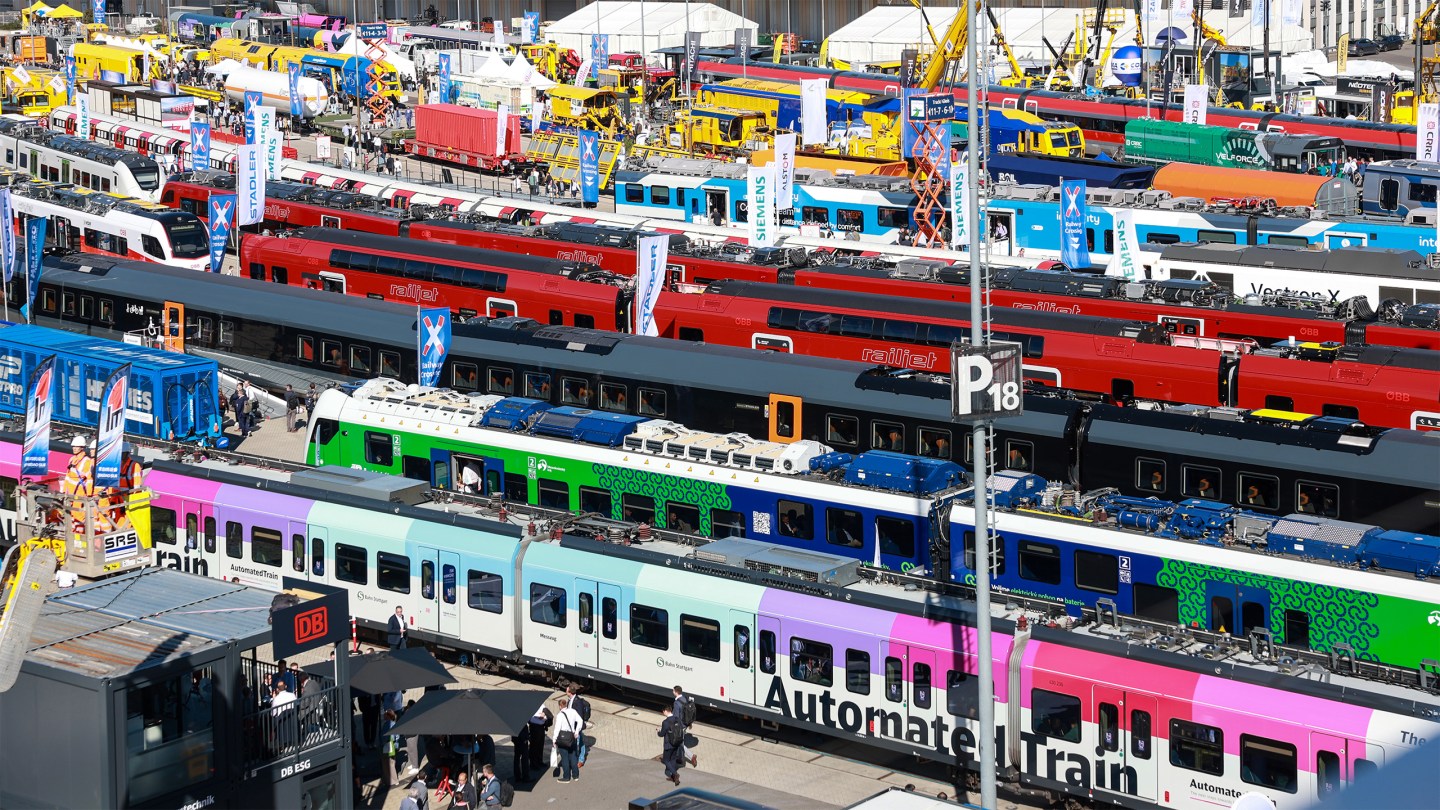
Changing from the London Underground’s Piccadilly Line to a Railjet bound for Innsbruck before hopping on a KTX to Seoul would normally require a few days’ travel. Not so at this year’s Innotrans, where all three kinds of trains are parked within walking distance. The world’s largest transport-tech fair is held biennially in Berlin and this edition’s biggest talking point is AI. It’s expected to lead to “a golden age in rail”, as more than one executive puts it, and is being promoted for, among other things, analysing workers’ posture in railway factories (“good for their backs”), scanning depots for vandalism (“good for buses”) and anticipating disruption caused by protests (“good for France”). And, of course, it’s being touted for its cost-cutting capabilities.
But not every cost-saving measure requires an algorithm. German mobility firm Hübner’s new aerodynamic fairing (a type of corrugated bellows), for example, smooths the gap between coaches. “It’s a small change with a big effect,” Dirk Wimmer, the company’s head of technology, tells Monocle. “By cutting drag, operators can save tens of thousands of euros in energy costs a year.” The design also reduces noise and protects cables.
Elsewhere, ideas familiar from cars and smart homes have found their way onto the rails. Siemens presents not so much a locomotive as a “smartphone on wheels”. Its Vectron X comes with its own app store. Drivers can, among other things, heat the cab remotely before turning up for work. Others are showing off battery-powered trains such as that of Chinese manufacturer CRRC, which pitches a modular battery-and hydrogen-powered locomotive as a greener option for freight. The promotional film demonstrates this with an interesting choice of cargo: coal.


The host nation supplies some of the more experimental ideas. Monocab is an autonomous rail taxi designed to revive disused rural lines. Its lightweight, self-balancing pods can travel in both directions on a single rail and be summoned with – you guessed it – an app. “Germany has about 6,000km of unused railway lines,” says Monocab’s Thomas Schulte. “At least half could be suitable for reactivation and it’s similar in other countries.” The team is aiming to have a working system by 2030 and has already received enquiries from Japan, the US and Australia.
Bavarian multinational Max Bögl, meanwhile, is betting on magnetic levitation, with test tracks south of Nuremberg and in Chengdu. “People might be sceptical but the advantages are considerable,” says Felix Niebler, Max Bögl’s head of product. “It’s quiet and weather-resistant, and the infrastructure costs only a fraction of a conventional underground line. You could carry passengers during the day and containers at night at up to 150km/h.”
While Elon Musk has given up on the Hyperloop, the idea lives on in Munich. Researchers there want to send passenger capsules through tubes at up to 700km/h. “We have built a small test track,” says Domenik Radeck, a postdoc at the Hyperloop programme of Technical University Munich. “Next comes a 3km-to-5km track to prepare the technology for commercial use. There’s a long way to go but it could change the way we commute.”
Back in the present, with night-train services booming across Europe, another race is under way: to build the best train bed. Talgo is presenting sleeper trains designed for overnight services between Stockholm and northern Sweden. Berlin start-up Nox plans to begin running overnight services across Europe in 2027, with business travellers firmly in its sights. “Our seats were inspired by long-haul business-class seats on planes,” says Thibault Constant, one of Nox’s co-founders, as he shows Monocle a suite in which the seat unfolds into a two-metre bed (click here to read the full report).
Czech manufacturer Borcad has its own solution: Flatwhite, a private compartment built around its first fully lie-flat rail seat. “Passengers appreciate the additional comfort,” says Tomáš Mutina, a marketing specialist at the brand.
The UK has a presence here too. British design agency PriestmanGoode’s Day/Dream concept turns existing carriages from daytime lounges into sleeping accommodation without requiring operators to buy dedicated sleeper trains.
Also from the studio is London’s latest Underground trains, which look positively miniature beside their bulkier mainline counterparts. “These are designed for some of the city’s oldest tunnels, so they are quite compact,” says Kirsty Dias, the managing director of PriestmanGoode, who worked on the redesign. From 2027, they will replace the Piccadilly Line’s 1970s fleet, bringing such luxuries as walk-through carriages, wider doors and, for the first time on a deep-level Underground line, air conditioning.
“The most brilliant thing about working on this is that everyone in London has such a strong relationship with it,” adds Dias. “It’s a train, yes, but it’s much more: it’s part of the fabric of London life.”