Global conflict sets a tone of controversy and contention at this year’s Venice Biennale
The preview week of the world’s most prestigious exhibition of contemporary art was an unruly spectacle – charged by political dissent, moments of beauty and works shining brightly through the chaos.
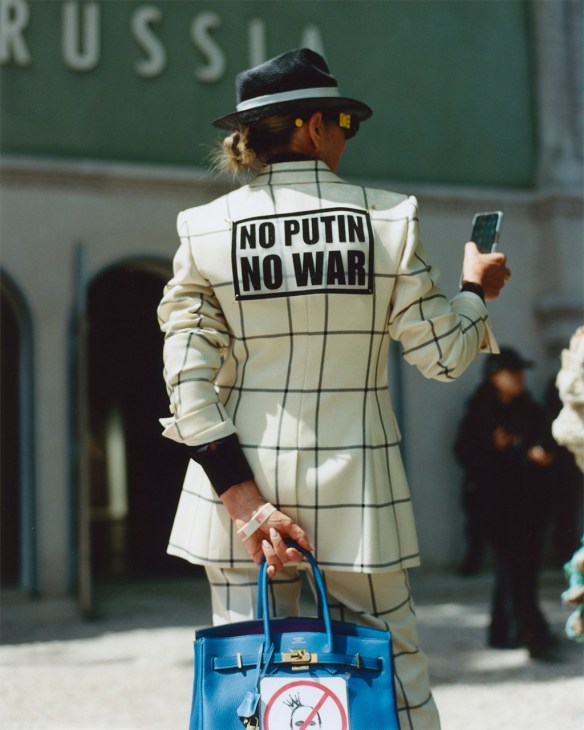
The day before the Venice Art Biennale opened to the public, a lone woman stood outside Russia’s pavilion. Her fedora, striking checked suit and sunglasses made her conspicuous but it wasn’t her style that kept a steady stream of smartphones and TV cameras pointed in her direction. On her back was a sign that read “No Putin No War”. The bright-blue Birkin bag swinging idly from her arm was emblazoned with a crossed-out illustration of the Russian leader’s face. “I’m protesting for all those who can’t,” she said, when asked about the bold action.
This was far from the only protest at Vernissage, the Biennale’s preview days for press and VIPs in early May. Feminist performance group Pussy Riot managed to shut the Russian pavilion temporarily when they arrived outside it wearing hot-pink balaclavas and wielding fuchsia flares. Elsewhere, the Solidarity Drone Chorus created a mobile demonstration of performers humming a viral song by Ahmed Abu Amsha, a music teacher from Gaza, accompanied by recordings of unmanned aerial vehicles. T-shirts worn by those taking part bore the names of Palestinian artists, many of whom were killed by Israel in the recent conflict. These activists turned their messages into haunting artworks: throughout the week, they were reported on as much as anything that hung on a pavilion wall.
The main focus of protests this year was the presence of Russia and Israel at the event, and the dissent culminated in a strike organised by the Art Not Genocide Alliance group (ANGA). On the final day of Vernissage, about 18 pavilions closed to visitors as part of the action – unprecedented in Biennale history. But while this year’s preview was an explosive assembly of activists and art cognoscenti, the complications started long before.
This 61st iteration of the Venice Biennale was put together by Cameroonian-Swiss curator Koyo Kouoh. She made history as the first black woman to take on the task but her role was cut short by her death in May 2025. While she chose the theme – “In minor keys” – it was up to the curatorial team that she assembled to oversee its execution. Just before Vernissage, the five-person jury that Kouoh appointed resigned in protest at the inclusion of the Russian and Israeli pavilions. Italy’s government also expressed its opposition to the former’s presence and announced an investigation into whether it might be in breach of EU sanctions.
While disputes and demonstrations might have dominated the news coverage, the works on show haven’t gone unnoticed. In the Giardini, Austrian artist Florentina Holzinger has created the most talked-about pavilion. Her exhibition, Seaworld Venice, extends beyond the building to include a topless performer dangling outside, becoming both a human clapper suspended in a giant bell and a striking advertisement for the presentation taking place inside. There, Holzinger’s company perform stunts nude on jet skis and take turns to be submerged in a glass tank surrounded by filtered urine from two adjacent Portaloos (open for use by visitors). Elsewhere in the Giardini, sperm banks, babies and belonging are the subjects of some of the most compelling national pavilions.


Here, artistry isn’t just contained in the main sites of the Biennale but floats and flows along Venice’s canals, in churches and gardens around the city, and across to neighbouring islets. From the boat en route to one of these – the tiny San Giacomo island – the first thing that you spot is a flock of bulbous, disembodied eyes fluttering in the wind. These omniscient kites are part of an installation by UK artist Matt Copson, marking the opening of San Giacomo.
At various points from the 11th century, the island has been home to a church, a military garrison and a vineyard. In 2018, San Giacomo was bought by the Italian Fondazione Sandretto Re Rebaudengo and it has now been transformed into a public art space with permanent sculptures and two galleries. There is also a private home for the organisation’s founder, Patrizia Sandretto Re Rebaudengo, with interiors designed by Italian filmmaker Luca Guadagnino.

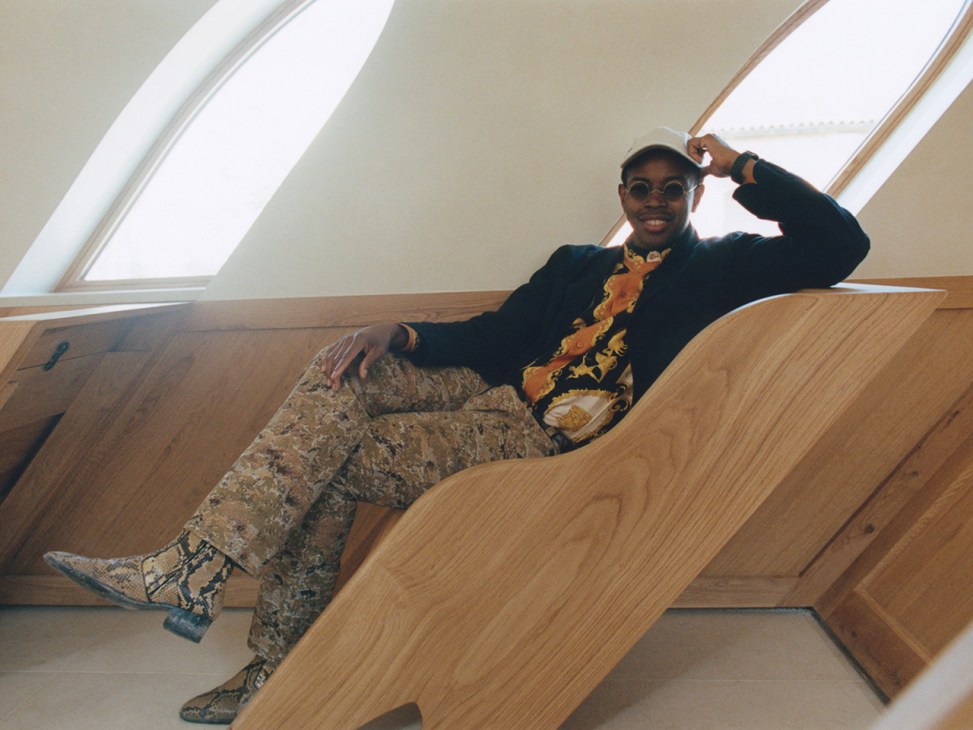
“It’s a place that actively responds to the work and, at the same time, the island resists total control,” says Sandretto Re Rebaudengo. “It asks artists to listen and respond. This often leads to art that focuses less on display and more on relationships with the natural world.” The floating eyes that hover over visitors enjoying lunch and glasses of icy rosé on the opening day rely on the wind to make their statement. So too does an enormous, monstrous black kite and a metal sculpture that creates a buzz as it moves with the elements.
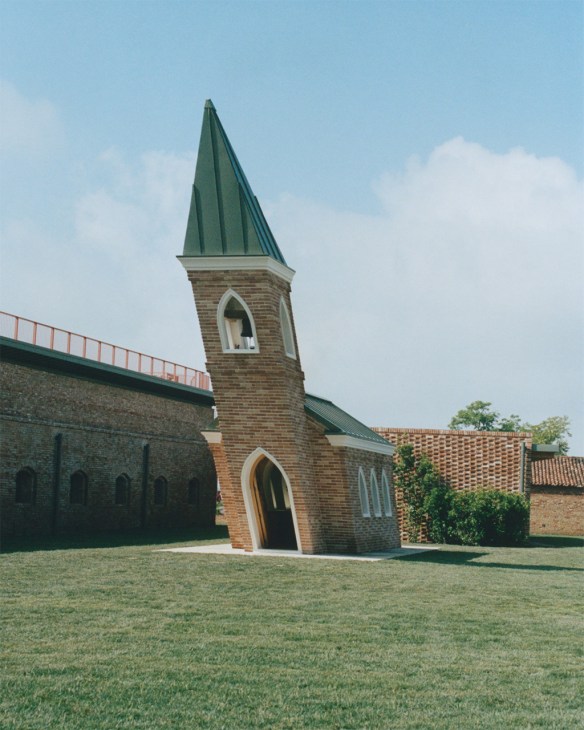
Many of the installations dotted around the island riff on the place’s history and landscape. “Huff and a Puff” by US artist Hugh Hayden – a full-scale place of worship, tilted forward at a jaunty 40-degree angle – nods to the past existence of a church here.
“All of the works reflect on questions that are central to San Giacomo – those of transformation, vulnerability, resistance and memory – and also the relationships between human and non-human systems,” says Sandretto Re Rebaudengo. “I think of them as a constellation, rather than a fixed curatorial statement. And I believe that the lagoon completes them.”
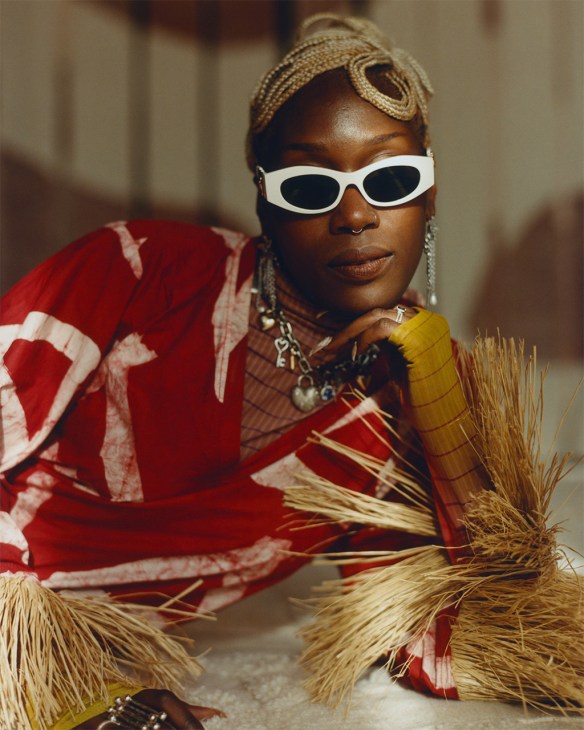
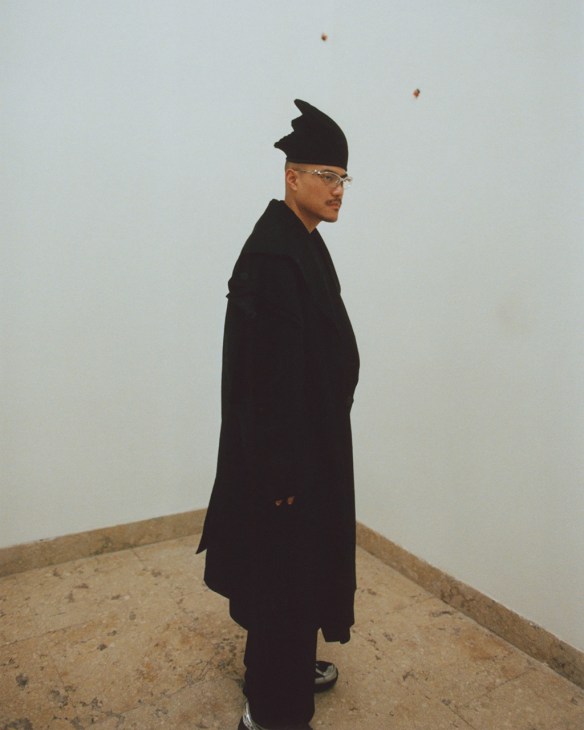
Back on the main island as evening falls, the Giardini and Arsenale begin to empty. Later, after dinner, the crowds reassemble outside palazzos. Extravagant outfits become home to sharp elbows as partygoers vie to enter exclusive events. At one, held by the Danish pavilion and Berlin-based arts platform Trauma, the Hungarian-Italian former porn actress, politician and pop star Cicciolina puts on a rare performance. Surrounded by flowers and wearing a matching floral crown, the septuagenarian provocateur’s disco ball of a dress competes for attention with her lip-syncing.
Outside, a green laser beams out from the island of San Clemente. This is an artwork entitled “Higher Power” by UK artist Chris Levine. Every evening this week, a militarygrade laser system shines a light upward. During testing, the beam was visible from the International Space Station. Further, bigger, better – perhaps it’s just another macho experiment in space exploration. Like the bulbous eyes on San Giacomo, it is, most of all, a reminder of the Biennale as a spectacle. The politics, the art, the people – everyone looking at what’s on show, watching each other or gazing upwards to follow a bright emerald light as it fades into the sky.