Revival or ruin? The controversial €65m makeover of Madrid’s Torres de Colón
Once a defining part of the Spanish capital’s skyline, the renovated Torres de Colón has lost much of its eccentric charm. A reminder that ‘architecture doesn’t have to appeal to everyone’.
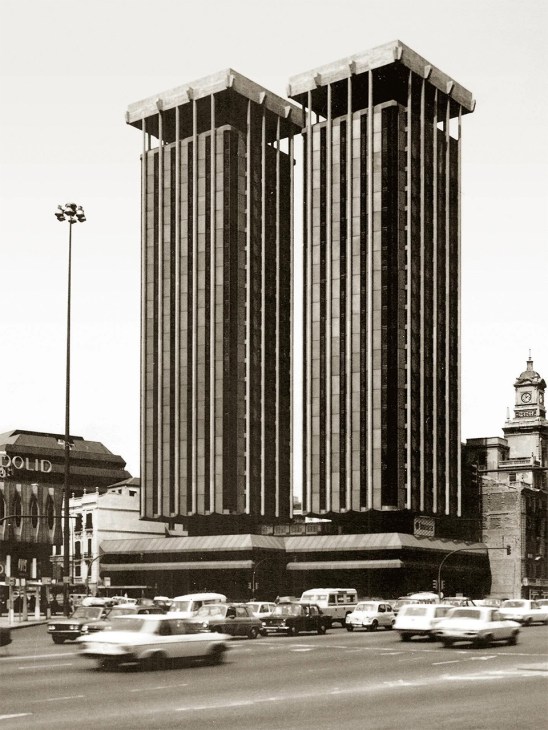
In the late 1960s, Spanish architect Antonio Lamela began construction work on Torres de Colón– twin skyscrapers covered in bronze-coloured aluminium (pictured) – in Madrid’s Plaza de Colón. Half a century since their completion in 1976, a recent renovation has stripped them of Lamela’s vision – leading many madrileños to question the rush to retrofit older buildings.
The original skyscrapers were divisive: for decades, the city’s residents debated whether they were architectural marvels or mockeries, an eyesore or a bore. The Torres Colón story began in 1964, when Lamela conceived the two 24-floor concrete structures. Spain’s then-dictator, the fascist Francisco Franco, was eager to attract foreign investment and the towers were intended to signify the country’s modernity. Before their completion, however, Madrid’s then-mayor got cold feet, issuing a tear-down order, which was promptly overturned by a level-headed judge. The Torres de Colón survived but drama has been a part of their story ever since.
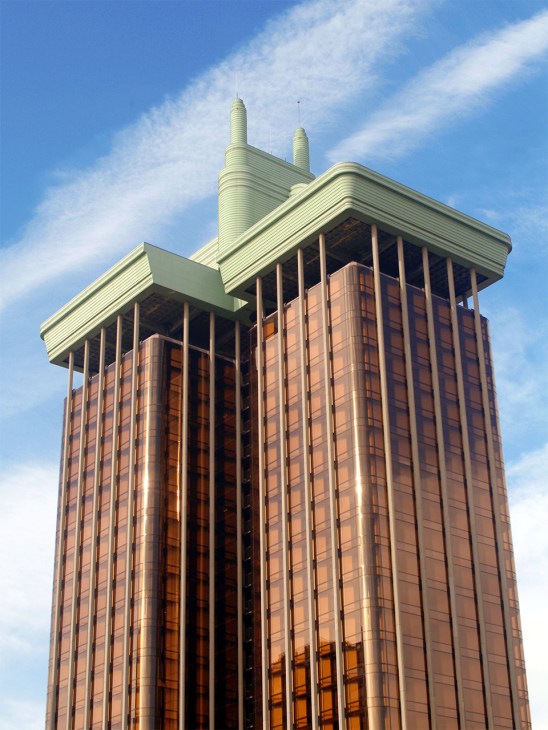
Following a change of ownership two decades later, a two-pronged turquoise crown was added to the roofs of the towers to obscure an emergency stairwell and antennas (pictured). Quickly dubbed el enchufe (the plug), it was loved and loathed in equal measure.
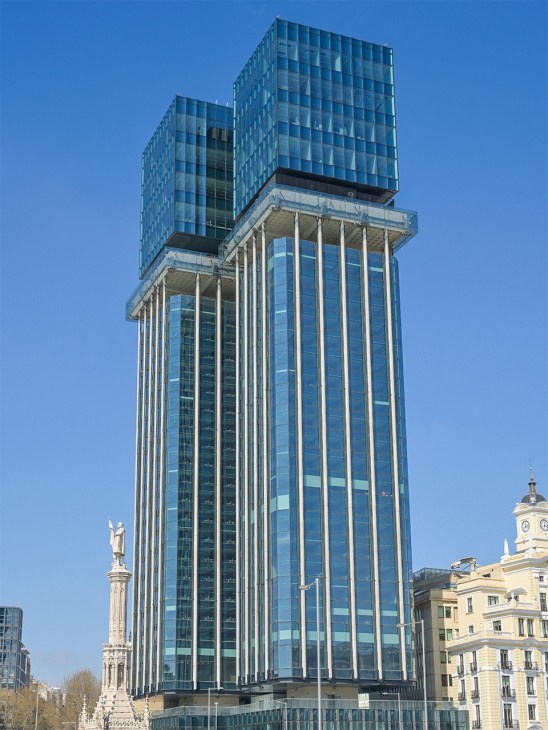
Writing about the towers today feels like an exercise in elegy. The latest makeover (pictured) – which reportedly cost €65m – has erased the edifice’s often spiky identity. The peculiar plug is gone, replaced by two giant cubes that add four floors. The building is glassier, sharper-edged and suddenly blue. Luis Vidal 1 Architects, the practice behind the Nuevas Torres Colón (the retrofit resulted in a subtle name change) touts the project’s sustainability: it is one of the capital’s most energy-efficient office blocks. But the Torres Colón’s old eccentricity is nowhere to be seen, replaced by a soaring yet unremarkable spectacle.
Among the renovation’s fiercest critics is Lamela’s son, Carlos. As the director of Lamela Architects Studio, he keeps his father’s legacy alive through projects including Madrid’s award-winning airport expansion. For Carlos, the entire revamp is “a disgrace”. He mentions the lack of consultation and points to mounting legal challenges against the city council. “Any building made with purpose that is then mistreated, disfigured and altered ends up being a disaster,” he says, lamenting the disrespect shown for one the city’s most iconic architects.
But let’s return to the optics. New, shiny glass towers of this kind could easily belong to a city such as Guangzhou or London – samey, square faced monuments that play it safe. This has become a recurring theme in the Plaza de Colón, where ideas of Spanish identity have a tradition of being explored in architecture and then recast. In 2019, for example, the brutalist stone façade of a bank was stripped, then replaced by a far more prosaic exterior; another distinctive metallic building was recently converted into a boring glass box.
In 2014, Torres de Colón was voted as one of Spain’s ugliest buildings in a poll conducted by ABC España – a testament to its power to inflame passions. Today, all three of the plaza’s newly refurbished buildings would likely fail to spark much of a response. Discussing the towers’ long history of controversy, Carlos says that aesthetic questions miss the mark. “Architecture doesn’t have to appeal to everyone,” he says. “It’s just like cinema: there are arthouse films and commercial hits but we need to respect the art form nonetheless.”
Madrid’s “plug” might be gone but other weird and wonderful buildings still stand. Before rushing to swap them all for shinier, more efficient replacements, cities should ask themselves: at what cost to the character of their skyline?
Other Madrid towers of note
- Torres Blancas by Francisco Javier Saénz de Oíza: A residential block that resembles a giant tree of stacked discs, this marvel from 1969 remains a celebrated iteration of organicism and futurism.
- Castellana 81 by Francisco Javier Saénz de Oiza: An exemplar of respectful retrofits, this 1970s metal-and- glass tower was given a n energy-efficient makeover in 2018 while maintaining the visionary architect’s original form.
- Serrano 69 by Fernando Higueras: Built in 1979, this office block is known for its innovative embrace of arched concrete apertures and embedded garden beds on its façade.
This article is from Monocle’s March issue, The Monocle 100, which features our editors’ favourite 100 figures, destinations, objects and ideas.
Read the rest of the issue here.