Lightbulb moments: Objects and ideas collide at New York design week
Our New York-based design correspondent takes us on a journey through the city’s design week highlights.
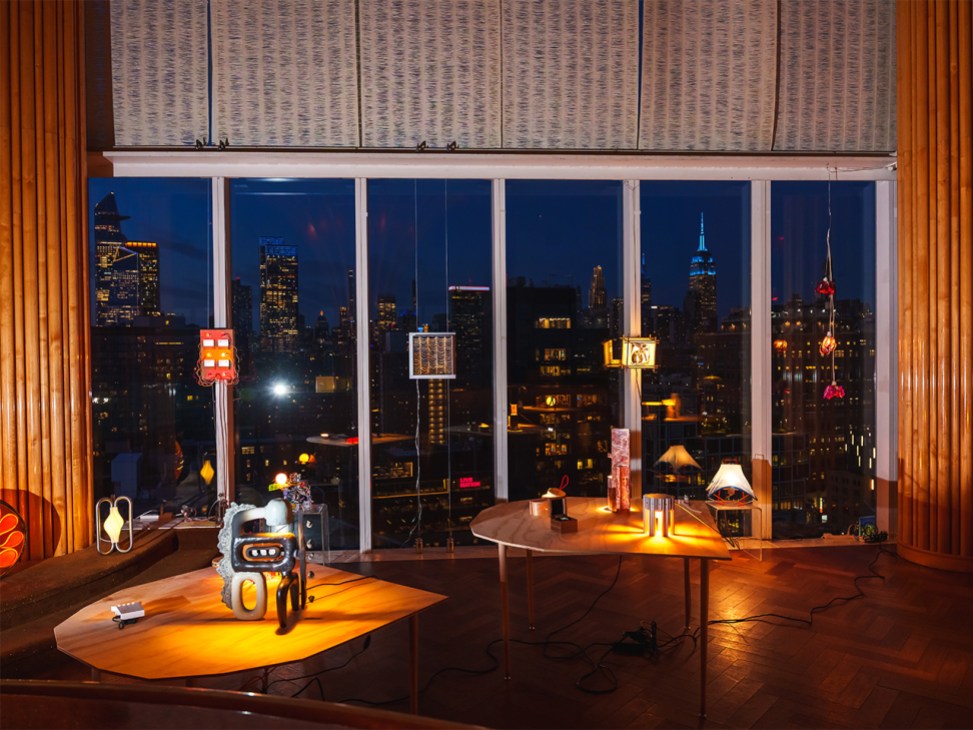
I walked up to The Standard hotel in New York’s Meatpacking District at about 21.00 on a Friday. Here, at the start of the city’s design week, there was a line stretching around the block. The hotel’s rooftop club, Boom, frequently hosts Met Gala afterparties and other celeb-studded bacchanals. This time, however, the people queuing were dressed-up design geeks there to look at lamps – specifically, the biannual Head Hi Lamp Show (pictured below). Upstairs, guests sipped margaritas while inspecting one-of-a-kind lighting creations that held their own against the Manhattan skyline.
As far as design-world events go, it was astonishingly glamorous. All the more impressive was that there was no big sponsor or marketing operation behind it. The showcase is organised by Alexandra Hodkowski and Alvaro Alcocer, the owners of a Brooklyn bookshop who select their favourite lights, which are sent in from around the world via open call. The event began as a lark but has grown organically, based on a simple love for the fun that can be had with lamp-making.
Compared with its counterparts in Milan and Copenhagen, design week in New York is a slightly more amorphous affair. Almost anybody can participate by setting up an exhibition and it overlaps with larger art-world events including Tefaf, Frieze and the Independent Art Fair. Add in the fact that New York is the world capital of collecting and this week made it clear that design is acquiring a more serious role in the upper echelons of that market.
Tefaf at the historic Park Avenue Armory is a good bellwether for this shift. The Maastricht-born fair also includes antiquities and applied arts – and this year the exhibitors had gotten the memo that design was worth the effort. Gracing the hallways were supersized ducks, rabbits and sheep by Francois-Xavier and Claude Lalanne – not because the fair had a farmhouse theme but because a Lalanne hippopotamus bar fetched $31.4m (€27.1m) at Sotheby’s in December. Amid many play-it-safe Prouvés were also some beguiling examples of contemporary design, such as Frida Escobedo’s glittering Creek bench, which Friedman Benda gallery sold on the preview day.
Across the board, American exhibitors know how to sell. Contemporary design gallery The Future Perfect continued the lamp theme with a show of nightlights ranging from the scandalous (a shrine to Luigi Mangione) to the sublime (a bulb preserved in amber-hued rubber) and started from $10 (€8.60). Downtown gallery Tiwa Select, in collaboration with architecture magazine Pin-Up, sparked material desire with Souvenir, a show of exquisite vases by Nifemi Ogunro, Minjae Kim, Dana Arbib and more.
To protect my finances, I headed to the Van Alen Institute in Gowanus to learn about Herman Jessor, the prolific yet forgotten New York architect who designed more than 40,000 working- and middle-class co-op units. His projects have been put back in the spotlight by Zara Pfeifer, Brad Isnard and Daniel Jonas Roche, who argue that Jessor’s unshowy, cookie-cutter housing is exactly what the city needs more of. The talk floated big ideas – empowering the public sector, redeveloping parts of Queens, merging New York’s transit authorities – that served as a welcome reset. It’s easy to forget sometimes but design is as much about ideas as objects – and New York City Design Week celebrated both.
Stella Roos is Monocle’s New York-based design correspondent.