Meet the Japanese-Italian collaborators who treat furniture as an ‘expanding landscape of daily life’
The rather attractive partnership between Design Studio S and Flexform connects Italian industrial production and traditional Japanese craftsmanship to make covetable products for the home.
In her 24-year career as the head of Design Studio S, Fumie Shibata has applied her unfailing touch to everything from thermometers and suitcases to lighting and plastic umbrellas. Coming from a family of weavers in the textile town of Fujiyoshida, she studied design at Musashino Art University in Tokyo and was a problem solver from the outset. Her first interest – unusually for a budding designer – was in medical equipment. “I wanted to contribute to society,” she says. “Even a slight change of design or a softer shape can make the patient feel better and lead to a more positive outcome.”
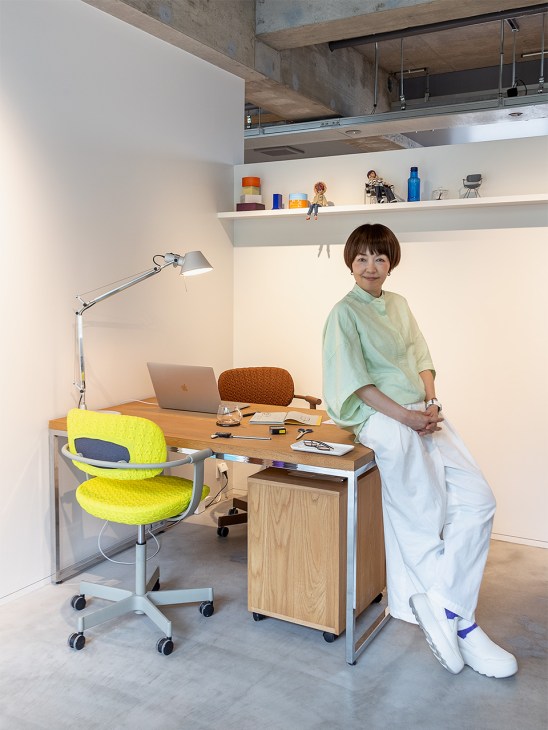
It’s this mindset of care and consideration that has been applied to her work with Flexform. She felt an affinity with the Italian manufacturer, a family business founded by the Galimberti brothers in Brianza in 1959 that is now in its third generation. “I went to the factory to see what kind of things they make and what their priorities are,” she says. “I listened to their stories.” She knew that she had found a good match. “I was impressed by the soft materials, such as leather and down, that we don’t really use in Japanese furniture.”
The partnership has spawned Eri, an armchair first unveiled in 2024 that has now gone into production; this year, it’s a mirror called Soreto. “I see furniture not as isolated objects but as an expanding landscape of daily life,” explains Shibata. “If Eri – inspired by a soft, enveloping collar – acts as an intimate point in space, then Soreto functions as an architectural line that organises the surroundings and introduces a quiet sense of order.”


The work, Shibata says, bridges the gap between industrial production and the traditional monozukuri craftsmanship with which she grew up. She sees no reason for the two to be mutually exclusive. “Human beings exist as physical entities, and how a body interacts with everyday objects deeply affects the mind,” says Shibata. “Therefore, regardless of the industrial methods used, the things we live with must possess a fundamental affinity with us,” she adds, explaining that industrial production and human-led craftsmanship don’t need to be in conflict. “By refining each form to imbue the design with a tactile presence, I hope to bring a sense of richness and tranquillity to daily life.”
It’s a cross-cultural – and cross-continental – outlook that’s producing covetable products for the home. Shibata has won multiple awards and, as a university professor, is teaching a new generation. She still craves fresh experiences but has no plans to expand beyond her team of six. “The studio is the size that I want it to be,” she says. “Small enough for me to still have my hands on everything.”
Need a designer? Discover the global studios that should be on your radar