More than ‘putting the Pope in a Balenciaga puffer’: Joelle Diderich on AI-generated haute couture and the future of craft
A conversation with ‘Women’s Wear Daily’ on the Dior, Chanel and Alexis Mabille Paris Haute Couture Fashion Week shows and what they mean for the future of the industry.
Haute Couture Fashion Week occupies an amorphous space within the industry. Where once it was strictly a showcase for a handful of the wealthiest clients, today its adjacent function is as a brand-marketing tool. For the fashion houses accredited to produce and present haute couture, it offers an opportunity to draw eyes: a theatre of spectacle for the ever-hungrier online ecosystem that we call the attention economy. So if couture today is mostly being consumed as on-screen entertainment rather than an in-person experience for a select few, what does that mean for the designs?
During the presentation of spring/summer 2026 collections in Paris last week, several responses to this question emerged. Perhaps the most controversial was Alexis Mabille, who unveiled an AI-generated collection (though, to be clear, based on his own designs), showcased on virtual models in front of an equally fictitious audience. The living, breathing viewers in attendance at the Théâtre du Lido witnessed the collection just as couture fans at home would: through a screen. On the other end of the spectrum, Matthieu Blazy’s debut couture collection for Chanel drew consternation online for its seemingly muted designs and humble materials – undeserving, some argued, of the “haute” label. But for those fortunate few who experienced the collection up close, the fine materials and stripped-back structures were a study in controlled craft.
One such audience member was Joelle Diderich, Paris bureau chief for Women’s Wear Daily and a fixture at the couture shows for the past 25 years. Fresh from the presentations, she joined Monocle Radio’s Lily Austin on Monocle on Fashion to share her impressions from the side of the stage and to reflect on what this season tells us about the role of haute couture in today’s fashion economy. The following interview has been edited for clarity and length.
How does haute couture fashion week differ from the other fashion weeks?
People use the term ‘couture’ very fast and loose but it actually refers to something specific: made-to-measure clothing. It’s a highly regulated industry that exists only in Paris, which means that there are only about a dozen houses that do it.
So, compared to typical fashion weeks, you’re dealing with a much smaller number of players. They invite young people as well as [established] guests to keep it fresh. Otherwise, it’s in danger of becoming a dying craft.
There were a few major designer debuts this past week, such as Matthieu Blazy at Chanel and Jonathan Anderson at Dior. Let’s start with Chanel – what did you make of the collection?
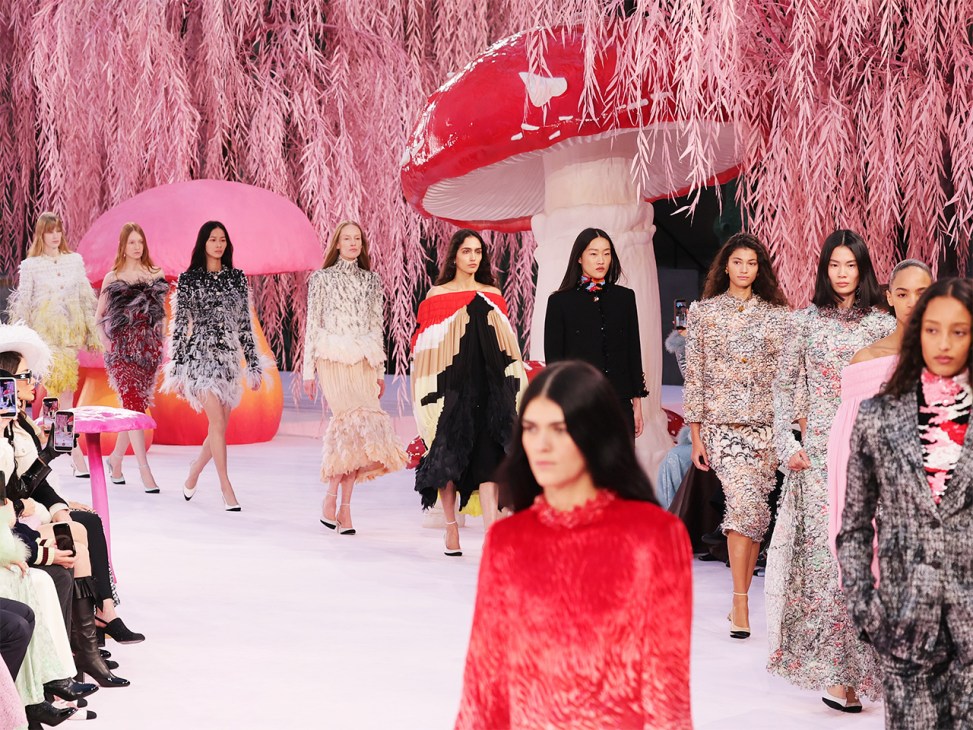
Chanel was highly anticipated. From the moment you walked into the venue, the set was super psychedelic with giant mushrooms and wall-to-wall pink carpeting. What Blazy did was quite daring. He did not do spectacular big dresses, which is the kind of statement that you might have expected. Instead, he went quiet – his first look was like an X-ray or a memory of a Chanel suit, made in see-through chiffon.
I have to say, if you had the privilege of getting up close and personal with any of the pieces, the techniques and craftsmanship would have blown you away. The amount of work that goes into weaving tweed or [creating] fabrics with feather details – even that black coat with the raffia flowers – is mind blowing.
Blazy is going back to what Coco Chanel did. Back in the day, there was no ready-to-wear. There was only a couture service, if you had that level of budget. Blazy said, ‘I want to go back to that.’ That black trouser suit that he created – that is ultimate luxury, and that’s what he’s talking about. It was interesting to see that being brought back into the conversation.
Do you think there is an expectation for couture to be a spectacle for a large audience rather than a product catering to a very exclusive market?
Absolutely. I shouldn’t be giving away my age like this but I started covering couture 25 years ago and, back in those days, it was people such as Nan Kempner and Danielle Steel who were the front-row clients. Those ladies are no longer around and couture has become primarily a vehicle for image-making and selling perfumes: brands have turned it into an advertising platform. The clients are still there but it’s not the same as it was 25 years ago. So to have someone go back to the purpose of couture does stick out. It was a bold statement on Blazy’s part.
After the show, people online were commenting things such as, ‘How is this couture?’ and ‘This is Zara.’ But believe me, [the clothes are] not made to wow you through the tiny format of an Instagram photo – they’re made to wow you when you touch and wear them.
It seems like Jonathan Anderson went the opposite direction with his collection for Dior, which featured some striking shapes and silhouettes. What did you make of it?
Anderson did something clever. It wasn’t just a runway show; it was a sequence of events, with some meant for the public and some for clients. The shapes on the runway were quite daring and experimental, which went back to that other purpose of couture: being a laboratory for experimentation. [Couture] allows you to go to the extremes with certain ideas, some of which might later filter its way into the ready-to-wear collections.
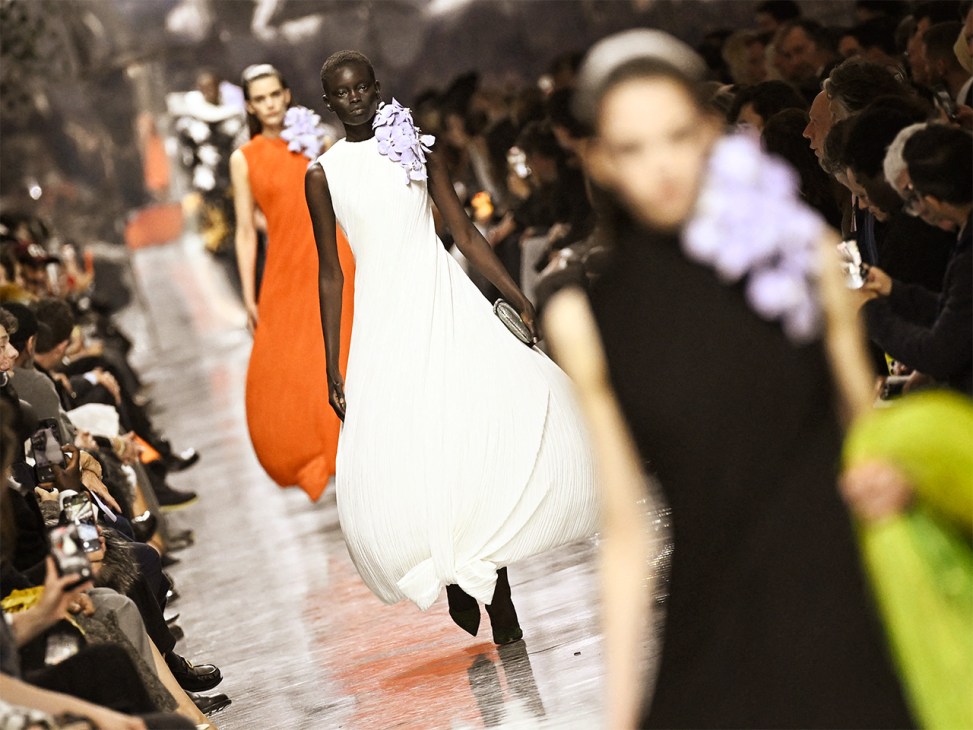
But in the evening, Dior took over a villa and filled it with all the runway looks along with an extra collection of more wearable silhouettes, bags and jewellery for clients. [The villa] catered to both the public appetite for spectacle and the clientele’s need for something practical to wear.
Alexis Mabille got a lot of headlines for his collection. Will you tell us about that?
Alexis Mabille didn’t tell anyone that he wouldn’t show any clothing [in-person] this season. [His show] was put together using AI, with AI-generated clothes on AI-generated models. The audience was a bit discombobulated.
The question is: is that allowed? Not in the creative sense, of course, because you can do anything that you want as a designer. But as I mentioned at the beginning of our conversation, couture is tightly regulated. There are rules about how many people you have to employ and how many looks you can show per season. Which leads us to the question: if you’re not showing actual clothes, are you still allowed to call it couture? There’s an ongoing debate on that.
Will Mabille go back to a more traditional show next season? From what I understand, his showcase this year was still labour intensive; he said it took up to 300 passes per outfit to make it look realistic. So it’s not like he was cutting corners and using AI as a quick fix. He was scanning the fabrics and had his atelier give feedback to the people doing the prompting about how certain pieces should look. But what do made-to-measure clothes at the highest level of personalisation mean if they’re all being done on the virtual runway?
It’s a bold move to make that choice. So far, AI is mostly associated with cheap imitations – the opposite of luxury. What do you think was his motivation behind it?
Mabille says many of his clients are asking to see things remotely. They don’t want to go to Paris for the fittings. [Using AI-image generation is] a way for him to get clients’ measurements, and he can send them a simulation of what the outfit might look like on them. I do know that he didn’t use AI to create the design, and that’s a very important distinction. It’s a bit different than [having an AI-image generator create a design entirely,] like putting the Pope in a Balenciaga puffer coat.
And do you think this week’s shows made a case for different kinds of innovations and for couture’s enduring relevance to the broader fashion industry?
The real takeaway for me was couture’s power to make you dream. We all need a bit of escape right now. Couture continues to send us strong messages about brand identity. Each of these labels, in their own way, is telling us something important about its outlook through these shows, while also functioning as entertainment.
And that’s a whole other debate. With fashion increasingly becoming more of a form of entertainment while also simultaneously slowing in sales, what exactly are luxury brands selling? They are sending us messages that will eventually filter through our perceptions of everything else – cafés, perfumes, handbags. It all ties together.