Meet the man feeding Paris from a single supply chain and an unmechanised farm
In a country that exports more than €80bn of its produce, Arnaud Dalibot is on a mission to educate fellow Parisians about the food that grows on their own doorstep.
The farm-to-table concept comes instinctively to the French. More than half of the nation’s territory is given over to agriculture, amounting to 17.4 per cent of the EU’s total farm land. Speeding eastward from the capital on an RER train, Monocle spies uninterrupted fields of wheat, barley and corn.
We’re on our way to Presles-en-Brie, a commune 40km southeast of Paris, where canteen and grocery shop Mûre cultivates about 1.5 hectares of south-facing land in small plots. Unlike most commercial farms that tend to focus on a primary crop, Mûre’s produces 150 varieties of fruit and vegetables. This traditional style of farming is known as maraîchage (market gardening); those growing food in this way often sell crops directly to restaurants.


Mûre’s farm is almost completely unmechanised. There’s one machine to remove old roots; everything else is done by hand. This allows space that conventional farms would reserve for tractors to drive on to be used for growing instead; failed crops can also be more swiftly substituted for new varieties. As demand for locally grown produce has risen and farming has become more sensitive to the vicissitudes of extreme weather, maraîchage has proven the efficacy of old-fashioned farming methods.
Instead of selling its produce to other businesses, Mûre keeps things in the family. At 05.00, electric vehicles transport the farm’s produce to the company’s grocery shop in Paris’s residential 11th arrondissement and its five restaurant canteens. At 07.00, chefs begin using those ingredients to prepare dishes for the lunchtime rush. At about 12.00, city workers flock to their nearest Mûre outpost to feast on the resulting dishes; the next morning, this cycle starts again.
On paper, Arnaud Dalibot doesn’t seem like the type of person who would have masterminded such an operation. But in 2014, the former finance executive at Moët Hennessy swapped the champagne business for planting, recipe testing and the difficult task of building a farm. “At the time, it was à la mode to open a burger restaurant in Paris,” says Dalibot. “But there was also growing demand for organic vegetables, beyond those prepared by fine-dining institutions such as Paris’s three-Michelin-starred L’Arpège.”
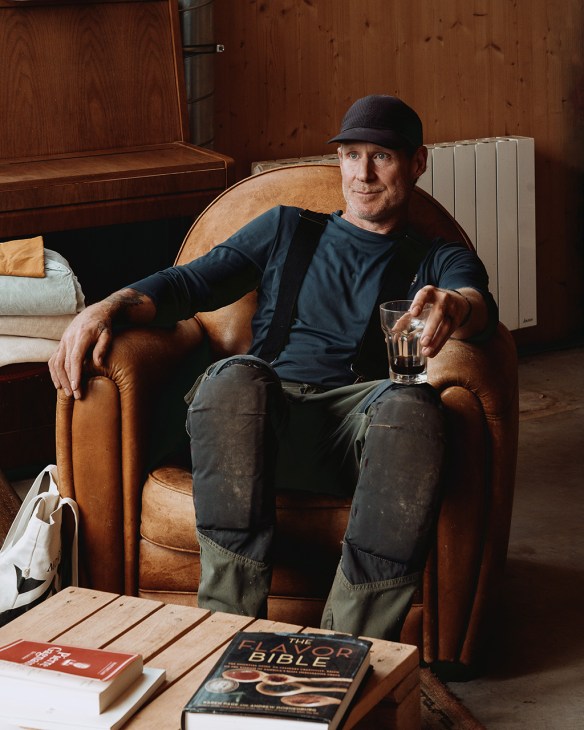
The idea for Mûre, which means “ripe”, took root while Dalibot was working in New York, where the urban-growing trend was in full bloom. “I liked the idea of connecting agriculture with nourishing cooking,” he says. Returning to France, he became aware that 85 per cent of the nation’s produce was being exported. “Paris has 10 million inhabitants and I wanted them to benefit from what grows on French soil,” he adds. “I’m interested in feeding Parisians.”
It can be gruelling work. “Running a restaurant when you’re also the grower and supplier means starting from scratch every day,” he says. “It’s a 24-7 job.” As well as spending three days a week overseeing the farm’s operations and the rest zipping between his grocery shop and canteens on a bike, Dalibot also develops seasonal menus. At weekends, he collects eggs from the farm’s 250 chickens (“This one’s called Linda,” he says, pointing to a mischievous hen trampling on the Swiss chard) and looks after donkeys Timy and Toumou. The link between the farm and the table here is Dalibot himself.


Back in Paris at Mûre’s new canteen on Rue des Italiens, a steady stream of employees from neighbouring offices are brandishing their restaurant tickets. Dalibot wanted these tax-efficient meal vouchers, provided by employers and typically valued between €7 and €14, to dictate the prices. A hot meal at Mûre costs €10.50. “We have slim margins,” he says. But affordability is a priority. On the menu today is roasted vegetable lasagne, an aubergine and confit tomato quiche and a courgette pizza with Grana Padano. “Parisians are epicureans,” says Dalibot. “Their first concern is the taste. Price is their second preoccupation. Whether a dish is produced sustainably tends to be at the bottom of their list.”
Bold, instructive branding is fundamental to Dalibot’s efforts to improve awareness. Mûre’s motto – “La cuisine des gens qui sèment” (“The cuisine of those who sow”) – is plastered on chalkboards. He concedes that some of the business’s hungry consumers might not fully appreciate the message. “But that doesn’t matter to me,” he says with a shrug. “I know that we’re doing the right thing.”
mure.family
Could France become self-sufficient?
As France is one of Europe’s most plentiful producers, food sovereignty is an entirely realistic possibility for the country. But while it is agriculturally resilient – particularly when it comes to dairy, grains and wine – its industrial food systems are still heavily reliant on imported coal and oil for machinery, fertilisers and transportation. Mûre’s closed-loop model, which takes things back to basics, shows that there might be another way.