Unlike my handwriting, the Republican politicisation of penmanship does make sense
Calligraphy is being politicised in the US, but it seems Ron DeSantis and co might have a point.
When it comes to handwriting, I’m ashamed to say my eight-year-old son has a better script than I do. Growing up in the late 1980s, my family were the kind of early technological adopters who would proudly pack me off to school with my word-processed homework even as my classmates wrote out every assignment by hand.
As a result, my handwriting got stuck around the age of six and to this day resembles the scrawling of a child. My actual child, however, is educated in the French lycée system, where students start learning cursive in école maternelle (preschool). Now his beautifully looping vowels and joined-up consonants dance across the page, putting my written words to shame.
It’s a regular feat of family fun to pore over my shopping lists, as my children take turns to guess the items that I have written down while howling with laughter. My ritual humiliation, however, is nothing compared to the embarrassment of some Americans who reportedly lack the penmanship skills to sign even the most basic financial documentation.
“They can’t sign their mortgage,” Toby Overdorf, a Republican legislator in Florida’s House of Representatives, recently told fellow lawmakers in the Sunshine State. “They can’t sign a bank cheque and I was astonished by this.”
Even worse, many American children apparently can’t read the US Declaration of Independence in its original 18th-century script, even as it takes a central role in classrooms this year as the nation celebrates its semiquincentennial.
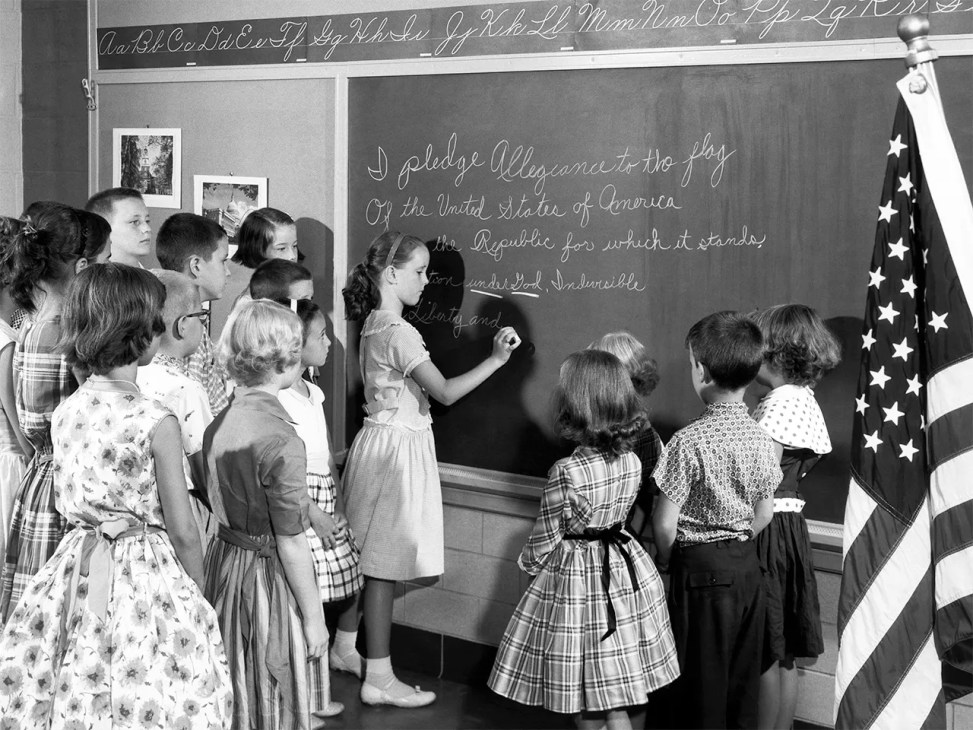
So last month, Florida governor Ron DeSantis signed a bill mandating that public schools teach cursive up to the fifth grade, part of a surprising resurrection across the US for a skill that many countries (the French not withstanding) declared moribund many years ago. Pennsylvania also mandated cursive writing in April, joining around half of US states that have revived the most traditional style of joined-up handwriting.
As well as allowing US kids to peruse the nation’s founding documents, proponents say that learning cursive helps to develop cognitive ability, hand-eye co-ordination, creativity and fine motor skills, as well as making it easier to identify potential learning disabilities.
But this is a deeply partisan America and nothing is just about the best interests of the child: it is also inevitably about the politics. Reviving cursive has become a conservative cause, embraced as part of a return to the traditional values of the past and a rosy nostalgia for the pre-woke days of education. One of cursive’s most ardent supporters is former Oklahoma schools chief and now anti-union activist Ryan Walters, who achieved brief notoriety in 2024 when he tried to compel every Oklahoma classroom to have a copy of the bible that almost exclusively matched one endorsed by Donald Trump.
But if it’s possible to put politics to one side, I’m all in favour of this revival of the classical writing style. Study after study shows us that learning in the analogue world is much more effective than on a screen. When we read on paper, our eyes dart across the pages between sentences and paragraphs, enhancing our comprehension and retention.
We also need to think about what skills children need going into a future jobs market dominated by AI. Children pick up technology quickly and intuitively: it’s literally designed that way, to be as easy to use and as addictive as possible. They don’t need to be taught how to use an iPad. With AI able to automate an increasing amount of our technological tasks, it makes sense to teach children a skill that helps them to slow down and think about what they want to say and how they want to say it.
Then there is the connection to the people in our lives. Every time I sit down to write a thank you note, a birthday card or a condolence message, I wince at my messy writing. I long for those loops and curls that would show my respect and care for the recipient.
So while it’s probably too late for me, I’m delighted that my offspring have acquired this skill – not least so I can start delegating those thank you notes and shopping lists to them.