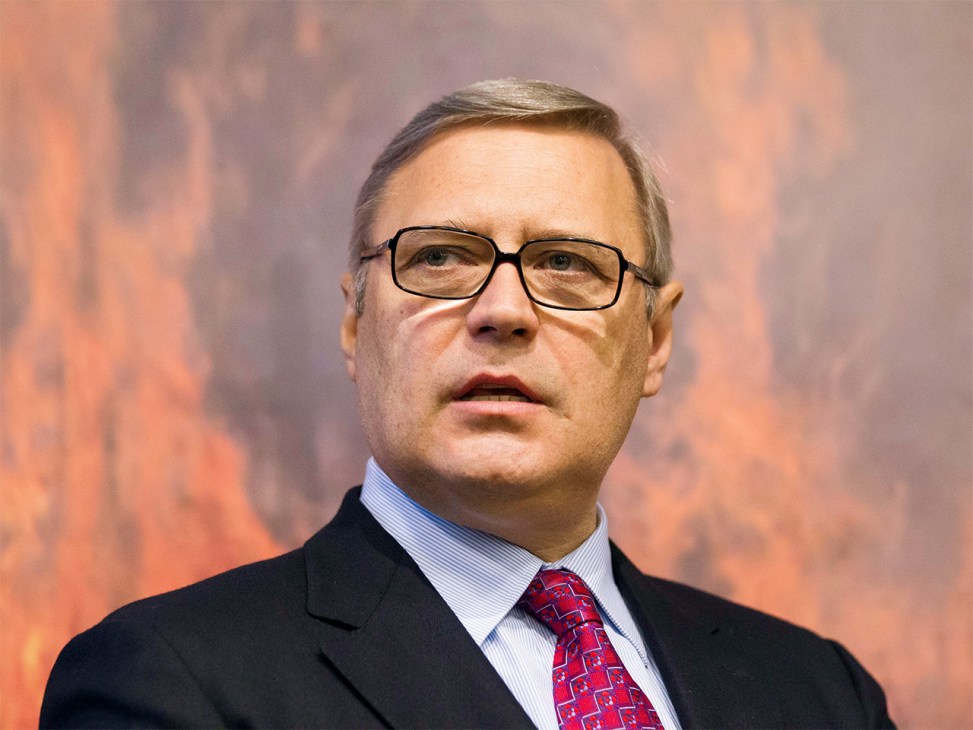
‘Putin is poisoning generations of Russians’: Mikhail Kasyanov on the future of the nation he once led
The former prime minister shared his thoughts on the current state of Russia, its leader and what the next 10 years might hold.
The wrath of Vladimir Putin is not an easy burden to shrug off: he is a man known for bearing grudges. Late last year, Russia’s federal executive agency for financial intelligence, Rosfinmonitoring, added Mikhail Kasyanov to its list of designated extremists and terrorists. When Rosfinmonitoring was established on Putin’s instructions in 2001, Kasyanov was prime minister.
At that time, neither leader was yet 50 years old, and the pair inspired optimism among Western democracies that perhaps Russia was, at last, preparing to join them. There was even some giddy talk of Russia becoming a member of Nato, and in 2000, Putin stated publicly that he wouldn’t rule out joining the alliance. By 2008, however, Russia had invaded a Nato aspirant, Georgia. Then in 2014, Russia commenced its assault on another, Ukraine.
Kasyanov, an engineer by education, had risen through Russia’s post-Soviet Ministry of Economy to become minister of finance by 1999; Putin made him prime minister the following year. Kasyanov’s efforts to liberalise Russia’s economy in the early years of this century did help the country recover from the chaotic collapse of the 1990s but did not endear him sufficiently to Putin to keep him in his position: Putin sacked him, along with the entire cabinet, before Russia’s presidential election of 2004.
Kasyanov attempted to run for president himself in 2008 but his candidacy was rejected by Russia’s Central Election Commission on dubious technical grounds. Kasyanov subsequently co-founded the People’s Freedom Party alongside Boris Nemtsov, who was assassinated in Moscow in 2015. Since then, Kasyanov has been a prominent critic of Putin – though it is difficult to know how much of his messaging still registers inside Russia.
Kasyanov now lives in Riga, Latvia. He spoke to Monocle’s Andrew Mueller at the recent Delphi Economic Forum.
When you became prime minister in 2000, what kind of country did you hope Russia might be by 2026?
It was absolutely clear to me that Putin and I were committed to building a democratic Russia with a market economy. Putin supported the majority of reforms that I wanted and my cabinet pulled Russia out of the economic crisis to a trajectory of sustainable growth. We had excellent relations with the EU. We had good relations with the US. I even publicly announced that my country would be a full-fledged member of Nato and EU, that we were strategic partners, and our goal was a free-trade zone and visa-free zone from Lisbon to Vladivostok.
In retrospect, was Putin sincere about wanting those things?
Yes but he simultaneously wanted to be recognised as a great leader. He thought that democratic rules, or international law, were things that should be interpreted the way he wanted.
Is it clear to you why he wanted to be recognised as the kind of leader he has become, rather than as a liberalising moderniser?
He thought mostly about his personal influence and personal respect, and when he started to get criticism from European and American leaders, he began to change. In his [2007] speech in Munich, he said that we were surrounded by enemies and started building a different policy. In 2008, he began to test the situation with the invasion of Georgia. And the West turned back to Putin and conducted business as usual. Putin took this as being given a special ticket that allowed him to act this way and the annexation of Crimea was the result.
Since 2022 especially, a narrative has taken hold in Europe that Russia is irreconcilable, that it can’t be a European country in the way that others [in the region] are. Do you agree with that?
Leaders should educate and lead people, rather than cultivate the negative aspects of their characters. Putin is poisoning generations of Russians. It is absolutely wrong and [he] will be reconsidered by Russians, I hope, soon.
Does Putin have to go before that can happen?
Any leader who will come after Putin, even [if they come] from Putin’s circle, will be looking for negotiations with the West to stop the war immediately. Russia is already integrated in the global economy and global affairs, European in particular. All people, even those around Putin except a few KGB [members], understand that Russia’s future is with Europe. We conducted the right policy in the beginning of this century and Putin was one of its producers. But he made a big mistake and now cannot get out of the problems that he [created] for the country.
You’ve been accused, along with a few others such as Vladimir Kara-Murza, Mikhail Khodorkovsky and Garry Kasparov, of conspiring to overthrow the Russian regime. Is there any possibility that Putin’s successor could be an exile returning or does the next leader have to come from within Russia?
No one from outside could be elected and democracy couldn’t happen overnight. Russia would have to, unfortunately, go through a very difficult time. It could be five to 10 years [before change happens]. Any leader who will step in instead of Putin will lack legitimacy and that’s why they would need to build up. They could start liberalisation to a certain extent but the country will be unstable for a long period. But a democratic Russia could be built with Western support.