College commencement season is upon us – now is the time to tackle big ideas
At a time when dulled language and strategised communication make our polarised worlds impenetrable, the upcoming spate of college commencement addresses in the US offers an opportunity to redeem the national conversation.
Commencement season at universities across the US is under way. But before this year’s graduating students hurl their mortar boards into the air, there is one final task that any self-respecting graduation ceremony will make its freshly garlanded graduates sit through – the commencement address.
These speeches are the centrepiece of a university graduation – words of wisdom styled to inspire their fresh-faced audiences as they bid farewell to their classrooms and step into what was once quaintly referred to as the real world. But it is often who gives the address that captures more attention than what they say.
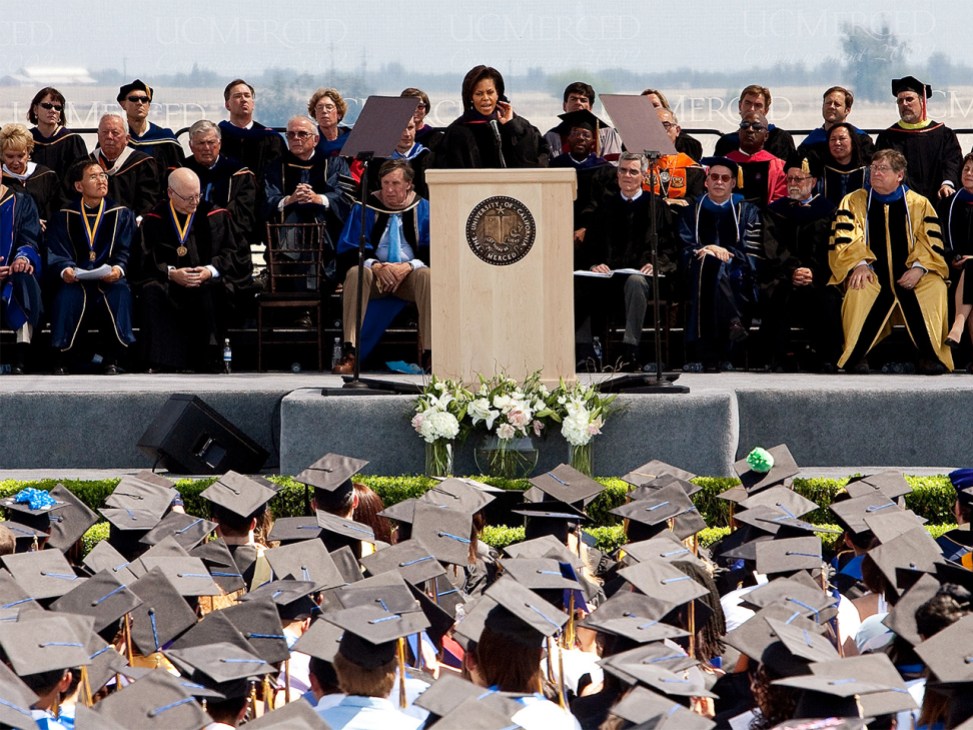
Michelle Obama, Mark Zuckerberg, Oprah Winfrey and Dolly Parton are all among the inductees into this who’s who of graduation speakerships past. Some think that the starrier the speaker, the more cynical the motive – that universities are keen on hitching their bandwagons to one celebrity or the next for the free publicity that their honouree will bathe their quadrangles in come graduation day.
But the truth is that if you’re somebody in America, you’ll be invited to give a commencement speech. Think of it as a US answer to the UK honours system – but instead of being anointed a knight or a dame, you get to be draped in robes, crowned with a tasselled academic’s cap and give a graduation address.
So, what if you’re asked what to say? Platitudes, suitably saccharine, that all of life’s wonders lie ahead of you, and so on, are most welcome here. But you might want to capture the zeitgeist in some way – as Hillary Clinton did at her alma mater, Wellesley College, the spring following her presidential election defeat in November 2016. Here, she noted not only how long walks (and big glasses of chardonnay) had steered her through tough times of late but also offered a rallying cry – that her audience’s appetite to battle on should be heartier than ever in the sting of defeat.
Even US presidents – past, sitting and future – have used commencement addresses to set out their pitches and principles to the country at large, far beyond their graduation day audiences. The current governor of Illinois, JB Pritzker, a likely contender for the Democratic Party’s presidential nomination in 2028, memorably argued in 2023 that the spirit of collegiality embodied by his audience should spill out far beyond the confines of college life.
But it is Toni Morrison, the late US novelist and Nobel laureate, who arguably captured the mood best in 2004, when she unsentimentally reminded students that, “You are your own stories. [And] although you don’t have complete control over the narrative – no author does, I can tell you,” she quipped, “you [can] nevertheless create it.”
It’s in that spirit then that we doff – or toss – our caps in honour of this year’s commencement season, where the art of oratory itself would be wise for speakers to muse on. Because the language that we use to speak to each other, to communicate a big idea or to argue a case can feel far less considered than it once was, particularly in the US. It has become pretty easy to flatten language out of its richness, dimming the gleam of what we’re really trying to say. In a noisy world where cynics deploy their words as weapons, speaking clearly, thoughtfully and honestly has never felt more vital – whether you’re about to graduate this summer or not.
Tomos Lewis is Monocle’s Toronto correspondent.
Further reading? Monocle’s editor in chief, Andrew Tuck, explains how to prepare before speaking publicly and how to host great on-stage discussions.