Trump could learn from the World Cup’s International Police Co-operation Center
As part of the International Police Co-operation Center, the multilateral intelligence-sharing efforts of 46 nations and 16 host cities keep the Fifa World Cup safe and secure – and it also teaches Trump a…
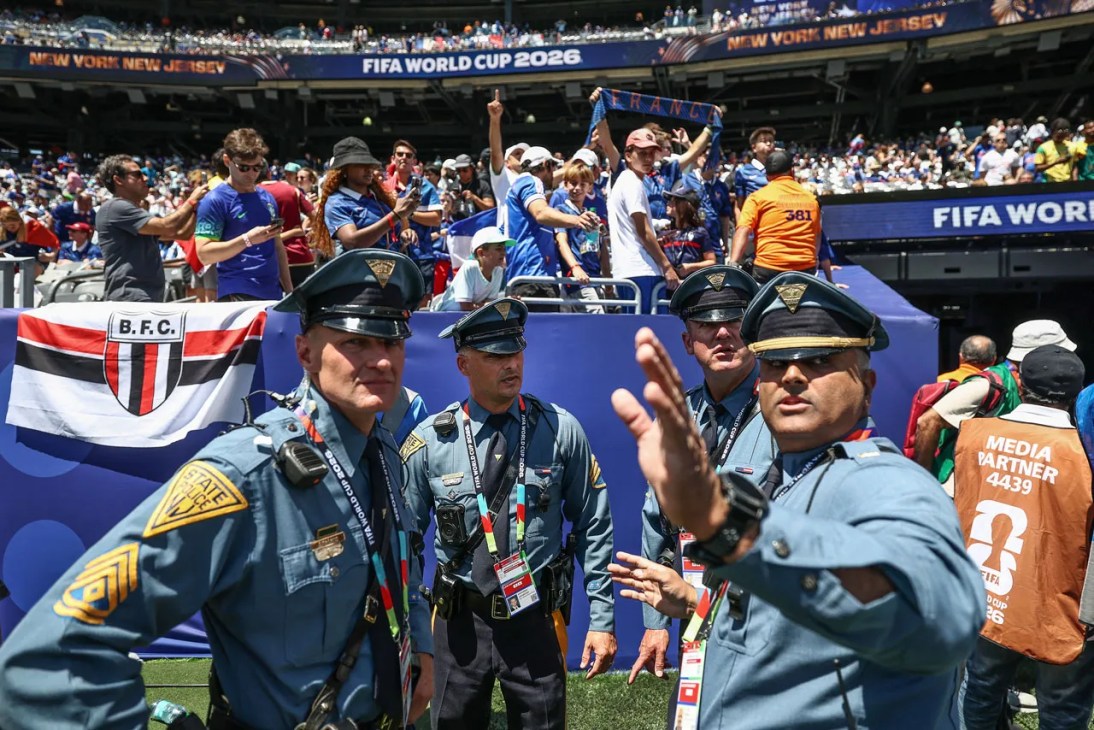
At a conference centre just south of the Virginian town of Leesburg, a Houston sheriff in a broad-brimmed Stetson sits at a table alongside two smart-suited Japanese law-enforcement officials and a Brazilian police officer with medals pinned to his khaki uniform. A few tables away, there is gentle ribbing between Belgian and Senegalese officials, as the White House’s World Cup point man, Andrew Giuliani, probes them on their teams’ respective playing styles. As security representatives from 46 nations and 16 host cities murmur to one another beneath large screens depicting national flags, the room has the feel of a UN confab – except with more cops and football talk.
While it’s a quiet morning when Monocle visits the International Police Co-operation Center (IPCC), the hub of the multinational operation tasked with keeping the 2026 Fifa World Cup safe, that changes when a match begins. “The atmosphere in the room gets pretty lively,” says FBI special agent Doug Olson, the senior co-ordinating official for this year’s tournament. “There’s a heavy bit of competition at the tables. It’s like a kind of a microcosm of the tournament itself, which is great.”
Healthy competition in the tournament comes at a time when the US has kicked off a less than sportsmanlike battle for global supremacy. From berating hisNato partners at the recent summit to threatening the seizure of Greenland and Canada, US president Donald Trump continues to busily work through a list of allies to anger and alienate.
The security repercussions have been wide-ranging. Many European nations, including the UK and France, stopped sharing some intelligence with the US because of their lethal strikes on boats suspected of carrying drugs in the Caribbean. The Netherlands also scaled back co-operation, concerned that intel could be used to violate human rights or assist Russia.
All of which makes international co-operation at the 2026 World Cup just a little bit eyebrow-raising. “The work that’s coming out of this IPCC has been absolutely key to making sure that this [World Cup] is safe and secure,” says Giuliani, son of Maga stalwart and former New York mayor, Rudy.
Pressed by journalists on whether ill-tempered relations between the US and its neighbours to the north and south had affected efforts to keep everyone safe, Giuliani and Olson insist that there has been no impact. “I can’t speak to any of the issues surrounding the World Cup but I can tell you that the security co-ordination with our Canadian counterparts has been outstanding,” says Olson. The Mexican contingent have similarly “been great partners”.
After gushing about working with the tournament’s co-hosts, Giuliani launches into Trumpian hyperbole. “I said that there’s going to be no larger platform to be able to show off true American exceptionalism,” he says. “People are seeing that now… the great hope and promise that the United States offers over our next 250 years.”
When Giuliani was appointed as executive director of the White House Task Force for this year’s event, there were whispers of nepotism and broad scepticism about his ability to manage such a huge sporting tournament. But as Sunday’s final approaches, there has been scant drama off the pitch. Much of this is down to the security co-operation by all the participating nations – except for Haiti and Iran, which were excluded from the IPCC.
During every match, the tables are rearranged so that representatives from each competing team are seated alongside officials from the host city. Then they can talk in real time about any intelligence coming from the ground or from online spaces warranting investigation or response.
If Trump bothers to pay attention, he will see the benefits of multilateralism in action. One nation cannot go it alone and browbeat others into co-operation. Keeping the world safe means some give and take, with cross-cultural understanding and respect helping forge alliances that will benefit everyone.
While there is no way that Giuliani would concede such a political point, one example he gave encapsulates it perfectly. He said thatwhile a US security apparatus might know the threat environment around a New York Giants or Philadelphia Eagles game, they need input from other nations to understand the behaviour of a global fanbase and to decode any warning signs of trouble.
Olson agrees. “Safety and security aren’t accidental,” he says. “We do these things deliberately every day and we receive threat information every single day. That is shared with all our partners at the local, state and international level. That’s how we’ve been able to maintain a safe World Cup.”
At the Nato summit in Ankara last week, Trump abruptly announced that the ceasefire with Iran was over and harangued his allies for not doing more to assist him in a conflict that he unilaterally started. It was classic Trump: combative, unco-operative and it didn’t win him any of the extra assistance that he was hoping for.
When Trump attends the World Cup final on Sunday, many of the US’s traditional allies will be hoping that some of that footballing goodwill flows off the pitch and helps the president understand that alienating your neighbours is a geopolitical own goal.
Charlotte McDonald-Gibson is a Washington-based journalist and regular Monocle contributor. For more opinion, analysis and insight, subscribe to Monocle today.
Further reading:
– The biggest contest of the 2026 World Cup is off the pitch
– A sticky World Cup tradition: Tracking down Panini football stickers
– Tacky? Yes. Patriotic? Often. But the World Cup needs its anthems