The new space race: How satellite internet is changing the face of the Ukraine-Russia war
Russia has launched its own fleet of Rassvet satellites, which could challenge Ukraine’s use of Starlink for combat.
It sounds like the battle sequence from a science fiction film. An enemy is detected by sensors that transmit the information to a command centre where software using artificial intelligence calculates an attack plan. A human approves the plan, then deploys an automated drone to destroy the enemy. The sensor confirms the kill.
Four-and-a-half-years into Russia’s full-scale invasion of Ukraine, this system, known as a kill web, is a reality. It combines live intelligence with tactics, planning processes and real-time logistics data to enhance precision and speed in war. While militaries around the world have been developing kill webs for decades, Ukraine is the first nation to use them at scale. That has shifted the war onto the internet and into space.
Ukraine’s kill web is made possible by an online connection between front-line units, command centres and hidden launch sites. But combat units can’t drag fibre-optic cables around behind them, so broadband-beaming satellites have become as important as missiles and drones. Access and use of those satellites is a battlefield in itself.
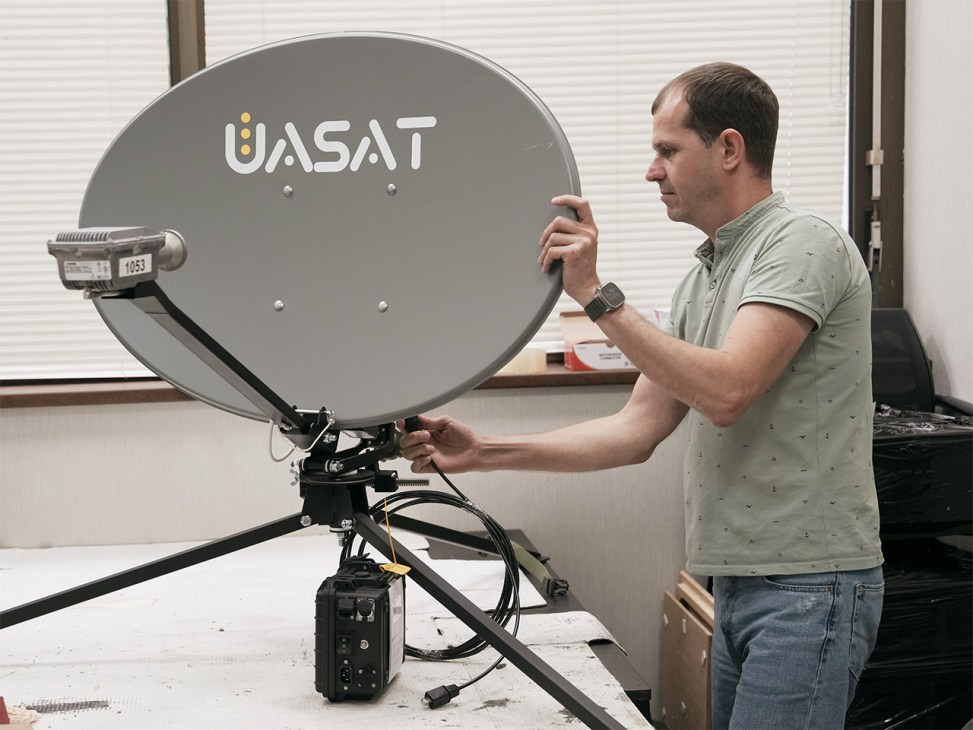
For much of the war, Ukraine has depended on Starlink, the SpaceX-owned, Elon Musk-run satellite internet network. Though sanctions prevented Russia from accessing the network directly, Russian troops used Starlink through terminals – the portable antennae that connect to the satellites – bought from resellers in the Middle East. That was until February of this year, when Ukraine’s then-defence minister Mykhailo Fedorov lobbied Musk to enforce stricter verification systems on the terminals, blocking Russia from accessing the network.
Russian forces suddenly found themselves without communications and Ukraine’s military took advantage of the ensuing chaos to recapture territory in the south. That loss of access and the ensuing operational impact drove Russia to speed up the deployment of Rassvet, its sovereign answer to Starlink, launching the first 16 satellites earlier this year. If everything goes according to plan, Rassvet will have 292 satellites in orbit by next year and nearly a thousand by 2035.
The introduction of Russian satellites will undoubtedly shift the war. By building its own network, Moscow will be able to deliver more precise attacks on Ukrainian troops, cities and infrastructure – something that Kyiv can’t do inside Russia. This is because SpaceX implemented geofencing, meaning that Starlink can only be used inside Ukrainian territory.
The network has made Ukraine vulnerable in other ways. During 2025 negotiations between the US and Ukraine, the Trump administration threatened to cut off Ukraine’s Starlink access if Volodymyr Zelensky refused to sign a deal. So, Ukraine has been exploring alternatives, such as Europe’s Eutelsat OneWeb.
Rassvet is a problem for Ukraine’s allies, too. Russia has already used drones for sabotage, reconnaissance and disruption operations in the UK, Scandinavia, the Netherlands, Germany, the Baltics, Romania and more.
Russian forces are slowly capturing tiny pieces of Ukrainian territory at an enormous cost to Ukrainian lives but Rassvet would shift the momentum in their favour. For now, the network is too small to provide the continuous internet coverage that Moscow needs to gain a battlefield advantage. Ukraine is furiously hitting the factories that make Soyuz-2 rockets (which launch Rassvet satellites) to stop the network from being completed.
The war in Ukraine has led to the fastest innovation cycle of any war in history. Both sides are constantly developing new capabilities, which each tries to counter and match. It began with tank battles, helicopters and large numbers of troops. Next, it was a race for artillery shells, then a contest of drone tactics and production. Now the battle has moved into space but the prize is still very much on Earth: the precious land of Ukraine.