How a Milan-based duo is rewriting the rules of design, one research project at a time
Formafantasma’s Andrea Trimarchi and Simone Farresin have been named Monocle’s Designers of the Year for 2026 thanks to work that delves into ecology, politics, history and the hidden forces shaping our world.
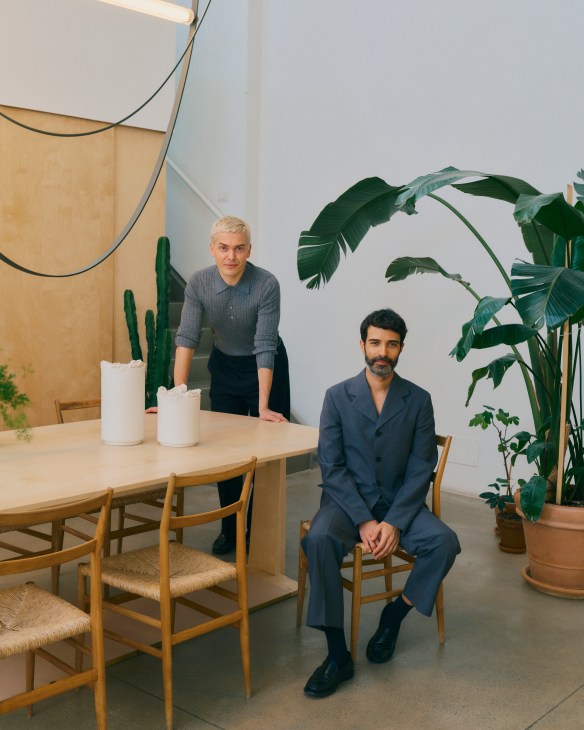
It’s a bright spring morning when Monocle meets with Andrea Trimarchi and Simone Farresin in their sunny studio, a former printing factory tucked between Milan’s Crescenzago and Cimiano neighbourhoods. The duo established the research-led practice Formafantasma in 2009, working on both client commissions and self-initiated research projects that explore ecological, historical, political and social forces.
Across more than 15 years of work, they have established academic courses at the likes of Design Academy Eindhoven, published books aimed at demystifying environmental science and developed design-led business strategies for furniture firms such as Finland’s Artek. They have also fulfilled no shortage of the more standard briefs, including spatial design for Marni’s Milan Fashion Week show this year, exhibition design for the newly opened Fondation Cartier in Paris and lighting for Italy’s Flos. The breadth of the portfolio is matched by the quality, which has earned them the nod as Designers of the Year in Monocle’s 2026 Design Awards. Here we dig into their approach and outlook to design.
Your practice spans everything from industrial and spatial design to curation. How do you ensure consistency across disciplines?
Simone Farresin: Design sits between economy, ecology, visual culture and the lives of people. So, why is it so strange that in our work we implement and explore all of these? Design has been described as a study and an aesthetic tool but the best designers never work in this way alone. Enzo Mari, for instance, was very political in his work; Charles and Ray Eames worked for corporations and films. These people have always been our references.
Andrea Trimarchi: There is a history of people who work across multiple media. It’s only in the past 20 years that we have become very set, with people only working on exhibition design, products or fashion.
How do you start to tackle problems and respond to briefs? Do you have a typical approach?
SF: We are visual people. We come from visual culture. We’ve always been interested in design, architecture and art – that’s our DNA. We have a sensitivity where we understand the world through that visual lens. But we also see the complexity that lays behind things. The two are not separate. Then there is the fact that there are two of us, so our work is conversational. Our world does not involve someone sitting down at a table in isolation and starting to draw something. We’re much more about these words that lead us toward the positioning of the design, rather than only an expressive act from an individual.
AT: We don’t think about our work insolation. Take the Superwire for Flos. It’s a beautiful lamp on its own but there’s deeper thinking behind it. It’s repairable and that stems from a project researching electronic waste that we did many years ago. Patterns start emerging between these works.


As a society, are we too scared of taking risks or being critical?
SF: Yes. There are a lot of people in our industry who will say ‘we can’t do that because people won’t understand’ – and that makes me nuts. Generally, the only people that don’t understand are in the room. There’s a perceived superiority over people in the streets. That’s why we watch horrible movies and have bad journalism – we underestimate the people.
AT: In any case, it feels like everything boils down to simplification – that’s in the cultural world and industry too. Sometimes this manifests in meetings where people want to remove details or even components, such as screws. But you don’t always need to remove the screws. It’s fine to see how things are connected. We don’t always need smooth and perfectly reflective surfaces. It’s a beautiful metaphor – if we smooth out all the friction, then eventually we will just fall asleep.
How do you remain motivated?
SF: The world is increasingly conservative right now, from politics to products. There is fatigue and a sense that we are overloaded with things. We see companies being bought by other companies being bought by corporations, so people go to work in the morning with the objective of making more money. If you have that as your objective, it’s not economy but culture – and that culture shapes our reality. So, it’s becoming increasingly difficult to do something meaningful, which is probably why our practice is so expansive.
AT: In this specific moment in time, we should go beyond surfaces. Design should never feel superficial to me. The best designers have always worked in moments of emergency.
formafantasma.com
Further reading:
– All 25 winners of the 2026 Monocle Design Awards