‘The perfect kitchen is where there is no fear.’ Seven global chefs share their tips for running a successful restaurant
The leaders of Attica, Masala y Maíz, Darjeeling Express, Baroo and Wursthall on striking the right balance between ambition, passion and creating safe, supportive environments.
In recent months the culinary world has been rocked by reports of abuse inflicted on staff members at Noma, the restaurant often considered one of the world’s most influential. Though volatility in professional kitchens has long been documented, the details that have surfaced – of public shaming and threats – have taken on extra significance given that Noma and its chef, René Redzepi, had the authority to stamp out these toxic behaviours rather than uphold them.
At their worst, restaurant kitchens can be chaos. But at their best, they can be a centre of community and creativity, and produce transcendent moments for their diners. Here, Monocle speaks to forward-thinking chefs and restaurateurs from five institutions about their efforts in striking the right balance between ambition, passion and creating safe, supportive environments in which their employees can thrive.
These conversations have been edited for clarity and length.
Kwang Uh and Mina Park
Co-owners, Baroo
Partners Uh and Park are revered in Los Angeles not only for their ambitious, fermentation-driven Korean menu but also for their progressive work practices.


What measures have you introduced [in your kitchen] to create an equitable, supportive workplace?
Mina Park: We offer good pay for the kitchen [staff] due to how big the tipping system is [for front of house] in the US. Our cooks make a higher-than-average hourly pay and we provide top-ups for our managers [to ensure] they’re never behind an employee who earns tips. What’s equally important is that our cooks work 40 hours a week.
Kwang Uh: I won’t ask my team to do anything I’m not willing to do myself. I set clear expectations and will follow up to make sure that things are on track. But I also want my cooks to feel a sense of responsibility for their work and that what they do here is helping them develop. I have frequent one-on-ones to see how they’re doing.
Kwang, you once considered becoming a monk. Do you operate the kitchen with a monk’s mindset?
KU: Being aware of every moment really helps with clear communication and focus. Buddhist ideas of compassion also help me be open to others and try to understand people from their own perspective, rather than be stuck on my own point of view.
Ben Shewry
Chef and owner, Attica
Attica, co-managed by Shewry, was one of the first restaurants to bring native Australian ingredients to global attention. Shewry’s 2024 book, Uses for Obsession: A Chef’s Memoir, calls out the industry’s toxic attitudes.


Why do you want Attica to be seen as one of the world’s best small businesses rather than as one of the world’s best restaurants?
The world’s best restaurants often have some of the world’s worst business practices. I will never allow the abhorrent things that have happened to me – bullying, harassment, verbal and physical assault – to occur under my ownership. When I took over, I wanted to draw a line in the sand, so I looked to companies in other fields for inspiration, including Patagonia [which is known for its fair labour practices and commitment to sustainability]. I couldn’t get around the idea that a culture of fear is somehow linked to elite performance. There are many performance advantages when you have employees who are supported, paid properly and know they’re not [just] a number.
How do you encourage staffers to take ownership of their mistakes – and how does doing so allow for better work?
Our workplace grants people the freedom to express opinions without fear [of being] made to feel stupid for doing so. If they can’t do this, it’s very hard for them to feel secure when they actually fuck up, which we all do. [When] people feel comfortable enough to make their managers immediately aware of any issues, problems are addressed quickly.
Why do your staffers do weekly speeches?
The front of house and kitchen used to be at odds and it would get fiery during service. The issue was that the teams didn’t know each other. We would never [reach] high performance unless we addressed this. Staff speeches were introduced [about] 15 years ago. Everyone gathers for 20 minutes on Wednesdays and a different person presents to the group. Our head chef has spoken about his love of Richmond, the local AFL football team, and we’ve also heard about much harder things. The day that someone told us about their experience of being bipolar was really touching. Standing in front of an audience and receiving positive reinforcement is empowering and being vulnerable builds empathy – and that passes over to our diners.
Norma Listman and Saqib Keval
Chefs and co-owners, Masala y Maíz
The Mexico City restaurant bridges the cuisines of Mexico, South Asia and East Africa. The duo behind the establishment is equally known for championing sustainability, social justice and better working conditions in the industry.


What measurements have you put in place to create a fair work environment?
Saqib Keval: We have humane working hours – the first guests arrive at 12.00 and the last staff member leaves at about 21.00. We hire more employees so that we don’t have to ask people at the last minute to stay late. We have open-book financial management [which allows our] staff to see the restaurant’s expenditures. There’s profit-sharing and the team shares tips, which applies even to those who are on leave.
Norma Listman: We decentralise our power. There’s an annual general assembly with our staff, during which we make addendums to the rules of the restaurant. We also have someone who does group coaching and provides one-on-one growth plans – for example, if there’s a worker who wants to eventually open a restaurant, then they’re going to sit in on our operations meetings.
The notion of the ‘genius’ chef has long been problematic. How do you combat that?
NL: When someone makes a dish that’s served in the restaurant, the menu and our servers will credit that person. It’s their creative and intellectual right to have their name attached to their work.
Unpaid kitchen interns have traditionally propped up the industry. What are your opinions on their role?
NL: We [hire] one stagiaire [an intern] every few months and it’s a paid position. If you’re doing a trial with us, you’re also paid for it. We don’t believe in free labour.
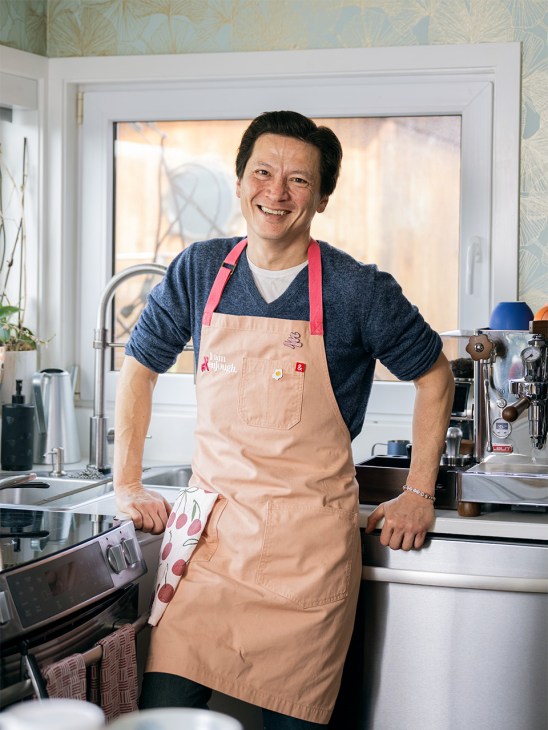
J Kenji López-Alt
Chef and author
Before a career in cookbook writing, López-Alt spent years climbing the kitchen ladder. Between 2018 to 2022 he operated Wursthall, a beerhall-inspired space in California.
Other than the obvious rules, such as no violence, what are your non-negotiables in the kitchen?
You can raise your voice to be heard but you can’t do so in anger. There are no public put-downs; if there’s something that needs correcting immediately – a safety issue, for example – you can address it but anything else must wait for when you can talk privately. And it’s always about addressing the issue, not the person. No sarcasm. No gender, race, sexuality and appearance-based comments. No cursing in any language. And make sure that camaraderie extends to everyone.
How did you make sure that your kitchen ran efficiently?
We made the space accessible for everyone. Many restaurants are designed around an average male frame. We adjusted shelf heights and made sure that step stools and ladders were within easy access.
Can you provide an example of good leadership that you have witnessed?
You have to let your staff know what the priorities are but you need to also understand that they’re there to learn. When I had questions, my old boss Jason Bond would say, ‘I hear you; right now is not the time but I’ll get back to you.’ After service, we would discuss my queries.
Good leadership is also not just about being prepared for a busy night but making sure that there’s a contingency plan – such as notifying the bar staff to send free drinks to tables that have been waiting a while for food – and that you’re mentally prepared if something goes wrong. You want people to respect you because you respect them, not because they fear you.
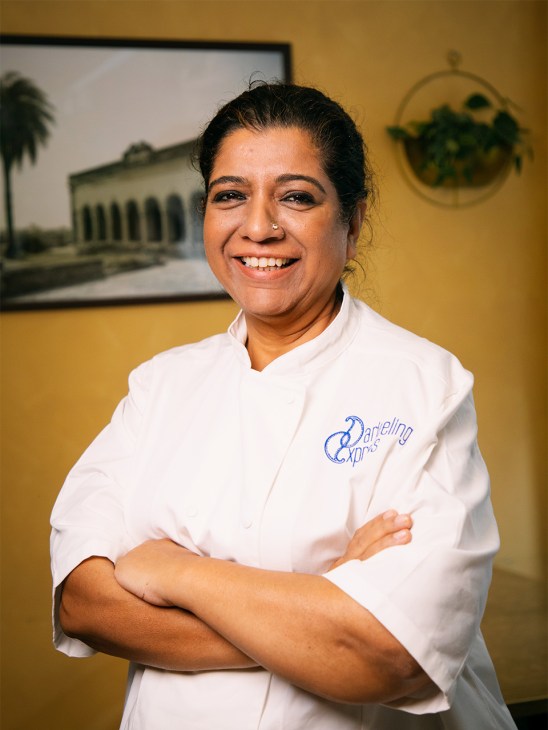
Asma Khan
Chef and owner, Darjeeling Express
The kitchen at Darjeeling Express, Asma Khan’s Indian restaurant in London’s Soho neighbourhood, is run exclusively by South Asian women, including several grandmothers.
How have you made your kitchen a safe space for women?
I have a flat system regarding leadership and payment: everyone has the same rate, including [myself] when I’m in the kitchen. It’s important to recognise that the kitchen porter is no less skilled than the person cooking the korma. It also prevents us from using the brigade [the traditional Western structure for organising hierarchy in the kitchen], which is a system set up to feed individuals who thrive on power. The perfect kitchen is where there is no fear.
How are duties assigned?
The cooks decide what to do on the day. Those who are good at certain tasks will do them. Those who aren’t in the mood to, say, make koftas and want to do the garnishing [instead] will negotiate – this is about communication. The staff [many of whom are second daughters, a family position traditionally subject to discrimination in India] are survivors of a patriarchal system, so they know that shouting leads to a zero per cent chance of co-operation.
How can hiring practices [in the industry] be improved?
Those in charge are choosing people who they can relate to and hang out with or they want the stereotypical chef – a young, volatile person with tattoos and piercings. Instead, they should [use their] imagination; hire women and train older women.
Read next: