Is it a bird? Is it a plane? No, it’s a rapidly evolving space race
The space race is back – and this time it’s an even more hotly contested arena. Can the world’s powers navigate this increasingly crowded orbit?
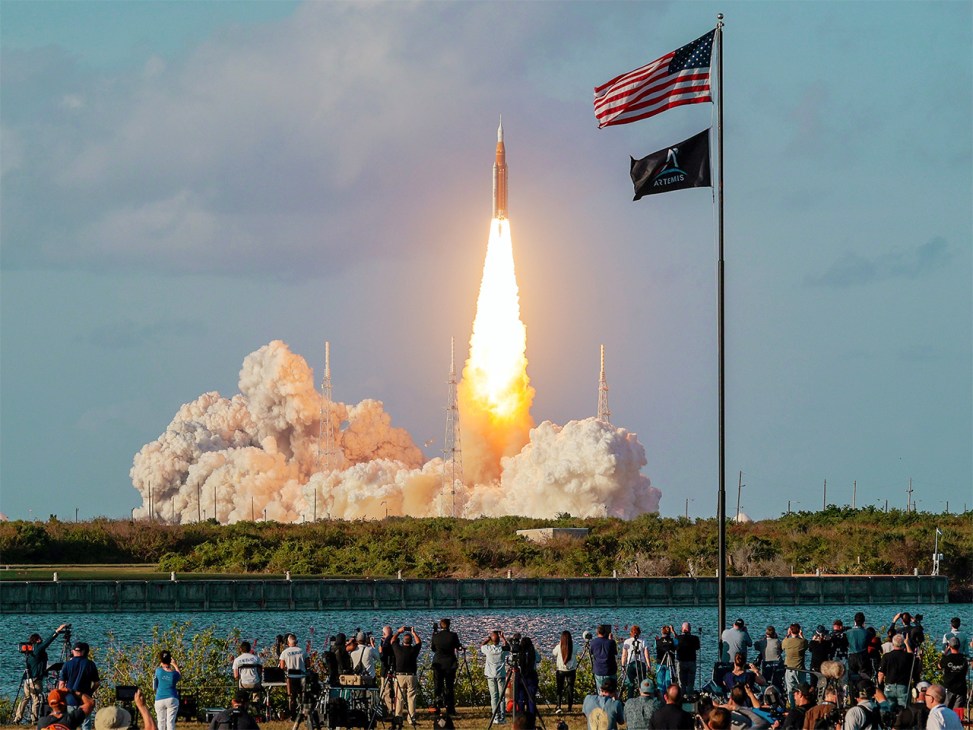
The recent completion of the Artemis II mission was meant to remind us that space can still be a shared frontier. Artemis represents a step toward sustained lunar exploration and, eventually, Mars. Yet that hopeful image sits alongside a harder reality: space is becoming a contested strategic domain and the gap between rhetoric and security practice is expanding like the universe.
The current state of arms control in space paints a picture of regulations that are thin, incomplete and increasingly outpaced by events. The 1967 Outer Space Treaty still bans weapons of mass destruction in orbit and on celestial bodies but it does not prohibit all military activity in space, nor does it provide a detailed rulebook for counter-space competition. Today’s UN process is therefore trying to manage the problem rather than solve it outright. In 2025, the General Assembly established a new open-ended working group for 2025-2028 to issue recommendations on preventing an arms race in outer space. That’s diplomacy but not disarmament.
The more immediate question is whether there are real prospects of open conflict in orbit. The answer is yes, in the sense that militaries are now planning for it as a live contingency. US Space Command planners are preparing for the first major war in space and Western officials increasingly speak of space as a war-fighting domain. Yet the more unsettling problem is that conflict is not a clear exchange of blows; instead, it is emerging as a pattern of coercion, rehearsal and ambiguity. That makes escalation harder to detect and therefore easier to misinterpret.
A lot that we can see in orbit looks a great deal like preparation for conflict. China, Russia, the US and India have all conducted anti-satellite weaponry tests, leaving behind debris that risks collisions with hardware. More recently, there have been reports of Chinese satellites practising co-ordinated “orbital dogfights”, as well as a Russian spacecraft that shadowed a US reconnaissance satellite for nearly two years.
Alongside this are persistent concerns about jamming, lasers, cyberattacks and close-proximity operations. European responses reflect this shift: France is developing patrol satellites to monitor adversaries; the United Kingdom is investing in sensors to detect laser threats; Germany is building a large encrypted military constellation; and the EU is expanding capabilities to improve resilience against GPS interference.
Recent reporting related to Iran is particularly sobering because it illustrates how space-based capabilities are being integrated directly into terrestrial warfare. In April, Iran reportedly acquired a Chinese spy satellite and used it to monitor US military sites in the Middle East. At the same time, Russia has been providing Tehran with targeting information on US warships and aircraft. Taken together, these developments point to a future in which orbital assets do not merely underpin deterrence; they actively enhance strike capabilities on the ground.
None of this is unfolding in a spacious or forgiving environment. Earth’s orbit is increasingly crowded and fragile, with more than 14,000 satellites and an estimated 120 million pieces of debris in low-Earth orbits. Even debris as small as one centimetre can be lethal, as the extreme speeds of hypervelocity impacts give such fragments enough force to disable a satellite or trigger catastrophic fragmentation.
This congestion has prompted warnings that parts of the atmosphere could become unusable without improved co-operation and data-sharing. Governments and commercial actors are acutely aware of how the security problem and the congestion problem are becoming one and the same. Starlink has announced a 2026 reconfiguration to lower its satellites and reduce collision risks.
And yet the most likely response from space powers will be familiar: to harden their positions. This will mean more patrol satellites, more resilient constellations, expanded electronic warfare capabilities and a greater emphasis on redundancy over vulnerability. Artemis II might have revived hopes of a co-operative future but the strategic environment surrounding it is moving in a harsher direction; toward a space order defined by enduring competition.
Gorana Grgić is Monocle’s security correspondent. To hear about what’s next for the space economy, tune in to Monocle Radio’s ‘The Bulletin with UBS’. And for more opinion, analysis and insight, subscribe to Monocle today.