Hydro is the Norwegian firm making aluminium the designer’s material of choice
The aluminium producer’s commitment to circularity offers a shining example of what real progress looks like in the materials sector.
Hydro Circal 100R
Monocle Design Awards 2026: Best material development, Norway
On a sunny morning in the southern Dutch city of Drunen, a front loader moves slowly across one of the storage depots at Hydro’s aluminium plant, scooping up heaps of scrap aluminium. The scrap is then moved to the adjacent building, where the air is warm with an unmistakable industrial scent. It is here that the metal begins its transformation. Crushed window frames, street-light poles and greenhouse parts are melted down in a 1,000-degree furnace, then purified and extruded into long, silvery profiles. But the molten material isn’t only used to make new building envelopes or car parts – it’s also finding its way into our homes as covetable design items.
This is the unlikely link that Norwegian aluminium producer Hydro has forged through its R100 project, a programme that turns post-consumer material into refined furniture and lighting pieces made entirely within a 100-kilometre radius. When the project – a collaboration between Hydro and five leading designers – was first presented at Milan’s Salone del Mobile last year, it caused quite a stir. Its reputation was only enhanced by its most recent showcase at Eindhoven’s Dutch Design Week, where it presented works made near Drunen.


The initiative is as much an experiment in the circular economy – to see how a global manufacturer can both recycle and produce on a local scale – as it is an endeavour to elevate the status of aluminium as a design material. It has also been a breath of fresh air for its production teams, according to plant manager Ben Mul, who has spent decades working with aluminium. “I was amazed when I saw the products,” he says. “We’ve always been a traditional industrial site, but suddenly our work was being shown at leading design fairs. Even my son, who is studying design, is proud.”
For Hydro, recycling isn’t new – but keeping the entire process, from scrap collection to production of final items, within a 100-kilometres radius was. With the project being based in Drunen, the Dutch geography helped – most of the country fits within the limits set by the producer. Hydro’s business-development manager for the Benelux region, Yon van den Oever, explains that the main challenge wasn’t quality but logistics. “We had to find new partners for bending and anodising within that small radius,” he says. “Some had never worked at this scale before. The engineers had little time to test, but the quality that we achieved matched virgin aluminium.”
Hydro is convinced that aluminium has the potential for becoming a key material in the circular economy of the future. “It can be recycled endlessly without the loss of quality,” says Van den Oever. The company’s most advanced recycled aluminium, the Hydro Circal 100R, produces just 0.4 kilos of CO2-equivalent emissions per kilo compared with the global average of 14.8 kilos. As industries seek to diminish their carbon footprint, Hydro has seen a massive uptick in demand for its recycled aluminium. “The demand outstrips how much we can produce,” Mul tells Monocle. “We have the capacity, but the bottleneck is finding enough scrap.”
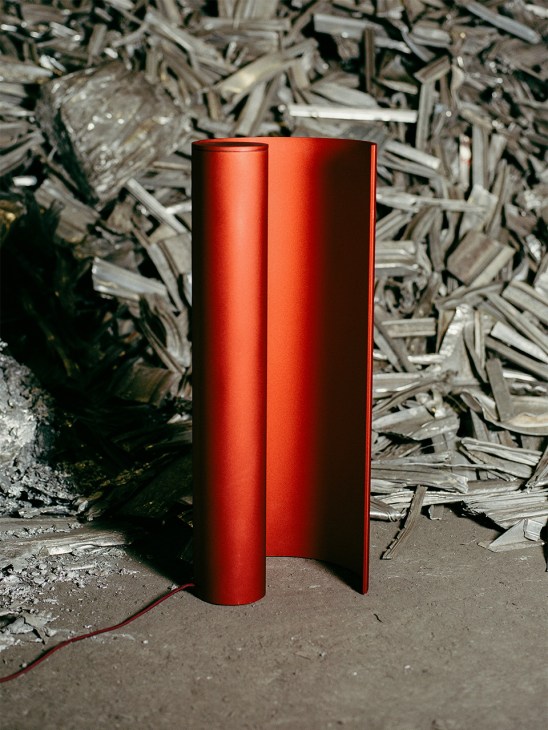
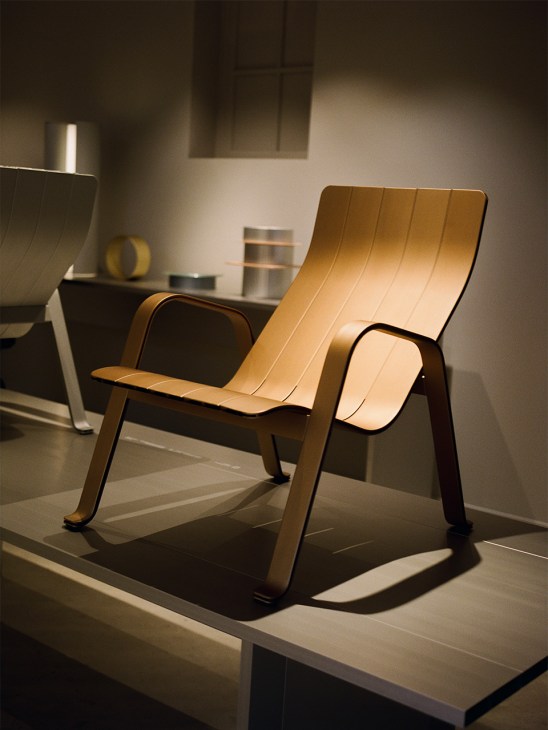
In Eindhoven, the results of Hydro’s project gleam under the soft lights of Kazerne, a local design hub. At the R100 exhibition presented at Dutch Design Week, curated by Hydro’s Lars Beller Fjetland, five designers unveil objects made entirely from Hydro’s groundbreaking material. Monocle meets two of them – Dutch designer Sabine Marcelis and German industrial designer Stefan Diez, who have each interpreted the Hydro Circal 100R through a different lens.
Marcelis’s Light Wings lamps are tall, gently curved extrusions that glow in shades of anodised bronze and rose. “The form follows the material,” she says. “Aluminium is light, it bends and you can give it so many finishes. People think of metal as cold, but anodising makes it alive.” The lamp’s structure is deceptively simple – the LED strip and dimmer are integrated into the extrusion so that, at the end of its life, the whole piece can be disassembled and recycled with minimal effort. Diez, meanwhile, has designed a family of cylindrical rubbish bins. Made from the same aluminium profiles, the pieces are both utilitarian and symbolic. “Why a trash can? Because we’re using scrap material,” he says. “It’s a metaphor: waste becomes a beginning. Circularity is complex and requires effort, but projects like this show that it’s possible if you start thinking differently.”
But why is Hydro doing this? The company could simply continue as one of the world’s biggest suppliers of industrial aluminium. For Hydro, the R100 programme is part of a broader strategy to future-proof its business. By 2030, the company aims to more than double its use of post-consumer waste, from 450,000 tonnes in 2024 to up to 1.2 million tonnes. For Marcelis, who usually works with glass and resin, aluminium offered a new challenge. “It’s opaque, so I had to think differently about how light interacts with it,” she says. “Colour became the way to bring warmth.” The project has also changed her professional expectations. “It’s given me the confidence to ask brands for more recycled material,” she adds. Diez, who also works as the head of industrial design at the University of Applied Arts in Vienna, has long advocated for repairable and recyclable design. He sees the collaboration with Hydro as part of a larger shift. “We designers still work in a linear way,” he says. “We need to create so that materials stay within their alloy families (a key to recycling). Don’t glue everything together – think about how to take it apart. It’s a major paradigm change.” Both creatives agree that working with Hydro gave them a rare level of technical insight. Marcelis describes the experience as “like being a kid in a candy shop”. Diez calls it “a laboratory where designers and engineers meet on equal terms”.
For Hydro, the impact of this project has been cultural as much as environmental. Workers in Drunen and the other plants followed the progress closely. “They were proud to see their aluminium become a desirable design,” says Van den Oever. And while these products were, first and foremost, experiments, they are already feeding back into the company’s mainstream operations. Van den Oever says the search for local finishing partners revealed new suppliers who now work with the company on other projects. The factory team, he adds, has learned to be “less conservative” about what aluminium can do. Fjetland believes this is where design and heavy industry overlap most productively. “Designers push us to the limits,” he says. “For example, we discovered new technical possibilities through [Marcelis]’s lamp, which will benefit Hydro long-term. At the same time, designers can learn what it means to manufacture at scale. There’s no contradiction between sustainability and mass production.”
The R100 project suggests a model for how the materials sector can evolve towards tighter supply chains, closer partnerships and a focus on designing for reuse. For Hydro, the goal is not to become a furniture brand but to show what circular production can look like when designers and engineers collaborate. As Mul puts it, “We are used to making lamp posts for roads. Now we also make beautiful lamps for people’s homes.” In a world where industries are rethinking how and where they operate, Hydro offers an example of what progress looks like as yesterday’s scrap turns into tomorrow’s design.
hydro.com