Does Barcelona’s building bonanza bombard everyone’s wellbeing?
The clatter of cranes and major construction projects cuts through the atmosphere of Barcelona. But are we sacrificing today for a distant future?
More than 10,000 professionals are gathering in Barcelona this week for the World Congress of Architects, marking the official start of its designation as the 2026 UIA-Unesco World Capital of Architecture. They are sure to feel at home because the entire city currently feels like an immersive building site. Currently, there are 10 transformational macro-projects slowly taking form within a 100 sq km radius. The city hasn’t metamorphosed in this manner since the map-altering build-up for the 1992 Olympics. But as panel discussions, exhibitions and visiting experts home in on highfalutin ideas and chest-thump about the power of the built environment to augment quality of life, will anyone be considering what so much construction means for the people living in the irksome interim?
We all know the drill: the steel-grinding noise pollution, endless traffic disruptions, all that building-site dust. But with this year’s far-reaching theme, “Becoming. Architectures for a planet in transition”, it’s also time to assess the balance sheet of all this harmonised upheaval.
Barcelona prides itself on being a bold champion of urbanism. The 1859 Plan Cerdà recalibrated the design of city blocks. More recently, the 12 painstaking years that it took to redevelop Plaça de les Glòries sent a busy traffic interchange underground to create a 1,000-tree park. As far as policy lodestars go, this is a city that really wants to be a functional urban utopia. And it won’t be rushed toward any ribbon cutting, either. A city never reaches completion but with so many works set at a constant simmer, it often feels like the wellbeing of today has been relegated by the faint promise of a far-flung tomorrow.
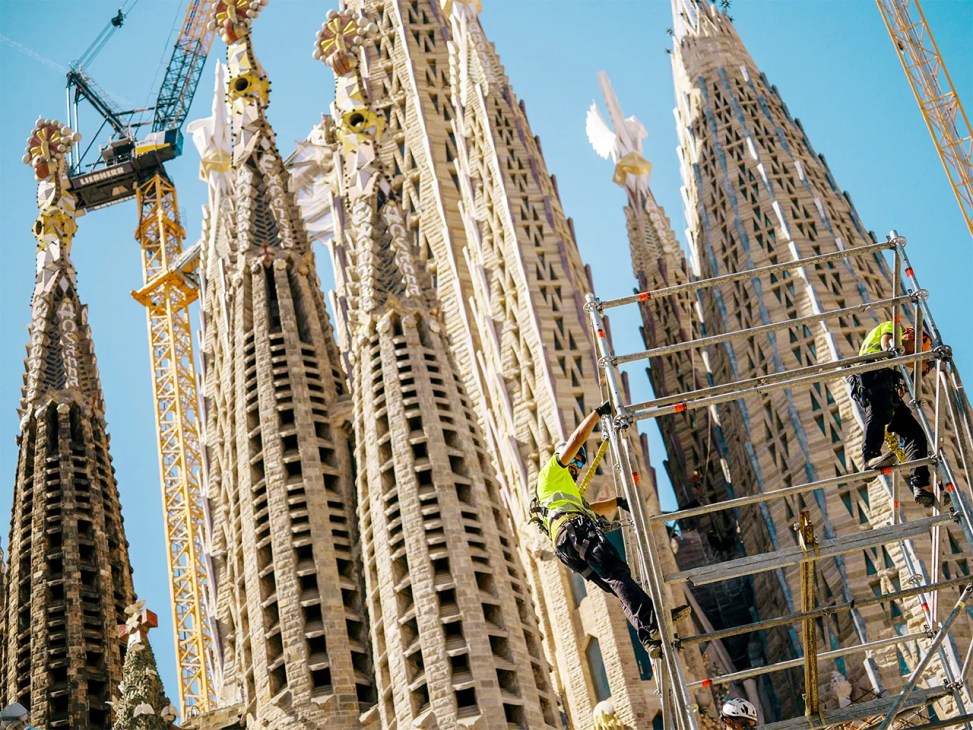
Earlier this month, Barcelona came to a standstill to celebrate the completion of the Sagrada Familia’s Torre de Jesus. There were fireworks, a synchronised lightshow, an orchestra, even a celestial apparition of Antoni Gaudí himself appeared in a drone swarm that was programmed to nod in poignant approval. The festivities were framed as a coming-of-age moment for the city; not to mention a boon for the Basílica’s neighbours, who have been living beside a construction site since 1882.
As the city’s oldest, newest and now tallest skyscraper, the Sagrada Familia stands as a totem for Barcelona’s wider organising principle, blending future-focused thinking with epic feats of emotional projection. While much of the il lusió (a cherished Catalan value that translates to hope and excitement) centres around the campaign to canonise Gaudí as a saint, the next, and rather awkward final phase of the project will attempt to address the question of demolishing surrounding blocks to create a proper entrance for the fanciful Basílica’s main entrance. Hundreds, potentially thousands, of long-time residents could be affected and/or relocated.
Meanwhile, another cathedral of sorts is set for a new lease on life. Easy to spot along the coast from any starboard window seat during the descent into El Prat airport, Les Tres Xemeneies, or the Three Chimneys, is a derelict thermal power plant earmarked for upgrade. On Sunday, the hollow structure became the inaugural hub of activities for the World Capital of Architecture Congress. Though the congress concludes on 2 July, Barcelona’s tenure as UIA-Unesco World Capital of Architecture will see a packed programme of 1,400 events, activities and exhibitions take place across 10 districts throughout the rest of the year.
Many attendees were eager to hear more about the imminent works – tipped for completion in 2028 – that will convert the industrial relic, known affectionately as the “secular cathedral”, into the Catalunya Media City business and tech hub. Sant Adrià de Besòs residents are preparing for an ambitious makeover of the surrounding parkland and esplanade.
As an opportunity to show how far the city has come while pointing to where it is heading, this week set the tone. There’s the massive Montjuïc redevelopment, which includes the expansion of the Museu Nacional d’Art de Catalunya (Mnac) from 49,000 to 71,400 sq m, bringing its main entrance down to the bottom of the hill. There’s the Port Olimpic revamp and the upcoming macro-conversion of the Marina de Prat Vermell. The city’s biggest train stations, Sants and La Sagrera, are both expanding with district redesigns too. For many months, the city’s iconic promenade Les Rambles (La Rambla), which has up to 330,000 pedestrians trot along its pavements per day on a normal weekend, has been turned upside down. The all-at-once revamp is expected to be finalised next year.
For several years, a pseudo-philosophy has been doing the rounds in Silicon Valley – another place hellbent on racing towards the horizon. Known as Effective Altruism, it is a popular, daresay, convenient, creed for anyone hoping to swerve around the immediate consequences of their pervasive plans for systemic change. One facet – long-termism – argues that the potential of future generations ought to be given paramount moral priority, even at the expense of people’s comfort or continuity in the present-day. With so many cities opting to be “smart” or “high-tech”, one gets the impression that some city planners have been latching onto a similarly misguided logic.
We can all grit our teeth through a bit of gridlock, sonic pollution, dust and debris. But one wonders whether anyone will eventually get to savour the spoils. By the time the latest round of mega-construction is finished, the city will probably be itching for another bout of revolutionary world-building.
People love feeling like their city is on the move, knowing that someone, somewhere, is tirelessly working towards making their travel times shorter, air cleaner, streets cooler and lives better. While some cities are lagging in their responsibility to adapt to climate, population and infrastructure strains, Barcelona should be commended for thinking and building big. But as any architect will tell you, one can’t build the roof despite the house.
In Barcelona’s case, perhaps the packed ledger of projects extends beyond the mere feeling of il lusió and can be explained by the Catalan contradiction of seny i rauxa, reason and impulse. The next few years will no doubt remake the city – and light the way for others to follow suit. But for the sake of everyone in-between, let’s hope the current projects move faster than the Sagrada Familia, which took 144 years – and there’s still nine more to go.
Liam Aldous is Monocle’s Madrid correspondent. For more opinion, analysis and insight, subscribe to Monocle today.